

Egypt's Ambassador to Lebanon and Lebanon's Culture Minister Ghassan Salameh speak to The Beiruter about the return of 37 ancient Egyptian artifacts.
Illegally smuggled Egyptian artifacts return from Beirut
Illegally smuggled Egyptian artifacts return from Beirut
By Jenna Geagea | September 17, 2026

Reading time 5 min
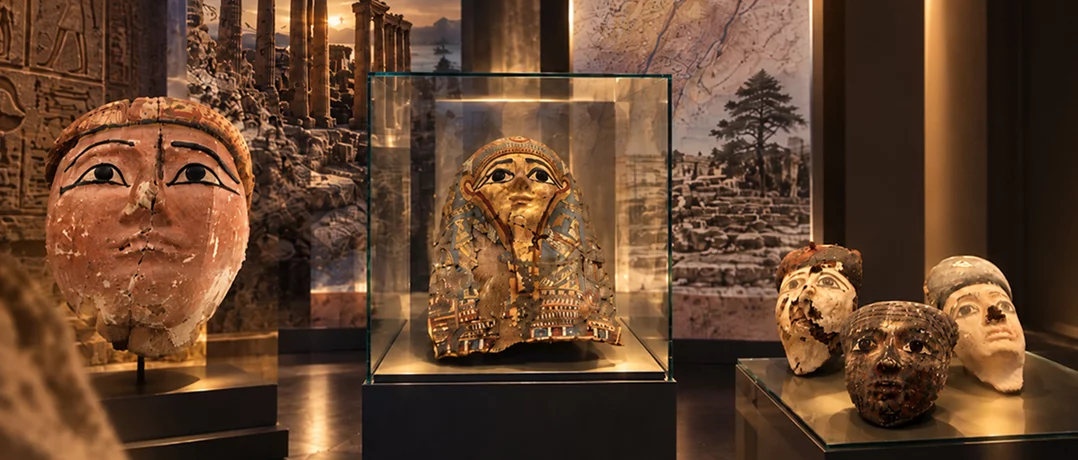
Six years after customs officers intercepted a suspicious shipment at the Port of Beirut, 37 pieces of ancient Egyptian heritage are finally on their way home. The container, which had arrived from another Arab port in 2020, held a trove of pharaonic-era treasures, masks, wooden dolls, Coptic textiles, glass-paste amulets, statues and two painted wooden coffins, that had been purchased by a Lebanese national with no documentation establishing where they had actually come from. Untangling their true origin took years of painstaking work between Lebanese prosecutors, Egyptian heritage experts and INTERPOL, who ultimately confirmed both the ownership and the authenticity of the collection.
That process reached its conclusion at the National Museum of Beirut, where Lebanon's Culture Minister Ghassan Salameh formally handed the artifacts to Egypt's Ambassador to Lebanon, Alaa Moussa, in a ceremony that carried the weight of a diplomatic milestone and the warmth of a personal farewell.
Egypt's Ambassador to Lebanon: “the Lebanese state is gradually restoring its role”
“Lebanon's conduct throughout the case was, in itself, a message to the world”, Ambassador Moussa told The Beiruter. He pointed out that “from the very first day, Lebanon reaffirmed its desire to resolve this matter and return the stolen property to Egypt. This was a positive gesture and confirmation that Lebanon is a state that respects international rules, procedures and legislation”.
Moussa said he hoped the episode does not remain an isolated case, "this is a model of cooperation that we hope will be repeated between countries, not only between Egypt and Lebanon."
He also pointed out to Lebanon’s own experience in recovering cultural property abroad.
"Lebanon also has experience with the United States in recovering some of its own cultural property, " he said, adding, "God willing, this process will continue, and we will be able to recover our property from around the world".
Asked about the broader relationship between Egypt and Lebanon, Moussa stressed Cairo’s longstanding support for the country. "Egypt has always supported Lebanon. I do not believe there is another country that has maintained such a clear and consistent position toward Lebanon as Egypt has. "
He said Egypt’s position extends to Lebanon’s sovereignty and territorial integrity. "We affirm that Lebanese sovereignty must be restored over all of its territory, that the Israeli occupation of Lebanon must end, and that Israel must fully withdraw from all occupied Lebanese territories. "
Moussa also reflected on the significance of the handover against the backdrop of Lebanon’s broader challenges. "The recovery of these artifacts may seem like a simple matter compared with everything Lebanon is currently going through, " he said. "But we believe that such steps highlight the role of the state, even as it faces many obstacles and challenges. These actions, along with others, demonstrate that there is a functioning state and that the state is gradually restoring its role."
He linked the handover to Egypt’s broader efforts to recover cultural property from abroad. "In recent years, Egypt has been working to recover all of its cultural property that is located abroad, and we have succeeded in recovering a number of these items from different countries,” he said, describing the cooperation with Lebanon as "an important model of cooperation that we hope will be replicated between all Arab and non-Arab countries. "
Looking ahead, Moussa said the artifacts case should serve as a starting point rather than an endpoint.
This is a very good indicator that we can build on, and we should build on it. And this cooperation should not be limited to the field of antiquities. Egyptian-Lebanese cultural relations are already on a strong path.
Lebanon's Culture Minister: “Our relationship with Egypt is exemplary”
For Lebanon's Culture Minister Ghassan Salameh, the significance of the handover lay not only in the return of the artifacts, but also in what the process demonstrated about Lebanon’s institutions and its relationship with Egypt.
Speaking to The Beiruter, Salameh described the occasion as “one of the happy days for several reasons,” beginning with Lebanon’s implementation of international law.
"First, we are setting an example in the literal implementation of the 1970 international convention concerning the prevention of the illicit trafficking of cultural property," he explained. "We are returning to their original owners property that was seized at the Port of Beirut six years ago. Over these years, we cooperated with the Arab Republic of Egypt, INTERPOL and, of course, Lebanon’s Court of Cassation Public Prosecution to verify its ownership, authenticity and that it had not been forged, as well as to establish our legal right to return it to its rightful owners."
Salameh said Lebanon also hoped the gesture would be reciprocated when Lebanese cultural property is found abroad.
We naturally expect other countries to treat us in the same way, by returning cultural property they may find in their possession that was obtained illegally.
He pointed to the similar case earlier in the week, when the United States returned Lebanese cultural property recovered in New York, with the Lebanese consul there receiving the items only days earlier. "Today, we are handing over, with great happiness and pride, property belonging to the Arab Republic of Egypt that was seized at the Port of Beirut in 2020," he said.
For Salameh, however, the significance of the occasion went beyond the legal process. The second reason for celebration was simply the identity of the recipient.
"It is Egypt," he said, stressing the depth of the bond between the two countries. "Relations between Egypt and Lebanon are relations between brothers, and both sides want them to be exemplary. Respecting an international convention in this way is a model for other countries. Our relationship with the Arab Republic of Egypt is exemplary, and today there is another reason to prove that."
The ceremony offered a rare moment of institutional continuity. As a demonstration that Lebanese institutions can still function, cooperate internationally and follow through on legal commitments, the handover stood out as a symbolic step that both Beirut and Cairo hope will not be the last of its kind.
-
-

-
Jenna GeageaReporter/Writer
-
