



After destruction, Diana Abadi turned a small Dahiyeh shop into a haven for plants, injured cats, and hope.
Inside Diana’s sanctuary of paws, greens and resilience
Inside Diana’s sanctuary of paws, greens and resilience
By Rayanne Tawil | November 30, 2025

Reading time: 4 min
Before you even step inside, Diana’s world meets you at the threshold. A forest of plants crowds the entrance pots of jade, cascading vines, and shy little succulents she grows and sells to keep her shelter running. “My plants are my kingdom,” she later tells The Beiruter, her hand brushing the leaves like they’re old friends.
At the front door, a small group of stray cats sit like they are regulars at a neighborhood café. Diana gives them food every day in the morning, even if she can hardly afford food for herself. It sets the tone before you even cross the threshold: tenderness lives here.
The inside is tiny, modest, and full of memories. The soil smell from the plants blends with the very light odour of cat food. Cages line the right wall not as prisons, but as hospital rooms. Some of these cats arrived blind, paralyzed, or tossed in front of her door during the war.
“No NGO helps me, wallah. I treat them from my own pocket,” she says. “Some are blind, some have broken bones. I can’t throw them like they throw them.”
The ones under treatment quarantined temporarily blink at you with wide, trusting eyes. They are impossibly cute, impossibly brave.
The upstairs softness
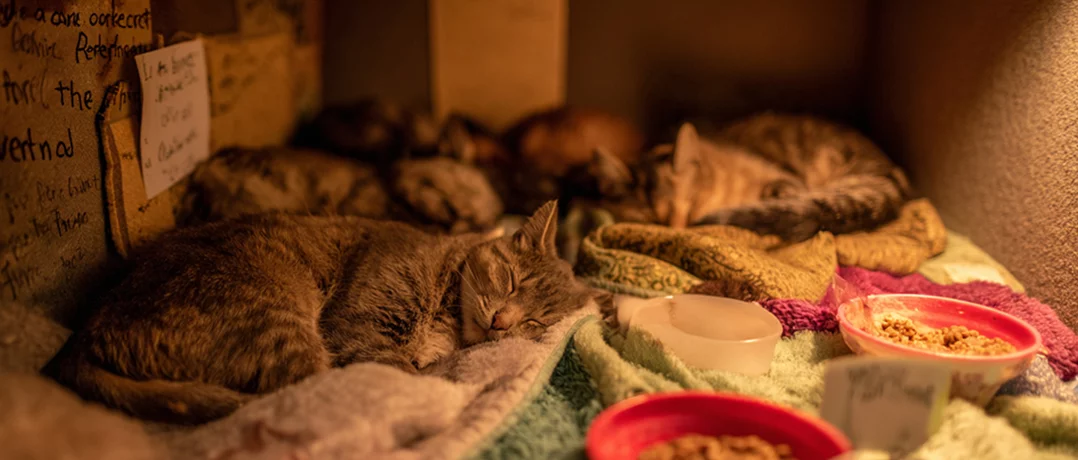
Upstairs, the shelter opens into a series of makeshift suites: mothers who recently gave birth, cats who need peace and quiet, and others who don’t get along with the crew downstairs.
And then suddenly, a door opens.
Inside: over 30 cats at least relaxing on wooden houses, jumping over stools, soaking up the sun on beams, and casually walking between our legs, feeling in a safe place.
While the interview was going on, they got into the conversation rubbing our legs, taking their places on our knees, and insisting on being noticed.
Staying through the war
The story of this sanctuary did not start gently.
When Israel began to regularly bomb Dahiyeh, Beirut’s southern suburbs, everyone told Diana to evacuate. Leave. Save herself.
But she refused.
Either we live or we die together
she recalls. “I won’t leave the cats". They’re souls. I was worried about getting the souls out.”
Bombs fell close enough to shake her building. She stayed. At one point, she found animals dumped outside her destroyed storefront. “They throw them and say there’s war. I don’t have the heart to leave them,” She added.
A friend eventually offered her a small garden room where she could shelter some of them. Others stayed with her in her shattered shop. She kept cleaning, feeding, isolating, treating even as the windows blew out and rents spiked from $250 to $800 overnight.
“I can’t pay it, but I have to; this is my place and my house,” she says. “This is my kingdom.”
A life devoted to rescue
Indeed, Diana's story began years before the war began, for when she was young, she tried to rescue her first cat after it had tumbled off the balcony. She grew up wanting to save more.
Neighbours began bringing her injured cats. “Look, broken leg, broken cat they used to bring them to me,” she says. “I took care of them, sent them to the vet, treated them, and returned them to their place.”
She worked ordinary jobs. She sold toys and thrift clothes. But everything she earned went to her rescues until she fell into debt.
Still, she did not stop.
One of her most emotional rescues was a paralyzed cat found near a coffee shop. “They told me, leave him, he’s dying. I said no let me see,” she said.
She took him to Dr. Fouad El-Haj, who warned her the road to recovery would be long. It took seven months. She used unsold clothes as bedding, sleeping beside him through his paralysis.
“Then one day he stood … then he walked … then he ran. After seven months!” she says, her face bright with pride.
Another cat, electrocuted, was treated with a calcium protocol she learned from a rescuer online. “Two weeks and she walked. Like a miracle. She’s, my daughter.”
The daily ritual of care
Her day starts before dawn.
“I wake up at 3 or 5 a.m.,” Diana says. “I go upstairs, clean the carpet, change the litter, scrub the floors, then go down for the others. I don’t finish before noon.”
She has blind cats, cats with incontinence, and cats recovering from injuries each with their own routine.
I can’t take the blind ones back to the street since they don’t accept anyone. I isolated them. I have two blind ones from the streets.
She sleeps here, on the sofa or on the floor, because the cats won’t let her go. “This is my kingdom,” she repeats. “I run away from them sometimes because they don’t let me sleep!”
Adoption as a sacred promise
When asked about adoption, her tone softens. “If I know the person is good, I give them the cat. But if they will throw her back in the street when she’s sick No. Never.”
She believes a pet is a blessing not a decoration.
A blessing at home. Not money no. It comes back in your health. In your life.
She warns people not to adopt lightly.
“If someone wants to get a cat and then regret it, I tell them no. Don’t take a blessing from your house.”
Support for growth
Diana survives on plant sales, small donations, and food shipments sent by her daughter and sister abroad. “I sell plants, food, medicine everything goes to them.”
When asked about what she needs most, she doesn’t hesitate: “Buy seeds, food, sand. Support financially if you can. Anything helps.”
Her dream is to expand to create a larger, safer shelter where the endless stream of abandoned animals can find refuge. “My ambition? To make it bigger. To have a big place for them, not this small one.”
A kingdom of kindness
The 13-year-old princess of the house, Loulou, slowly moves to the door to give a farewell as we exit the shelter. Diana, like a mother with a drowsy kid, takes her up kindly.
The plants rustle softly behind us. Cats stretch like warm shadows. The place is quiet, modest, cracked by war, but full of life.
A sanctuary built not with money or resources, but with stubborn, steadfast love.
And Diana, who stayed when the world shook continues sweeping, feeding, healing, planting. Because for her, as she said from the beginning, “Either we live or we die together.”
-
-

-
Rayanne TawilCultural writer
-
