As record-breaking heatwaves and wildfires spread across Europe, North Africa, and the Middle East, experts warn that Lebanon must invest in prevention and preparedness before climate-driven fires become even more destructive.


As record-breaking heatwaves and wildfires spread across Europe, North Africa, and the Middle East, experts warn that Lebanon must invest in prevention and preparedness before climate-driven fires become even more destructive.

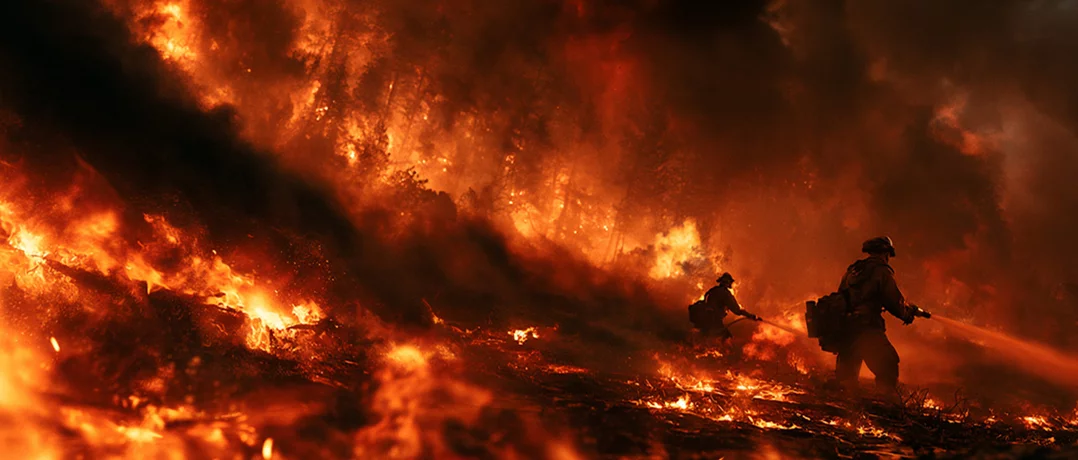
From the pine forests of Bordeaux to the mountains of Kabylia, from the deserts of Iraq to the streets of Beirut, fire and heat have become the defining story of 2026. Hundreds of thousands of people have been evacuated in Europe, entire neighborhoods have gone dark in Tunisia to save the power grid, and temperatures across the Arab world are flirting with the edge of what the human body can survive. What follows is a look at what is burning, why, and what it means for a region, the Middle East and North Africa, that is heating up faster than almost anywhere else on Earth.
Southern Europe has been on fire since early July. France has already seen 3.4 times its annual average number of fires this year, and Spain 1.7 times its average, according to Copernicus, the EU's climate monitoring service. The worst blaze tore through France's Gironde region near Bordeaux and jumped into the Madrid region of Spain, forcing more than 300,000 people to evacuate in what has been described as France's largest evacuation since the Second World War. Researchers point to a familiar mechanism, an unusually wet winter produced dense vegetation, and the intense heat that followed dried it into a tinderbox, exactly the scenario climate scientists have been warning about.
The same pattern has jumped the Mediterranean. Deadly forest fires have been raging across Algeria, Morocco and Tunisia for over a week, driven by an ongoing heatwave, dry conditions and strong winds that have hampered firefighting. Algeria alone recorded 159 separate fires in a single 24-hour period in its forests, woodland and farmland, while Tunisia had to call in international firefighting aircraft to help contain its own blazes.
The common thread linking Bordeaux to Bouira is heat. Rising baseline temperatures, drought, and erratic rainfall are turning ordinary vegetation into fuel and giving wildfires the extra push to grow larger, faster and more frequent.
Lebanon has spent the past two weeks under a heavy, humid blanket of heat. The country and the wider eastern Mediterranean have been affected by hot air masses pushing in from the Arabian Peninsula, raising temperatures above seasonal norms inland and in the mountains, while high coastal humidity has made the heat feel even more intense. Average July temperatures for the month range from the low-to-mid 20s up to the low 30s in Beirut, and higher still, up to 34°C, in inland areas like Zahle, and Lebanese meteorologists have issued specific warnings about the elevated risk of forest fires as the ground dries out.
Lebanon's discomfort is mild compared to what much of the Arab world has endured this summer. A heat wave described as the most severe since the start of summer 2026 hit eight Arab countries between mid- and late July, pushing temperatures close to 50°C across southern and central Iraq, Kuwait, eastern Saudi Arabia and large parts of the UAE. In Tunisia, the heat has strained infrastructure directly, long power outages have compounded an intense heatwave with temperatures reaching 49°C, while in neighboring Algeria more than 100 people were hospitalized because of wildfires. Tunisia's state electricity company has been issuing daily rolling blackouts as heavy air-conditioner use pushes the national grid to its limit.
Scientists studying the region have long flagged this trajectory. The Middle East is warming roughly twice as fast as the global average, and unlike a short, sharp heatwave elsewhere, its summers now bring months of sustained, dangerous heat with little overnight relief, a pattern most difficult in countries where electricity and cooling are least reliable.
The Beiruter spoke with Former Minister of Interior Ziad Baroud who worked directly on the country's wildfire file for years. During his tenure, Baroud said the government approached wildfires as a growing national risk, particularly as Lebanon’s forest cover continued to shrink and climate change intensified fire conditions worldwide.
Efforts focused on strengthening the agency through improved equipment, sustainable funding and the formalization of its volunteer workforce, while also developing a multi-year national wildfire strategy.
The plan emphasized rapid local intervention, particularly in remote municipalities surrounded by forests, where waiting for Civil Defense teams to arrive could allow a small fire to spread beyond control. “The idea was to equip municipalities with four-wheel-drive vehicles carrying small water tanks and firefighting equipment,” Baroud explained.
If a fire is contained immediately, at its very beginning, that can solve the problem before it spreads.
The strategy also included the creation of access routes and firebreaks within forested areas. These unpaved corridors would allow Civil Defense vehicles to reach remote locations while helping slow or stop flames from moving through continuous stretches of woodland.
One of the plan’s most significant components was the acquisition of three Sikorsky helicopters designed for firefighting. Baroud said the aircraft were selected following a technical assessment conducted by the Lebanese Army Air Force and Bureau Veritas.
“Some of the helicopters currently used by the Army can carry around 700 to 800 liters,” Baroud said. “The Sikorskys could carry between 4,500 and 5,000 liters. That makes a major difference in the volume of water dropped and in their effectiveness.” Baroud said the initiative represented a rare example of successful cooperation between the public and private sectors. Contributions came from major donors as well as schoolchildren who organized small fundraising activities.
“Some school students sold lemonade to contribute 100,000 or 200,000 Lebanese pounds,” he said. “It was a participatory effort and, in my view, one of the best examples of a partnership between the public and private sectors.”
The helicopters remained operational for approximately five or six years and were deployed during major fires, including a large blaze in Bkassine. However, after the initial maintenance agreement expired, funding for their upkeep was not sustained. Baroud said the annual maintenance cost was estimated at around $150,000, a relatively small amount compared with the environmental and economic damage caused by a major wildfire.
Unfortunately, once the maintenance period ended, there was no longer funding. In Lebanon, we often start things but do not know how to continue them until the end.
“Today, Civil Defense is fighting fires with its bare hands, so to speak,” he said. “They are making enormous efforts, but they do not have enough equipment.”
He called for municipalities in high-risk areas to be equipped with specialized four-wheel-drive firefighting vehicles, arguing that local response capacity can prevent small fires from becoming large-scale disasters.
Across three continents, wildfires are exposing the same reality, a hotter world is becoming harder to protect. For Lebanon, continued investment in prevention, local response and sustainable firefighting systems can help protect its forests and communities as conditions continue to change.