



Hardine and Kfar Helda reveal a lesser-known side of Batroun, where Roman temples, ancient churches, medieval frescoes and centuries-old traditions preserve nearly two millennia of history.
Into Hardine & Kfar Helda: The oldest Christian villages
Into Hardine & Kfar Helda: The oldest Christian villages
By Jenna Geagea | September 03, 2026

Reading time 4 min
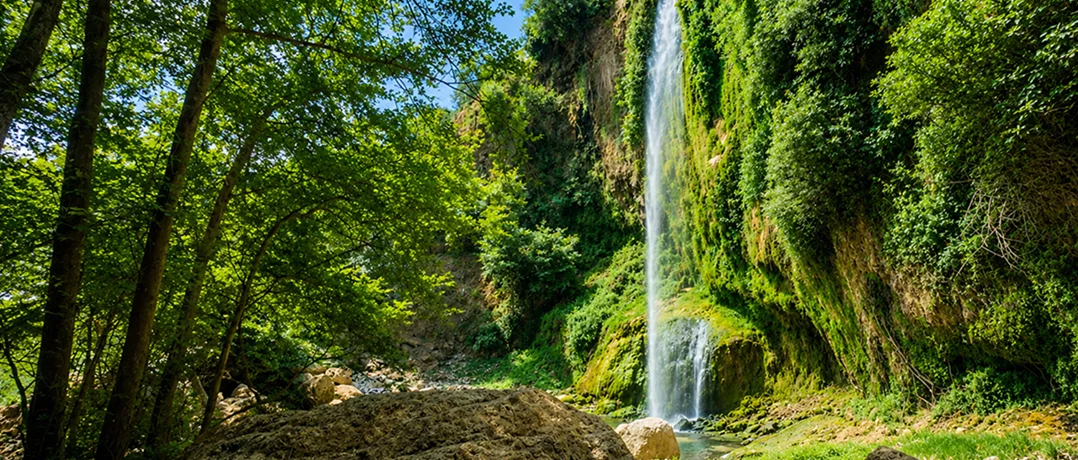
In the mountains east of Batroun, two villages carry an outsized share of the region's religious and archaeological memory, Hardine, often called the oldest Christian village in Lebanon, and Kfar Helda, a quieter valley town wrapped around a waterfall and a fifth-century church. Neither is large. Both are old in ways that reshape how visitors think about the Lebanese mountains.
Hardine: The village that predates Christianity itself
Hardine sits between roughly 850 and 1,450 meters in elevation in the Batroun highlands, its name drawn from Syriac. most commonly translated as "pious" or "witness of justice," though other readings tie it to fear or terror, a possible memory of a village long subject to attack. From its ridge, the village offers views stretching across Batroun, Koura, and Bsharre all the way to the Mediterranean.
Long before it became a center of Maronite religious life, Hardine was a pagan stronghold. Its most striking relic is a nearly 1,900-year-old Roman temple dedicated to Mercury, built during the reign of Emperor Hadrian and originally ringed by roughly 30 towering pillars in the Ionic style, remnants that still stand today. Christianity arrived dramatically. A Roman official is said to have imprisoned his own daughter in Hardine around 270 AD after she converted to the new faith, only for her to go on to convert much of the village around her. Whatever the truth behind the legend, Hardine is widely regarded as the first village in Mount Lebanon to embrace Christianity, a distinction that shaped everything that followed.
That religious identity became formalized centuries later, when Hardine served for roughly three hundred years as the seat of the Maronite Patriarchate at the monastery of Mar Sarkis el Karn. The village today holds around 30 churches, monasteries, and hermitage cells, medieval structures like Mar Geryes, Mar Tadros (dating to the 10th century), and Mar Challita and Nohra among them, a density of religious architecture matched by few villages its size anywhere in Lebanon. It is also the birthplace of Saint Nimatullah Kassab Al-Hardini, the 19th-century Maronite monk canonized in 2004, whose family home and legacy still draw pilgrims.
Hardine's geology is as distinctive as its faith. A 300-meter slab of grey Jurassic limestone, known locally as the Blata, slopes evenly through the village, embedded with fossilized shells and crustaceans hundreds of millions of years old; villagers once used its flanks to build "baydars," terraces for sorting grain, traces of which remain visible. Nearby, the Ram plain is celebrated for its quince orchards, giving the village its reputation for quince jam.
The 19th century brought both crisis and departure. Along with much of northern Lebanon, Hardine suffered during the sectarian violence of 1860, churches burned, vineyards destroyed, families displaced, prompting waves of emigration that scattered Hardine natives across Cyprus, Sicily, Malta, France, England, and eventually the United States, with Wilkes-Barre, Pennsylvania becoming home to one of the largest Hardine diaspora communities. The village's connection to that emigration turned tragic in 1912, when twelve of its citizens died aboard the Titanic.
Kfar Helda: A village built around water and an ancient church
Some distance further into the Batroun hinterland, in the Bsatine al-Issi valley, lies Kfar Helda, a village whose identity is inseparable from the Al-Jawz River running through it. The river's cascade over local rock has long fed the terraced fields below, sustaining the farmers who have worked this valley for generations, while also giving the village its reputation today as a scenic retreat, its riverbanks lined with restaurants built to catch the sound of moving water.
Kfar Helda's oldest surviving religious structure, the remains of St. Peter's Church (Mar Botros), dates back to the fifth century AD, placing it among the earliest church sites in the wider Batroun district. Its parish church, dedicated to St. Phocas (Mar Fawqa), predates the 19th century, and the village is also home to St. George's Church and the Church of Our Lady of Kfarmalkoun, notable for preserving old paintings and inscriptions.
The ruins also point to a settlement history more complicated than that of a single continuous village. On the heights above present-day Kfar Helda once stood Kfarmalkoun, a settlement recorded in Ottoman sources but later abandoned. An earthquake is believed to have contributed to its destruction, leaving its medieval church standing amid the remains and earning it the name Saydet al-Khara'ib, or Our Lady of the Ruins. Inside, fragments of 13th-century frescoes survive: a Deisis in the apse, traces of Syriac and Greek inscriptions, and remnants of a Nativity scene showing angels and a shepherd playing a flute.
Perhaps most striking is a Byzantine-era church dedicated to St. Theodore, dated to the sixth or seventh century, its surviving inscriptions rendered in both ancient Syriac (Estrangelo script) and Greek, a rare bilingual trace of the region's late-antique Christian community. Scattered around the village, tombs, sarcophagi, rock engravings, and old water mills along the river round out a landscape where nearly every stretch of ground carries some remnant of earlier centuries.
Two villages with profound stories
Though separated, Hardine and Kfar Helda tell a connected story about how Christianity took root and endured in the Batroun highlands, through pagan temples repurposed or overshadowed by churches, through monastic networks that linked isolated villages into a wider religious order, and through communities that weathered violence, emigration, and isolation without losing the churches, legends, and land that define them still.
-
-

-
Jenna GeageaReporter/Writer
-
