

Iran’s latest protests unfold amid shifting regional dynamics, renewed international pressure, and unprecedented participation from key pillars of society, signaling a potential historic turning point.
Iran at a crossroads: Why this uprising feels different
Iran at a crossroads: Why this uprising feels different
By Marwan El Amine | January 12, 2026

Reading time: 5 min
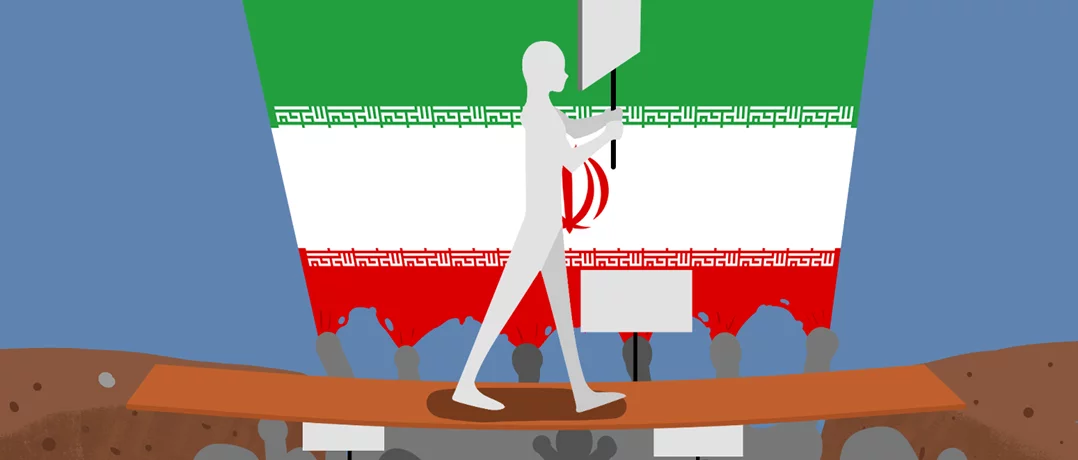
The countries of the region and the world at large are watching closely a pivotal moment in which the Iranian people may once again redraw their country’s contours through their own will. The return of Iranians to the streets, demanding freedom and an end to Mullah regime, is not a passing event. It is an expression of exceptional courage and of a cumulative political awareness forged through previous uprisings that came at an enormous cost. Despite the systematic repression those movements faced during which the regime deployed every instrument of coercion and intimidation to silence public voices popular determination has resurfaced today with even greater resolve.
What distinguishes the current Iranian protest movement from its predecessors is its coincidence with a set of political variables that were absent in earlier experiences. The most significant differences can be summarized as follows:
First, during the era of the “Green Movement,” former U.S. President Barack Obama occupied the White House with a singular priority: reaching a nuclear agreement with the Mullah regime. In pursuit of that objective, Iran’s rulers were given wide latitude not only inside Iran, but across the region as a whole. At the time, the Iranian people paid a double price: brutal repression by a dictatorial system and international particularly American complicity. Obama’s decision to stand aside, without intervening to protect Iranian protesters, was widely interpreted as providing political cover for the crackdown.
A similar pattern reemerged, albeit in a different form, during President Joe Biden’s tenure, when the “Women’s Revolution” erupted following the killing of Mahsa Amini at the hands of Iranian security forces. Once again, Iranians confronted the same machinery of repression, and once again they were met with a hesitant U.S. stance that disappointed their aspirations, leaving protesters to face systematic violence alone.
Today, however, many are placing their hopes in a changed international context. Donald Trump’s presence in the Oval Office, coupled with his explicit warnings to the Iranian regime against using violence against demonstrators, has restored a measure of hope within the Iranian street that the Obama–Biden scenario will not be repeated. This perception was reinforced by Trump’s actions in early summer 2025, when he followed through on those warnings by granting Tehran a 60-day deadline to reach an agreement before authorizing, on the sixty-first day, a military strike against Iran via Israel.
Second, since the events of October 7, 2023, the region has entered a new trajectory in which regional balances are being recalibrated through the targeting of Iran’s so-called “Axis of Resistance,” from Gaza to Lebanon and Syria, and onward to Iraq and Yemen. By its very nature, this trajectory is incompatible with the continued rule of a hardline theocratic regime in Iran one that relies on exporting chaos and terrorism to impose its regional influence. This reality raises an urgent question: will the Iranian people’s movement this time receive sufficient support and protection to achieve its goal of toppling Mullah regime and opening a new chapter for Iran that aligns with the region’s ongoing transformations?
This question gains further legitimacy in light of the severe blow the Iranian regime suffered during the “Twelve-Day War,” which struck at the heart of its prestige and shattered the image of strength it has long sought to project domestically and internationally. This moral and political setback has emboldened Iranian actors who were previously hesitant to speak out, exposed the fragility of the regime’s internal structure, and unleashed latent power struggles among military, security, political, and economic centers.
Third, the participation of the Bazaar in the current movement carries exceptional significance, as it represents a decisive factor absent from all previous protests. The Bazaar is not merely an economic hub; it is a social and political pillar of considerable weight within Iran, historically intertwined with the religious establishment. Its involvement in the present wave of dissent sends an unprecedented signal: discontent is no longer confined to the street alone, but has begun to penetrate the very heart of an institution that once constituted a foundational pillar of the Mullah regime.
The symbolism of this development is amplified by historical context. The last time the Bazaar played an active role in a popular uprising was during the revolution that overthrew the Shah and paved the way for Ayatollah Khomeini’s rise to power. Today, the Bazaar returns to the political stage but this time in opposition to the very system it once helped sustain. This profound political and social irony reflects the depth of the fractures within the pillars of power and signals that the current movement has crossed the threshold of episodic protest, approaching instead a genuine historical turning point.
Between the bitter legacy of past betrayals and the emerging indicators of transformation, the Iranian movement now stands at a critical crossroads. Either these variables will coalesce into a real opportunity that supports the demands of the street, or the same familiar scene will be reproduced at the cost of yet another price paid by a people whose will and aspirations to rid themselves of the Mullah regime have not been broken by decades of repression.
