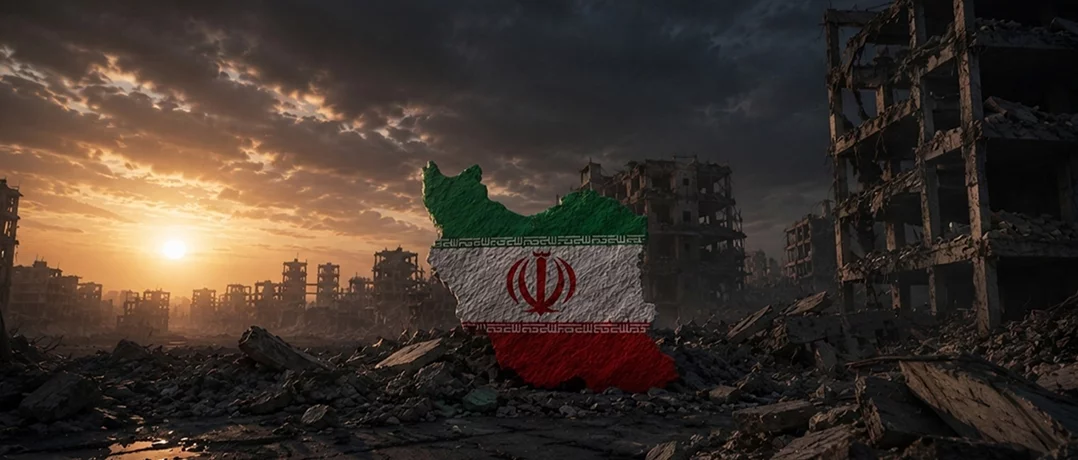
As military setbacks, economic turmoil and growing internal unrest converge, Iran's leadership faces mounting pressure that could reshape the future of the Islamic Republic and the broader Middle East.


As military setbacks, economic turmoil and growing internal unrest converge, Iran's leadership faces mounting pressure that could reshape the future of the Islamic Republic and the broader Middle East.

Perhaps the tears shed during the funeral of Iran's late Supreme Leader, Ayatollah Ali Khamenei, were meant to project unity after months of war. Instead, they came to symbolize the uncertainty and seismic loss surrounding the Islamic Republic and the future of the Axis of Resistance it spent decades building.
Behind Tehran's displays of defiance, the regime now faces mounting pressure on multiple fronts. As military setbacks, economic hardship and internal tensions converge, one question looms larger than any other: what is really happening inside Iran beyond the official narrative?
According to Foreign policy expert Dr. Walid Phares, years of military confrontations have significantly weakened Iran's strategic capabilities, but they have not eliminated the regime's ability to survive. "Objectively speaking on the military level, as announced by U.S President (Donald) Trump, most of the regime's strategic weapons are now destroyed, including the navy, air force, most - though not all - of the ballistic missile force, main radar and command centers, and a large segment of military logistics”.
He argued that the regime’s ability to mount a counterattack against U.S. forces in the region has been significantly weakened, "The ability of the regime to mount a counterattack against U.S. forces in the region and defeat them is near none. But the regime's militias are still strong and can mobilize hundreds of thousands of armed men across the country”.
Those forces, he noted, cannot simply be defeated through air strikes alone, but only through ground combat. Since the American public is not in favor of a major ground campaign in Iran, the only option for actual change inside Iran is a military uprising by the Iranian people involving both the Persian majority and Iran's minorities.
For Phares, that possibility represents the regime's greatest fear.
The regime can withstand air campaigns to a certain point, but it would be totally threatened if Iranians launched a rebellion in the streets and provinces. That is why the regime quickly rushes to negotiations whenever it believes a revolution is close to erupting.
Should Washington seek regime change “external military pressure alone would not be enough. The U.S. will have to arm and train such a rebellion and protect it from the air if the decision is to bring down the regime. Otherwise, the air campaign and the repetitive ceasefires and "talks" risk falling short of a regime change”, the expert explained.
Speculation over divisions within Iran's leadership has intensified in the wake of recent regional conflicts. Those questions were further fueled by the conspicuous absence of Iran's new Supreme Leader, Mojtaba Khamenei, from the state funeral and weeklong mourning ceremonies for his father and predecessor, Ayatollah Ali Khamenei, despite the attendance of senior Iranian officials and foreign delegations.
His absence has prompted widespread speculation about both his health and the balance of power within the Islamic Republic, although Iranian officials have attributed it to security concerns following the February attack in which he was reportedly injured.
“For now, the remnants of the regime are still organically unified, even if opinions are divided”, Phares pointed out that
the IRGC generally rejects any agreement that could lead to regime change because it knows any new government would dismantle the Revolutionary Guard. As a result, it acts as if it has won the war.
By contrast, he noted that Iran's financial establishment has different priorities. "The heads of financial interests, from banks to financial agencies, want an agreement that would save the regime. Tehran's negotiators are seeking a quick transfer of the $24 billion promised in the memorandum of understanding and the resumption of talks regarding the $300 billion investments”.
While tensions exist, he does not believe they amount to an imminent split: "there are tensions between the IRGC and “political elite”, but not to the point of civil war. However, if another revolt begins, the chances of the Artesh (conventional armed forces in Iran) distancing itself from the Pasdaran (IRGC) could become high."
Phares believes new unrest may already be taking shape, particularly among Kurdish forces in Iran, "Kurdish fighters in Sanandaj and Iranian Kurdistan have been sporadically clashing with the IRGC and Basij, even during last year's 12-day war. But this year, Kurdish forces under the unified control of the five main parties have clashed with regime forces for weeks in the northwest”.
He noted that reports have circulated of intercepted arms shipments, although independent verification remains limited. For Phares, the development is significant. "Regardless of the veracity of this incident”, Phares said, “weapons shipments will have to resume if future U.S. and possibly Israeli campaigns take place. Kurdish, and eventually Ahwazi, Baluch, and other communities' uprisings are brewing."
On Feb. 22, about a week before the outbreak of the war involving the United States, Israel and Iran, six major Iranian Kurdish organizations announced the formation of a joint political and military alliance opposing the Islamic Republic.
That organization and political presence have raised fears in Tehran that Kurdish groups could receive international backing to challenge the Iranian government.
The collapse of the U.S.-Iran ceasefire and the memorandum of understanding have reopened two fronts in the conflict: one military, the other economic.
As military pressure intensifies, Iran’s President Masoud Pezeshkian has previously declared that Iran's economy is the country's "most important battlefield”. A statement that mirrors the regime’s critical battle for its survival, even as many Iranians continue to bear the brunt of inflation, unemployment and declining living standards.
Phares argues that two very different economies exist inside Iran.
Unfortunately, there is a difference between the economy of the Iranian people and the economy of the Iranian regime.
According to him, the population continues to bear the economic burden while state institutions maintain access to financial resources. "While the people's economy is weakening and the population is getting poorer, the regime's finances still rely on funds generated through the Iran deal and revenue controlled by the regime itself, much of which is not publicly accounted for,” he said, adding that a political transition would fundamentally alter that equation: "If a revolution rises, the regime's economy will crumble, while the national economy will flourish rapidly."
Early 2026 a major nationwide uprising began in Iran triggered by a collapsing currency and soaring inflation. Iranian authorities have responded with an unprecedented deadly crackdown and, since 8 January 2026, cut all internet access.
Security forces have used unlawful force, firearms and other prohibited weapons against protesters, which resulted in mass killings and serious injuries.
Iran’s regime now faces simultaneous pressure on every front, military, economic and domestic. The missiles may have slowed for now, but the battle over Tehran's future may reshape not only Iran, but the balance of power across the Middle East.