



From a street lined with second-hand treasures and vinyl records to a red-carpeted classic car show beneath strings of lights, Sook El Vintage brought three days of fashion, nostalgia, music and classic cars to Jounieh’s historic center.
Jounieh’s old souk turns vintage

There was something different about Jounieh’s old souk this weekend. During the day, people wandered between its stone buildings, stopping at cafés for food and shisha, walking their dogs, browsing local art and looking through racks of vintage clothes. Children moved through the crowds, people paused for photographs beside old cars and strangers exchanged glances over pieces they had discovered in the market.
From Sept. 18 to 20, Defilé Classique joined forces with DOORA.APP, Autopiaworld, Backdrop.lb and Vasy.lb to turn the historic street into Sook El Vintage, a three-day village of second-hand fashion, accessories, furniture, vinyl records, food, music and entertainment.
The setting did much of the work. Old stone façades rose on either side of the street, their balconies and arched windows catching the late afternoon light. Strings of bulbs crossed overhead, gradually becoming part of the scenery as the sky darkened.
For Nagham Abdeldayem, an organizer of Defilé Classique, the choice was deliberate. “We so appreciate the heritage that exists here,” she tells the Beiruter. “The souk is very appealing for the Classic Cars and such events, because it's a very classic event.”
The event returned to the souk for its second edition, with Abdeldayem also pointing to its role in bringing people back into the area. “We wanted to do it for the second year in a row here,” she says, adding that the event was designed to make the area more appealing and encourage people to discover Jounieh.
A street inside the street
One of the liveliest sections was Sook El Vintage, where DOORA took over an alley within the wider festival. Nine shops brought different selections of pre-loved clothes and objects, creating a market where every few steps offered something new.
For Andrea Tegho, eco-entrepreneur and founder of DOORA, the idea had been sitting in her mind for some time. “I’ve always wanted to create a physical experience for DOORA,” she says. “There’s something very important about seeing, touching, and experiencing the pieces in real life, especially when it comes to building trust and community.”
The inspiration came partly from the flea markets Tegho experienced while living in France, where an entire street could become a world of clothes, objects, music and people. “I wanted to recreate that feeling, but in our own Lebanese way,” she says.
That meant DOORA had to leave the phone screen for a few days. Clothes could be touched, vinyl could be listened to and vendors could speak directly with visitors. Tegho describes the market as “welcoming, nostalgic, unexpected,” three words that suited the alley as people moved between racks, tables and displays.
The market also brought a different kind of relationship with pre-loved fashion. “If we want second-hand to grow, it needs to feel accessible and normal,” Tegho says.
When the cars took the stage
Then came Sunday night.
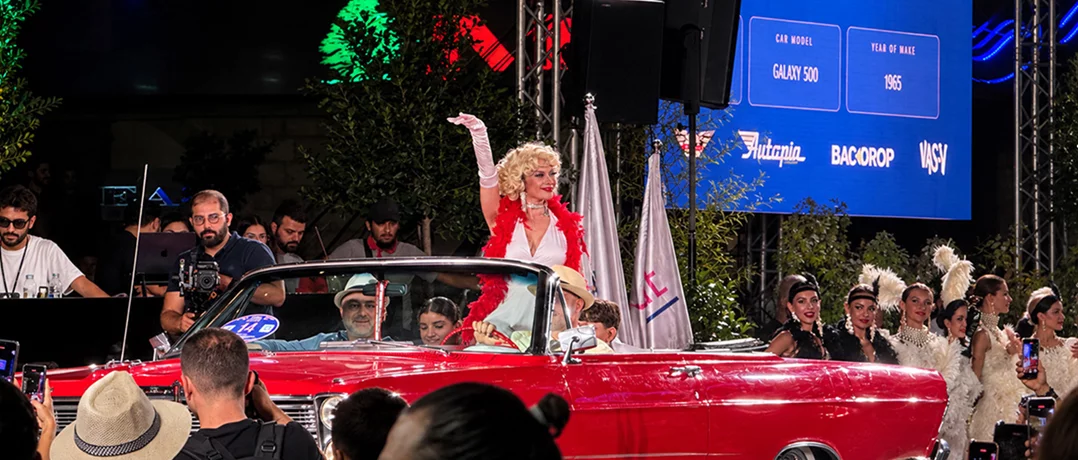
In front of Jounieh Municipality, the old stone architecture became the backdrop for a full-scale spectacle. Lights rose over the street; a red ramp stretched toward the stage and more than 100 classic cars gathered for the competition.
There were cars parked along the old road throughout the day, where visitors could walk around them and take photographs. At night, they became the stars of the show.
The competition brought together models spanning decades, including a 1946 DeSoto Custom and a 1954 Mercedes listed among the competing cars. One of the most personal stories belonged to Ralph Khoury, who entered his late father’s DeSoto, turning the competition into a way of carrying out a wish that had stayed with the family.
A jury watched from the stage as the cars made their way up the red ramp, while the public could also participate in the voting.
Abdeldayem explains that this year voting is different. “So this year we as well uplifted our voting,” she says. “So people can scan the code on each car and vote for the best car of their choice, so it will actually be part of the final result.”
Tony Baroud hosted the evening, working the crowd as children squeezed toward the front and adults raised their phones to capture the cars as they passed.
A show inside the show
The cars were only one part of the evening. Earlier, a fashion show brought pieces from the vintage market onto the stage, followed by dancers, disco balls and a burlesque-inspired performance featuring a Marilyn Monroe look.
The atmosphere shifted constantly: vintage fashion in one corner, live entertainment in another, food and cafés spilling into the street, people taking pictures beside polished cars. The old souk became a place where generations could occupy the same space without needing the same reason to be there.
For Abdeldayem, that variety was essential. “Kids can come, families can come, youngsters can come, old people can come,” she says. “Everyone would find an area for their scope of interest.”
Tegho sees the physical gathering as a first step for DOORA. “The market lets people experience DOORA in real life: seeing the pieces, touching the fabrics, and meeting the people behind them,” she says.
As the night continued, the bulbs hanging above the souk reflected off the cars, people kept moving through the crowd and children tried to find a view of the stage.
Under the lights, the old street was full again.
-
-

-
Rayanne TawilCultural writer
-
