



Lebanon’s aging watch repairers keep a disappearing craft alive, preserving decades of skill, memory, and patience in small village workshops.
Keepers of time… Lebanon’s watch repairers

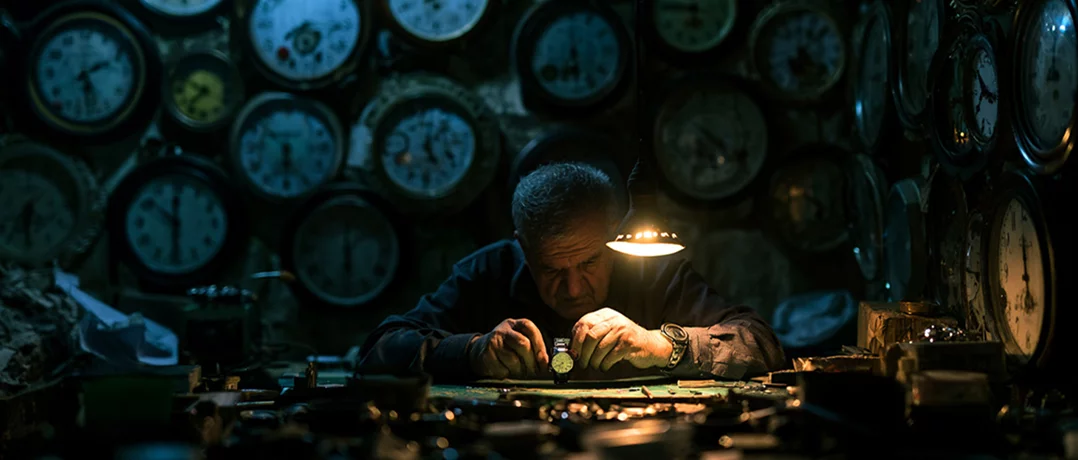
Across the country, a handful of old men still bring dead watches back to life. Their workshops are shrinking, some no larger than a closet, and their client lists thin with each passing year. Yet in villages scattered across Mount Lebanon, from the heights of the north to the hills above the Jounieh coast, this trade survives, carried by hands that refuse to stop moving. The Beiruter traveled to two of them, Blawza, a small village in the Bsharri qada near the Qadisha Valley, and Shnanir, a modest cluster of homes above Sahel Alma near Jounieh.
Youssef Maroun and the watch that waits
The road into Blawza narrows before it reaches Youssef Maroun's shop, a single room wedged between a shuttered grocer and a stone stairway leading nowhere in particular. Inside, the walls are lined with clock faces that have stopped at different hours. Maroun, eighty-three, has repaired watches here since he was a teenager, trained by his father with tools that still sit in the same wooden drawer.
"My father used to say a watch is a small heart," he told The Beiruter, turning a disassembled movement over in his palm. "You don't fix a heart by force. You listen to it first." Maroun's clientele has changed with the decades. Where he once repaired the timepieces of farmers and priests, today most of his visitors are grandchildren returning a grandfather's watch, hoping to hear it tick again before a wedding or a funeral. "They don't come for the time," he said, “they usually come because I am repairing a person's memory of another person."
Maroun remembers one lesson from his father more clearly than any other. He was still a boy when he tried to repair a watch that had stopped working, only to make the problem worse. "I was impatient. I wanted to open it, fix it quickly and close it again," he recalled. His father took the watch from his hands, placed each tiny piece on the table and told him to first understand why it had stopped before touching anything. "He said, ‘If you don't know what is wrong, your hands will only make it worse.’ I never forgot that." Years later, Maroun came to understand that the lesson applied beyond watches. "One small piece can stop everything, and sometimes you have to go back to the beginning to find it."
Business, he admits, is not what it was. "In this village, maybe two, three watches come to me in a month. Sometimes none. But I open the shop anyway.” Still, Youssef does not consider retiring, "Retire to what? To watch the fog come and go? At least here I do something with my hands until my hands no longer want to work."
Elias Estephan’s workshop behind the kitchen
Elias Estephan repairs watches from a workshop he built behind his kitchen forty years ago. There is no sign outside his home. Clients only find him by word of mouth. I never wanted a shop in the street,"Elias, seventy-nine, explained. "A watch is a private thing. People feel more comfortable handing it to me at my table than across a counter."
Elias’s clientele reflects the crowd that passes through Jounieh, old Kesrouani families, but also Lebanese expatriates who arrive each summer with a broken watch, saved specifically for him.
"A woman came from Australia this june," he recalled, setting down his tweezers. "She had her father's watch, stopped since he died. She said, 'I did not want anyone else to open it.' That trust, that is the real payment. The money is secondary."
Elias’s workshop is smaller than a single parking space, crowded with drawers of loose springs, crystals, and straps sorted by decade. His grandson sometimes watches him work, though he is doubtful the trade will continue. "He is curious, but," he paused. "This work needs both eyes, both hands, and no hurry at all. Young people today have three of those things missing."
Still, he insists there is dignity in the smallness of it. "I fixed maybe one hundred watches this year that I can remember. Each one, someone's father, someone's wedding day, someone's first paycheck. I am not a rich man. But I have one hundred small victories."
Two mountains, the same discipline
Between the heights of Blawza and the calm of Shnanir, Youssef Maroun and Elias Estephan practice a craft that modern Lebanon has largely outgrown, yet neither man speaks of it with bitterness. Both describe their work as restoration of memory. a grandfather's wrist, a father's last gift, a family's sense of continuity ticking forward. As mass-produced electronics render mechanical watches nearly obsolete, these two craftsmen, separated by an entire country's width, are united by the same conviction, that patience, unlike time itself, does not run out, it is simply handed down, like the inheritance of a special old watch.
-
-

-
Jenna GeageaReporter/Writer
-
