



In Ramliyeh, Sawsan Shaaban cooks Christian-Druze mountain dishes the slow way, with time, memory and stubborn faith in authenticity, and carries them down to the city every week.
Keeping Lebanon’s mountain cuisine alive

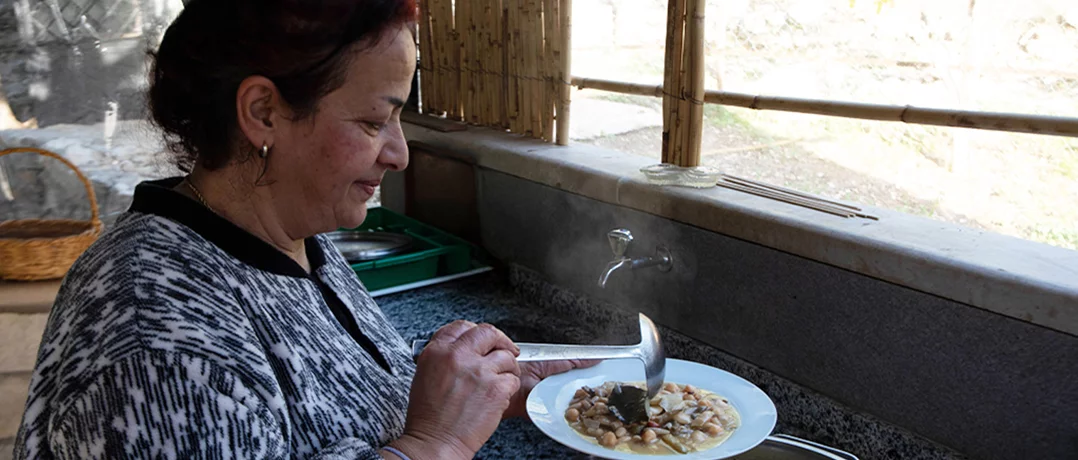
Sawsan Shaaban’s house in Ramliyeh feels like a place you stumble upon by mistake. Tucked deep in the wadis, the road thins out, the trees thicken, chickens wander freely, and cats soft, fearless, impossibly cute seem to own the land. You’re surrounded by green, silence and that mountain calm that makes Beirut feel very far away. Sawsan presents her sanctuary: a space filled with her supplies. Shelves filled with jars of mouneh, and sacks of bulgur, olives curing slowly and an oven for saj immersed in a glass-walled section of the garden. In winter, it feels like summer. You cook, but you also see everything: the trees, the sky, the land that feeds the food.
Where the kitchen becomes the land
The kitchen wasn’t enough anymore, she laughs, so she took over the living room too. “I started with nothing,” she says simply. More than 30 years later, she is one of Souk el Tayeb’s longest-standing participants, bringing mountain food to Beirut week after week. What she carries down isn’t just dishes, it’s a way of cooking that belongs to Christian and Druze mountain life, shaped by season, patience and necessity.
That afternoon in Ramliyeh, Sawsan was cooking makhlouta, kebbeh bi labneh, and a mountain tabbouleh that immediately disrupts everything you think you know about the classic Lebanese salad. There is no parsley here. Instead, chickpeas are boiled with onions, cabbage is added, and local bulgur is softened not by chopping, but by soaking it in the cooking water. “Parsley is not important,” she says, half-smiling. “This is mountain food. It’s very old.”
She recalls her mother preparing it when she was about five or six years old. It was served hot, greasy and enveloped in cabbage leaves, sometimes even as a breakfast, a dish made with the intention of satisfying and retaining the eater.
Slow food, stubborn memory
The difference between mountain and coastal food, she explains, starts with rhythm. In Beirut, food is fast, lighter, built around convenience. In the mountains, food takes time. “If you put it on high heat, it won’t taste good,” she insists. “Everything needs low heat, time, patience.” Even preparation is stretched across days: grape leaves rolled midweek, kept uncooked until Friday night. Nothing is rushed. Nothing is wasted.
Much of what Sawsan cooks is tied directly to what the land offers. Cabbage from nearby fields, bulgur and chickpeas sourced from Rashaya, olive oil used generously, unapologetically. Not everything is organic, she admits honestly, but everything is known. She knows where it comes from, who grew it, how it was treated. “It’s better than the supermarket,” she says. Her family cultivates onions, mint, and eggplants, while her son has planted lemon, avocado, pomegranate, and kiwi trees. She produces her own pomegranate molasses in limited quantities, jars that are primarily reserved for her and a couple of loyal customers.
This deep connection between land, food and identity is exactly what cookbook author and food heritage expert Barbara Massaad has spent years documenting. Mountain cooking, she explains, is built around self-sufficiency and seasonality, especially dishes linked to foraging, or sli‘ah. “People wait for this time,” Massaad says, “they go pick wild plants, it’s like free food. Very humble dishes, but very, very tasty.” These recipes weren’t designed to impress; they were designed to sustain.
For Massaad, Christian and Druze mountain dishes reveal entire ways of life. They are ancestral, learned and passed down, but now at risk. “If we don’t highlight them now, if we don’t speak about them, they might disappear,” she says. Younger generations don’t sit in the kitchen for hours anymore. They want quick, affordable meals. And yet, these dishes: mjadra, kebbeh batata, makhlouta are some of the healthiest, most thoughtful foods we have.
Even mjadra tells a regional story. In the South, it’s yellow lentils. In the North, red. In Beirut, black. Some versions are watery, others firm, others stew-like. “Each area has its own mjadra,” Massaad explains. “You don't have the histories of the dishes, you have to guess, it's like a puzzle that you have to put together.”
Sawsan’s mjadra is dark, ground, slow-cooked, finished with cabbage, lentils, sometimes pomegranate seeds, walnuts and olive oil. It’s not restaurant mjadra. It’s mountain mjadra. And people in Beirut love it. University students, families, older customers of “all the ages,” she says proudly. Warak Enab (Grape leaves) sell out first. Some customers complain it’s expensive. She understands, but she doesn’t apologize. Between ingredients, transport, and a $25-per-table Souk el Tayeb fee, she barely breaks even. “I don’t run a bank account,” she says. “I go for the blessing.”
This is where the mountain meets the city most sharply: value versus convenience. Some people want cheaper food, faster food. Others want food that tastes like their grandmother’s kitchen. “They tell me: this is my mother’s food, my grandmother’s food,” Sawsan says. Customers bring customers. Memory does the marketing.
Massaad believes mountain cooking offers a blueprint for today, sustainable, local, deeply rooted. But only if we stay curious. “People have to be adventurous,” she says. “To go to villages, meet people, eat at their houses.” Beirut, with its speed and pressure, has drifted far from that curiosity. But every Saturday, when Sawsan drives down from Ramliyeh with her pots and boxes, the distance briefly collapses.
Through her food, the mountain arrives intact. Slower. Heavier. Truer. And for a moment, Beirut remembers how it used to eat.
-
-

-
Rayanne TawilCultural writer
-
