



Tracing the origins of Kibbeh and Kibbeh Nayeh, from ancient Mesopotamia to the modern Levant, and why the dish still matters.
Kibbeh and the question of origins

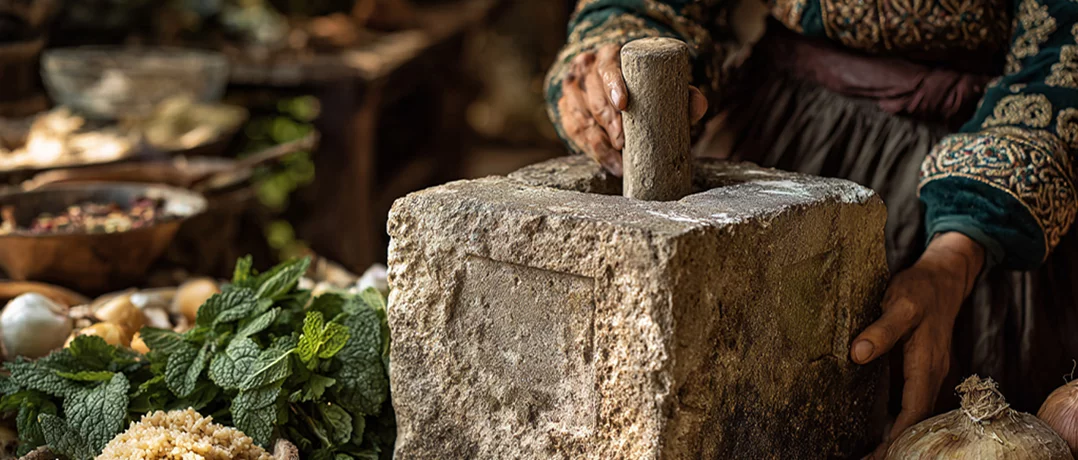
Kibbeh is one of those dishes that feels ancient even before you know anything about it. Its texture alone reveals the labor behind it. Meat pounded until it loses its original shape; wheat worked by hand in movements that feel almost ceremonial. Across the Levant and beyond kibbeh exists in dozens of forms: fried, baked, stuffed, flattened, rolled, pumpkin-based and potato-based. All these variations share a single concept that transforms meat into communal and purposeful dining experiences.
Despite how fixed it feels on today’s table, kibbeh was never static. According to Manal Mourad, founder of the research-driven food platform @lebanesefeed, the dish evolved across centuries and borders, shaped more by movement than by nation-states. “Kibbeh didn’t appear fully formed in one place,” Mourad said. “It adapted as it moved, depending on ingredients, climate and regional taste.”
Before it was raw, it was cooked
If historians agree on one thing, it’s that kibbeh did not begin as a raw dish. Mourad traces its earliest form to ancient Mesopotamia, in modern-day Iraq, where ground meat preparations were already part of daily cooking. Even the word itself may hint at that origin. She points to the Akkadian terms kobba or kobu, meaning “round” or “dome,” a reference both to shape and to the shared linguistic roots of Semitic languages.
In medieval Arabic texts, kibbeh appears under the spelling kubbah, but it functions as a category rather than a recipe. Charles Perry, widely regarded as the world’s foremost expert on medieval Arab cookery, notes that these references overwhelmingly describe cooked meat dishes. “There is no mention of a raw meat preparation in the 10th- and 13th-century Arabic cookbooks,” Perry said, adding that minced meat was “most often served in the form of meatballs.”
Even bulgur, now inseparable from modern kibbeh, complicates the timeline. Perry points out that early Persian sources used the term palghur simply to mean “ground,” not necessarily cooked wheat.
Search for kibbeh’s origin online and Aleppo appears again and again. But Mourad cautions against confusing visibility with birthplace. Positioned along the Silk Road, Aleppo became a culinary crossroads where foods were exchanged, refined, and documented. “Foods that passed through Aleppo were often credited to it,” she said, “even if they were adopted from elsewhere in the Levant or West Asia.” What Aleppo had was a wide range of dozens of kibbeh preparations, not necessarily the original blueprint. “What was served somewhere and where something started are two very different questions.”
When raw meat entered the picture
Kibbeh nayeh is where certainty gives way to speculation. Stories abound: people ate it during wartime because they couldn’t light fires; mountain communities prepared it in hiding; rulers demanded it as a show of luxury. Mourad has encountered all of these narratives and found little evidence for any of them.
What does hold up historically is timing. Both Mourad and Perry point to the Ottoman period, particularly the 18th and 19th centuries, as the moment when raw meat dishes became more common throughout the whole region. The traditional Turkish dish “çiğ köfte” which uses raw meat as its main ingredient and the cooking method “frakeh” show that two distinct culinary traditions developed during the same historical time period.
The earliest reference that exists in clear form dates back to 1847 when American missionary William McClure Thomson documented his observations of local people consuming pounded meat. The account shows that people already made kibbeh-type dishes, which included both cooked and raw versions, by the middle of the 19th century.
“The most defensible conclusion,” Mourad said, “is that kibbeh originated as a cooked dish in ancient Mesopotamia, and that kibbeh nayeh emerged later, during the Ottoman period, shaped by regional practices and evolving food cultures.”
A dish meant to honor
For Perry, kibbeh nayeh’s power lies not in its age but in its symbolism. He explains that raw kibbeh has long been associated with special occasions precisely because of its risk. “It showed special honor to the guest,” Perry said, “because it requires the finest quality meat, only muscle tissue, no connective tissue. Anything less would be instantly noticeable.”
In that sense, kibbeh nayeh functions less like a survival food and more like a statement. Perry compares it to tah chin in Iranian cuisine, the prized crispy rice traditionally reserved for the most honored person at the table. Both dishes, he suggests, may have emerged relatively recently, but that doesn’t diminish their meaning. “I think it shows the ongoing vitality of a people’s culinary life,” he said.
The dish of kibbeh nayeh exists as a demonstration of both practical uses and high social status throughout most of the Levant. Mourad describes it as a dish that likely began among peasants closest to livestock, those with access to fresh meat, before gradually moving upward.
The practice of serving raw meat carries cultural meaning. Red meat serves as an honor for guests in Lebanese families, kibbeh nayeh functions as a special dish that proves their hospitality. The statement indicates you are welcome while simultaneously showing your trusted status.
Outside the region, kibbeh nayeh often shocks. Why eat raw meat when you could cook it? Mourad sees that reaction as part of a broader double standard. Raw fish, she notes, is celebrated as refinement; raw meat from West Asia is treated with suspicion. “It’s a form of Orientalism,” she said, “to separate kibbeh nayeh from something like sushi.”
And yet, kibbeh nayeh persists because it tastes good, because it carries memory, and because it continues to say something about generosity and trust. As Perry suggests, foods don’t need to be ancient to be meaningful. Sometimes, the fact that they are still evolving is what makes them worth defending.
-
-

-
Rayanne TawilCultural writer
-
