



From Ottoman-era religious portraits to contemporary works exploring psychology, identity and collective memory, Lebanese portraiture reflects the country’s evolving cultural influences, social hierarchies and sense of self.
Lebanese portraiture, faces of a nation

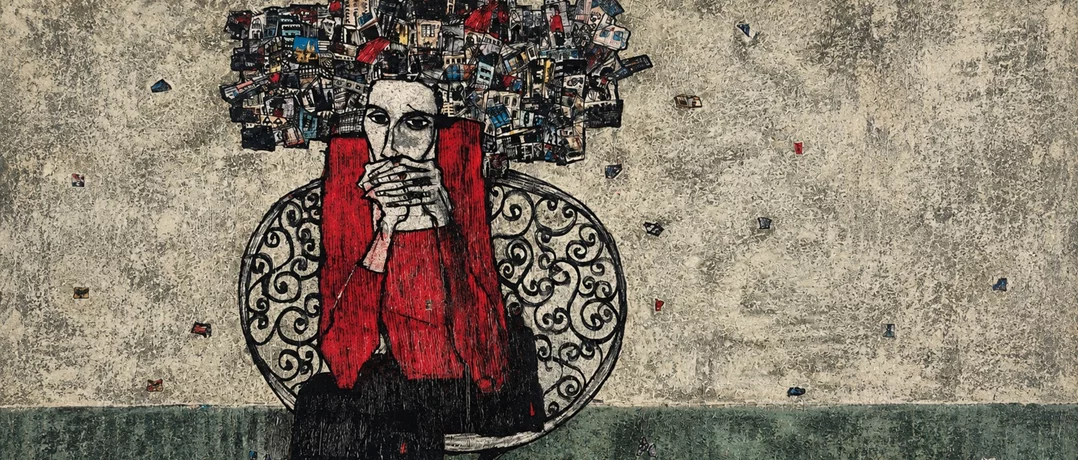
Portraiture in Lebanon is a creative record of faces. Across the Ottoman era, the French mandate and the eras since, it has tracked how a society saw itself, and how it wished to be seen. Each phase, from religious iconography to classicism, Impressionism and expressionism, reflects a shift in who held power, who paid for art and what identity meant.
During Ottoman rule (1516-1918), art in the region grew from two sources. Officers and soldiers learned drawing and sketching for topographic purposes, and their work, tied to what is known as the Marine School, mostly depicted the Empire as a unified whole, with an emphasis on high-ranking officers and generals. Alongside it, religious art flourished under strong Roman influence. Clerics encouraged local artists, often trained by missionaries, to portray clergy and sacred subjects for the Church. Painters educated by Italian missionaries, among them Khalil Ghorayeb, Ibrahim El Gorr and Salim Haddad, recorded the status of senior clergymen and prominent figures, keeping portraiture tied to ecclesiastical patronage for a long time.
Commissions from Beirut's wealthy merchant families gradually weakened the dominance of religious themes. Sitters posed in opulent rooms, framed to suggest cultured modernity. Clothing did much of the talking. Western fashion appealed to the upper class from the start, though some men kept Ottoman elements such as the salvar, mintan and kaftan. Over time, the Western suit worn with a tarboush became the signature of status and modernity. Women's portraits, by contrast, lingered on silk, lace and jewelry. Serour's portrait of Eugénie Rubeiz, with her puffed sleeves and elaborate jewels, shows how dress announced a woman's place in elite society. Everyday subjects appeared in more modest attire, Bedouins in black veils, villagers in richly ornamented traditional costume.
A modern sensibility
From around 1930, Beirut's art scene broadened and reached a wider public. Four figures dominated portraiture for the next period: Omar Onsi, Moustafa Farroukh, Cesar Gemayel and Marie Haddad. The three men had European academic training and kept faith with fidelity to the model, perspective and anatomy. Yet their backgrounds, painted with short, rapid, colorful strokes, borrowed from Impressionism and hinted at a new sensibility. Haddad, trained through private lessons in Beirut, took a freer path, painting children, Bedouins and peasants, and later moving toward bold, Fauvist color.
Gibran Khalil Gibran fused Western realism with Eastern themes of spirituality, as his portrait of his friend Amine Rihani suggests. Georges Corm widened the genre by turning to villagers and the working class.
Portraits also became arguments. Farroukh's 1929 painting Unveiled shows a woman shedding her veil, wearing Western makeup and holding a red umbrella, and was conceived as a catalyst for changing gender relations in a conservative city. His pastel portrait of Iqbal Aliya, still wearing a yashmak, strikes a more tentative note. Together they show how the same artist could explore women's journey toward liberation through different moods and media.
This generation also helped shape national pride. Using oil, pastel and watercolor touched by Impressionism, they depicted people in traditional costume, Druze subjects from the mountains and women at craft work, building an early Lebanese style in the portrait genre. Orientalism played its part too, Serour, Onsi and Haddad were drawn to Bedouin subjects, with Haddad focusing on their tattoos and dark attire and Serour moving from outward description toward the hardships of Bedouin life.
In the mid-century, styles multiplied. Alfred Baccache, a Syrian artist working in Lebanon, painted women in vibrant color with dramatic light and shadow, moving from the classical precision of his early work toward emotive dynamism. Saadi Sfeir offered muted, deliberate portraits celebrating tradition. Cici Tommaseo Sursock painted aristocrats from the 1940s in a distorted style recalling Bernard Buffet, with bold lines, magnified eyes and elongated necks.
Contemporary Portraiture
In this day and age, portraiture is less about likeness than meaning. Some artists still balance tradition and innovation. Samir Tabet, known for his portraits of Lebanon's presidents, pairs realistic faces with unfinished strokes that merely suggest suits. Others push toward psychology and critique. Zena Assi's early figures, twisted by urban angst, evolved from skeletal outlines toward composed portraits. Ayman Baalbaki layers thick paint to give faces a sculptural presence, charged with collective memory and conflict. Mohammad El Rawas builds collages from balsa wood, aluminum and string, mixing comics, manga and classic masterpieces. Khodor Hachem, shaped by his Armenian-Lebanese experience and war, paints women and children as visual poems of survival. Samia Osseiran used close-ups, bold hues and flat backgrounds to emphasize inner life, while Raouf Rifai's 'Darwiche' series turns dervish-like figures into joyful, satirical archetypes of cultural identity. Rima Amyuni upends hierarchy by making her housekeeper, Danny, the focus of her canvases.
Lebanese portraiture has widened its gaze with each generation. Its faces trace a country negotiating its Arab heritage and Western influences, and they remain one of the most revealing windows into its changing identity.
-
-
-
Jenna GeageaReporter/Writer
-
