



Lebanon-Syria Investment Forum 2026 brings together leaders and investors to explore economic cooperation, business opportunities, and a new era of partnerships.
Lebanon and Syria’s new economic horizon

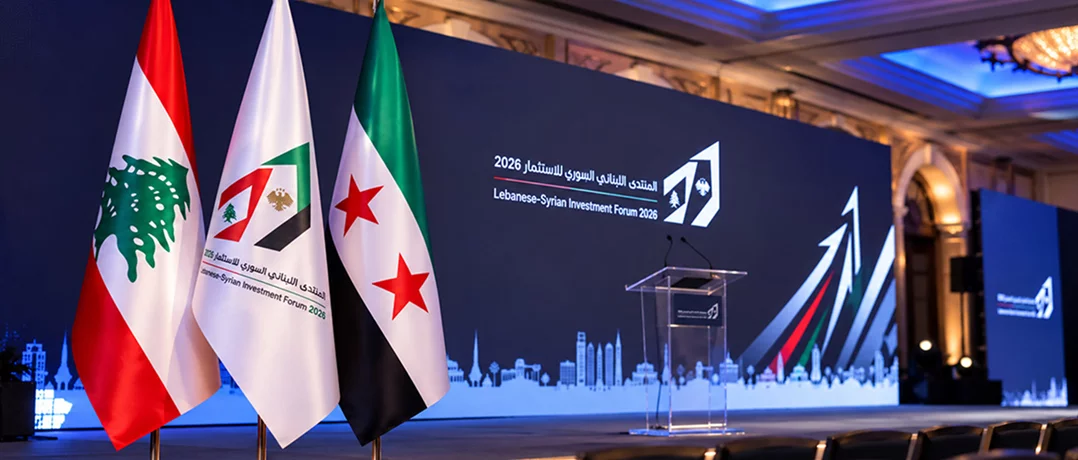
As Lebanon and Syria enter a new phase in their bilateral relationship, economic cooperation and investment opportunities are emerging as key areas of discussion between the two neighboring countries. In this context, the Lebanon-Syria Investment Forum 2026 brings together government officials, business leaders, investors, and economic experts in Beirut to explore potential partnerships and mechanisms for strengthening commercial ties.
The forum, held in Beirut on Wednesday, aims to create a platform where representatives of both the public and private sectors can discuss investment opportunities, address obstacles facing businesses, and identify areas of mutual economic interest, thus moving economic relations toward greater private-sector engagement and investment-driven cooperation.
A forum to redefine economic relations
Opening the forum, Lebanese Minister of Economy and Trade Amer Bisat, representing President Joseph Aoun, described the gathering as an opportunity to establish a new phase in Lebanese-Syrian relations based on greater clarity and balance.
Bisat stressed that the relationship between the two countries has been shaped by decades of shared geography, economic links, and political developments, emphasizing the importance of drawing lessons from the past and transforming geography from a constraint into an opportunity. “Lebanon and Syria are facing an opportunity to establish new relations between the two countries, clearer and more balanced,” Bisat said, stressing the need to move “from intentions to institutions, and then to implementation.”
He highlighted the importance of building an institutional framework for cooperation through agreements and protocols while reducing bureaucratic obstacles affecting businesses and investors. According to Bisat, Lebanon and Syria have the potential to benefit from a changing regional economic landscape by acting as complementary partners rather than competitors.
For his part, Syrian Minister of Economy and Industry Mohammad Nidal Al-Shaar described the forum as an important step in opening a new chapter in relations between the two countries. Al-Shaar said that economic integration does not require either country to abandon its advantages, but rather allows both sides to benefit from their respective strengths. He stressed that a stable Lebanese economy is also in Syria’s interest, adding that the two countries should move beyond traditional commercial exchanges toward broader economic cooperation.
Stressing respect for the sovereignty, independence, and national interests of both countries, Al-Shaar said
Syria and Lebanon do not need to rediscover each other, but rather redefine their economic relations on clearer and more balanced foundations.
He added that Syria seeks to benefit from Lebanese expertise, while Lebanese companies can benefit from opportunities in the Syrian market, particularly in sectors requiring investment and reconstruction.
Syrian Chargé d’Affaires in Lebanon Iyad Al-Hazzaa also highlighted the importance of transforming geographical proximity into economic partnership. He described Lebanon and Syria as “not merely two countries on a map, but one geographical and historical space,” arguing that cooperation between Lebanese logistical and service capabilities and Syrian economic potential could contribute to broader development.
During his meeting with the Syrian delegation at Baabda Palace, President Joseph Aoun highlighted the importance of developing Lebanese-Syrian relations based on integration, balance, mutual respect, and non-interference.
Aoun said he attaches significant importance to the concept of regional economic integration, arguing that Lebanon and Syria’s geographical position on the Mediterranean provides opportunities for broader economic cooperation.
A new vision for Lebanese-Syrian economic cooperation
In an interview with The Beiruter, Ahmad Hechmieh, founder of the Lebanon-Syria Investment Forum 2026 initiative, said the forum seeks to establish a new vision for economic relations between Lebanon and Syria based on broader cooperation, strategic partnerships, and increased private-sector participation.
Hechmieh explained that the initiative was designed to bring together decision-makers, investors, and experts in one platform to facilitate communication and identify practical opportunities for cooperation. According to him, the forum’s objective is not limited to discussions, but rather to creating conditions that allow available opportunities to be transformed into concrete investment projects and long-term partnerships.
Based on moving from traditional cooperation toward a more open and sustainable investment partnership, Hechmieh asserted that
The forum presents a new vision for Lebanese-Syrian economic relations.
He stressed that the event aims to strengthen coordination between the public and private sectors while creating direct channels between investors and officials responsible for economic policy and investment decisions.
Hechmieh also noted that some investors continue to approach the Syrian market with caution due to questions related to regulations, procedures, and investment conditions. He explained that one of the forum’s goals is to provide investors with greater clarity by allowing them to engage directly with relevant institutions and understand the opportunities and challenges involved.
According to Hechmieh, the forum comes at a time when both countries have the opportunity to reshape their economic relationship, with investment serving as an important tool for expanding markets, encouraging private-sector involvement, and developing sustainable economic partnerships.
Priority sectors for investment and economic cooperation
The forum places particular focus on sectors considered essential for future economic cooperation between Lebanon and Syria.
Hechmieh highlighted that infrastructure and reconstruction represent a significant part of discussions, particularly given the need for major investments in rebuilding and developing essential sectors. Lebanese companies, with experience in construction, engineering, consulting, and services, are viewed as potential partners in projects requiring regional expertise and proximity.
Energy and transportation are also central areas of interest. Improving connectivity, trade routes, and logistical networks could contribute to facilitating economic exchanges between the two countries while strengthening their ability to access wider regional markets.
Agriculture and food industries represent another area of potential cooperation due to the complementary nature of production and trade between Lebanon and Syria. Similarly, sectors such as healthcare, pharmaceuticals, and technology are expected to be discussed as areas where private-sector partnerships could develop.
Hechmieh stressed that the diversity of participating institutions and the broad representation of economic sectors aim to provide investors with direct access to decision-makers and create opportunities for practical cooperation.
What is the Lebanon-Syria Investment Forum and who participated?
The Lebanon-Syria Investment Forum 2026 is an economic gathering bringing together representatives from both governments, the private sector, investment institutions, and business organizations to discuss future cooperation and investment opportunities.
The event is hosting around 400 to 500 participants, including Lebanese and Syrian business leaders, ministers, government officials, investors, and economic specialists. The participation includes approximately 190 Syrian businessmen and more than 200 Lebanese businessmen, alongside representatives from several economic institutions.
The Syrian delegation represented one of the largest official visits to Lebanon in recent years and included ministers responsible for economy, health, tourism, agriculture, and transportation, as well as officials from investment and aviation authorities.
The Lebanese side included government officials, business associations, economic organizations, and representatives from investment institutions.
The forum’s sessions focused on four main themes: Lebanon and Syria’s role in the region’s changing economic landscape; financing investment and restoring confidence; reconstruction and sustainable development; and transportation, ports, logistics, and regional connectivity.
The Lebanon-Syria Investment Forum 2026 represents a significant platform for bringing together economic stakeholders from both countries at a time when investment and private-sector cooperation are gaining greater attention.
-
-

-
The Beiruter
-
