

A proposed Gulf-Europe railway could reshape regional trade routes while reopening questions about Lebanon’s historic and future role in Middle Eastern rail connectivity.
Lebanon and the Gulf-Europe rail vision

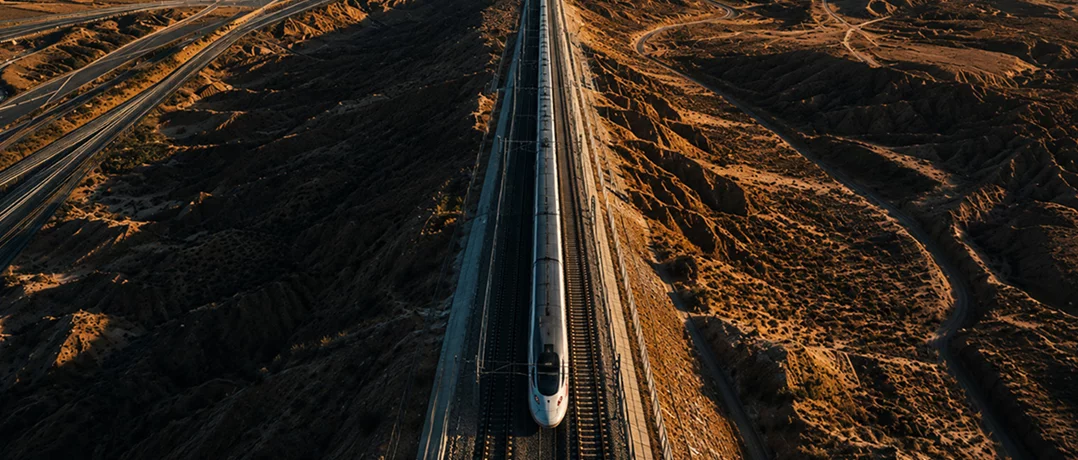
As countries across the Middle East invest in new transport corridors, railways are re-emerging as tools of economic integration and geopolitical influence. The Gulf-Europe railway reflects a growing regional effort to diversify trade routes and reduce reliance on increasingly vulnerable maritime chokepoints.
Turkey and Saudi Arabia have set their sights on stitching the Gulf to Europe by rail. Turkish Transport Minister Abdulkadir Uraloglu said the two countries aim to build a railway linking them with Jordan and Syria within three or four years, with other Gulf states joining later. The plan, formalized in a memorandum of understanding signed in Riyadh on June 9, would carry freight, oil, natural gas, and passengers, including Hajj pilgrims, along a corridor running from Saudi Arabia through Jordan and Syria into Turkey and onward to Europe.
A response to a closed strait
Uraloglu framed the railway as insurance against disruption. The corridor, he argued, would ease the problems created when the Strait of Hormuz, the maritime artery for a fifth of the world's oil, was choked by the war in Iran. Roughly the same logic underpins the wider regional scramble for overland routes: as the Suez Canal, the Red Sea, and the Gulf's chokepoints become more vulnerable, the appeal of dry land between the Gulf and the Mediterranean grows. Ankara has been explicit about wanting to position Turkey as the indispensable transit hub for trade that no longer trusts the sea.
The engineering is further along than the headlines suggest. Uraloglu said the line from Saudi Arabia to the Jordanian border is finished, and on the Turkish side the link runs through Islahiye to Kilis and Gaziantep, near the Syrian frontier. What remains is a gap of roughly 400 kilometers across Syria, plus a planned $100 million rebuild of the Aleppo route to create a direct link to Damascus. Turkey's warming ties with Damascus after the fall of Bashar al-Assad in late 2024 have made that stretch politically conceivable for the first time in years.
An Ottoman ghost returns
None of this is new track in the imaginative sense. The corridor revives the Hejaz Railway, the Ottoman line that opened in 1908 to carry pilgrims from Damascus south to Medina, with Damascus as the hub from which branches reached north toward Aleppo and Turkey, and west toward the Mediterranean. Severely damaged during the First World War and fractured by a century of shifting borders and conflict, the Hejaz network became a romantic ruin. The new memorandum is, in effect, a proposal to weld the broken pieces back together with modern signalling and standard gauge.
Lebanon's branch line
Lebanon was once a working limb of this same body. The western branch of the old Damascus network ran to Beirut, and the junction town of Riyaq, in the Bekaa Valley, was the pivot: a station and major repair complex that connected the Lebanese coast to Damascus, Homs, and ultimately the rail systems reaching toward Iraq and Turkey. The first train left Beirut for Riyaq in 1895, a nine-hour journey. A separate line connected the northern port of Tripoli to Homs in Syria as early as 1911, and during the Second World War Allied forces extended a coastal line through Beirut, briefly making Lebanon part of a through route from Turkey to North Africa.
Then it all stopped. The cross-border link toward the south was severed as Arab-Israeli relations deteriorated, and the Civil War of the 1970s gutted what infrastructure remained. A short stretch between Beirut and Chekka limped on for cement trains until 1997. Since then, no trains have run anywhere in Lebanon.
Inside the room, or outside it?
Lebanon is not a signatory to the Turkey-Saudi memorandum, nor to the trilateral Turkey-Syria-Jordan transport agreement signed in Amman in April that underpins it. Its connection to the emerging corridor is historical and potential rather than contractual. Turkish interest in Lebanon has so far been heritage-flavored: in 2018, following a protocol signed in Beirut, Turkey's development agency TIKA took on restoring the Tripoli station, including a museum to the line's history.
A corridor anchored on Damascus naturally regenerates the logic of Riyaq: the Bekaa junction sits a short distance from the Syrian capital, and any serious revival of the Damascus hub puts a Beirut connection back within geographic reach. Lebanon's Tripoli port, meanwhile, is a credible Mediterranean outlet that competes with, or complements, the Turkish and Syrian coastlines the planners currently favor. The country has the geography to belong. What it lacks is the functioning state, the financing, and the political bandwidth to claim a seat while the routes are being drawn.
The tracks ahead
For now, the Gulf-Europe Railway is being planned without Lebanon at the table. Yet the project follows routes that once passed through the country, highlighting how closely Lebanon's geography aligns with the region's emerging transport ambitions. If the corridor moves forward, it could create opportunities for Lebanon to reconnect to regional trade networks through links such as Riyaq and Tripoli. Whether those opportunities materialize, however, will depend on future investments, infrastructure rehabilitation, and the broader political and economic environment.
-
-

-
Jenna GeageaReporter/Writer
-
