



A look at Lebanon’s golden cinema archive of the 1960s, when Beirut’s film industry and landmark works turned the country into a regional cultural and cinematic hub.
Lebanon's golden cinema archive of the 1960s

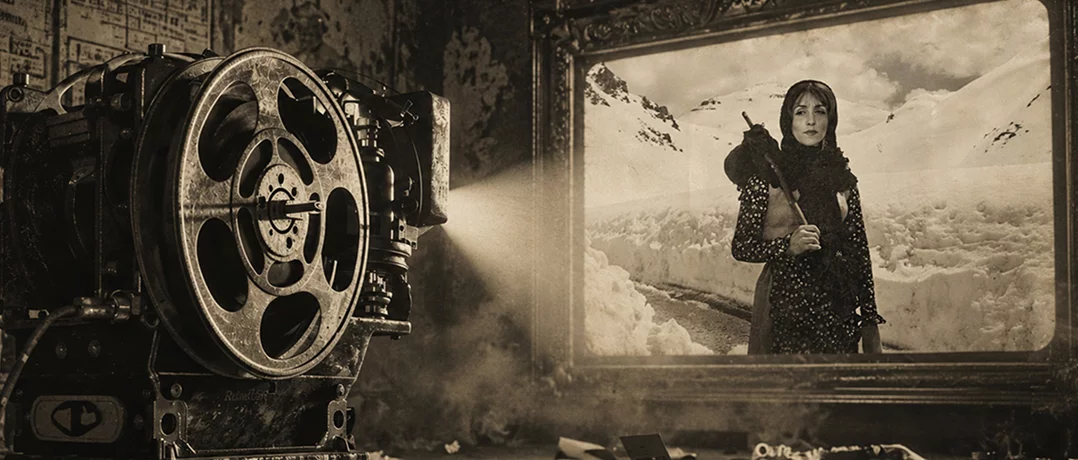
In the 1960s, Beirut, known globally as the “Paris of the Middle East”, was a city where culture was produced, and nowhere was this more visible than in its cinema halls. With more than 150 cinemas across the country and a thriving distribution industry rooted in decades of handling Egyptian film exports, Lebanon entered the decade already fluent in the language of cinema. What followed was a brief but remarkable era in which Beirut emerged as a regional filmmaking hub, producing a body of work that reflected a society watching itself, and imagining its future, on screen.
What followed was a decade of real cinematic ambition: Beirut emerging as a rival to Cairo, and a film scene that blended glamour, commerce, and political imagination. From melodramas to social comedies and nationalist epics, the films of this era captured a country experimenting with itself on screen, some forgotten, others destined to endure.
The voice that became an archive
No figure defines Lebanese cinema of this era more completely than Fairuz. Born Nouhad Wadi Haddad, she was already the Arab world's most beloved voice when she stepped in front of the camera. Her film trilogy with director Henry Barakat and the Rahbani Brothers, Biyaa El Khawatem (1965), Safar Barlik (1967), and Bint El Haress (1968), became a cinematic archive of a Lebanon that the war would soon erase.
Safar Barlik, released in 1967 and set during the Ottoman occupation of 1914, was the most politically charged of the three. Filmed in the northern Lebanese villages of Beit Chabab and Douma, it depicted the Ottoman forces attempting to starve the Lebanese people by blocking wheat imports, a collective memory that still ached. Fairuz played a village woman resisting occupation with spirit and song. The Rahbani Brothers' score wove nationalist feeling into melody so effortlessly that the film became a television staple, replayed every Independence Day as a kind of cultural liturgy. It did not feel like a film so much as a memory the whole country shared.
Bint El Haress, released the following year, was lighter in register but no less beloved. Fairuz played Nejmeh, a young woman who disguises herself as a criminal, to help her father, a guard who has been fired because the village is too peaceful and crime-free to require his services. Directed again by Henry Barakat, the film glowed in Technicolor compositions of mountain landscapes and cedar light, each frame complemented by Assi and Mansour Rahbani's songs. It was charming, politically playful, and visually sumptuous, and beneath its whimsy ran a genuine current of populist sympathy for the working man. Audiences across the Arab world adored it.
Art Cinema and Literary Adaptation
Not all of Lebanon’s filmmakers of this era were working within the popular tradition. A parallel current of more formally ambitious, internationally oriented cinema was developing simultaneously, anchored by directors who had trained abroad and returned with a different set of ambitions.
Georges Nasser was among the most consequential. Having studied film at UCLA, one of the first Arab directors to earn an American cinema degree, he returned to Lebanon and made Ila Ayn (Where To?) in 1957, a stark, realist portrait of rural migration and urban dislocation. The film became the first Lebanese production selected for competition at the Cannes Film Festival, where it screened alongside works by Ingmar Bergman and Federico Fellini. Nasser returned to Cannes in 1962 with The Small Stranger (Le Petit Étranger), a coming-of-age drama shot in French, the first French-language Lebanese film ever made, that signaled the cultural complexity of a country navigating multiple literary and linguistic traditions simultaneously. In 2017, sixty years after Ila Ayn first screened on the Croisette, Cannes restored and re-screened the film to a standing ovation. Nasser, then ninety years old, was present to receive it.
Literary adaptation offered another avenue into art cinema. The Broken Wings (1962), directed by Youssef Maalouf, drew its source material from Kahlil Gibran’s 1912 novel of the same name, a poetic account of doomed love set in turn-of-the-century Beirut, in which a young man modeled on Gibran himself falls for a woman named Salma, only to lose her to a corrupt social order that forces her into a loveless, arranged marriage. Shot in luminous black and white, with stage actress Nidal Al-Ashkar delivering a performance of remarkable restraint and feeling in the role of Salma, the film became the first Lebanese production to receive an international commercial release, reaching American audiences before the decade was out. That a Lebanese film in Arabic, adapted from a Lebanese-American poet’s early novel, found distribution in the United States in the 1960s is a measure of how seriously the country’s cinema was beginning to be taken.
Beirut as stage and star
What made the decade so distinctive was not only the quality of homegrown production but the degree to which Beirut itself had become a cinematic object of desire. International film crews arrived in growing numbers, drawn by the city’s generous tax incentives, its visual drama, and its singular atmosphere, a capital that was simultaneously Mediterranean resort, financial hub, and crossroads of civilizations.
The landmarks of the era became backdrops: the St. George Hotel gleaming on the waterfront, its terrace a stage for the city’s social theater; the Casino du Liban perched on the cliffs above Jounieh, improbable and magnificent; the old Burj souks alive with the noise and color that no set designer could replicate. Hollywood and European productions incorporated these locations into their visual grammar with evident relish. 24 Hours to Kill (1965), a British thriller starring Mickey Rooney, used Beirut as its principal setting. Where the Spies Are (1965), starring David Niven, wove the city into an espionage narrative in which glamour and danger were inseparable — which is to say, it used Beirut as Beirut actually was. In 1967, the first Pakistani film ever shot outside Pakistan, Rishta Hai Pyar Ka, chose Beirut as its location, a choice that speaks volumes about the city’s international cultural standing at the time.
An archive against forgetting
What we call Lebanon’s cinematic golden age is, in the fullest sense, a record of a society at the height of its self-belief. The films of the 1960s captured a Lebanon that was urban and rural simultaneously, cosmopolitan and fiercely local, politically conscious and irrepressibly musical. They held all of these contradictions in suspension without resolving them, which is precisely what serious art does, and what propaganda cannot.
When the civil war began in April 1975, it interrupted this archive mid-sentence. Annual production, which had reached dozens of films per year at its peak, collapsed to one or two. Cinema halls across Beirut and the south went dark, were shelled, or were converted to other uses. Reels were lost, destroyed, or simply abandoned as the institutions that housed them ceased to exist. An entire industry’s infrastructure was dismantled in the space of a few years.
But the films survived. And in surviving, they carry something that no subsequent reconstruction effort has fully been able to restore: the image of a Lebanon that believed, without qualification or irony, in its own future. The country those films portray is not naive. It is not ignorant of hardship or injustice. But it is alive with a confidence, cultural, creative, political, that the war would cost Lebanon dearly to lose, and that it has spent the decades since struggling to recover.
That belief, preserved on celluloid, is the most precious thing these films contain.
-
-

-
Jenna GeageaReporter/Writer
-
