Despite making up nearly half of the agricultural workforce in Lebanon and the MENA region, women farmers continue to face deep inequalities in land ownership, wages, and decision-making power.




Despite making up nearly half of the agricultural workforce in Lebanon and the MENA region, women farmers continue to face deep inequalities in land ownership, wages, and decision-making power.

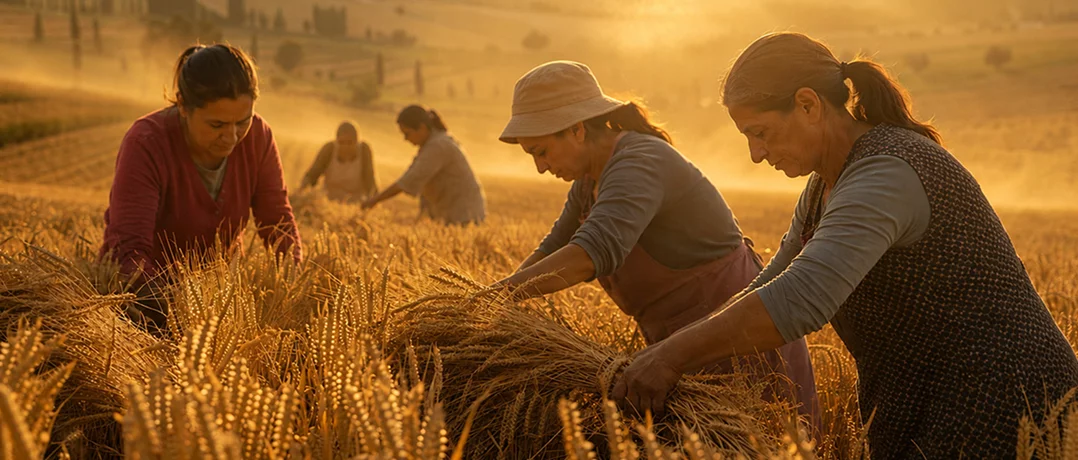
Women have farmed for at least 10,000 years. Agriculture itself was likely invented in the Fertile Crescent, the same soil that today stretches across Lebanon, Syria, Iraq, and Jordan. Yet in the region where women first planted seeds, they remain locked out of the land they cultivate, the wages they earn, and the decisions that shape their livelihoods.
The numbers are blunt. In rural Lebanon, women make up 43% of the agricultural workforce (UN Women, Women in the Agro-Food Sector in Lebanon, 2023). Across the wider Middle East and North Africa, around 50% of the agricultural workforce is female (Middle East Institute, 2024). But participation is not the same as power. In 2010, only 9% of farms in Lebanon were headed and managed by women, and only 5% of the total agricultural area was cultivated by women (UN Women, 2023, citing FAO 2020 national study).
The ownership gap is even starker at the regional level. Women own less than 5% of the agricultural land in the MENA region, and they are often excluded from decision-making related to land management, a figure published by the International Center for Agricultural Research in the Dry Areas (ICARDA), and the lowest rate of female agricultural land ownership in the world. The Middle East Institute reports that in Morocco, Tunisia, and Jordan, women are only 4.4%, 6.4%, and 3.4% of total landholders, respectively. The share of actual owners, as opposed to those who simply work land registered to male relatives, is smaller still.
In Lebanese agriculture, women often earn between half and two thirds of what men earn for the same work (UN Women, 2023). That gap of 33%-50% is significantly wider than the global agricultural wage gap. The FAO's 2023 report The Status of Women in Agrifood Systems found that women earn 18.4% less than men in wage employment in agriculture globally, 82 cents on every dollar.
The same report quantifies another loss: the gender gap in land productivity between female- and male-managed farms of the same size is 24% (FAO, 2023). Women aren't less capable farmers. They are less resourced, denied credit, inputs, extension services, machinery, and irrigation access on the same terms as men.
Inheritance laws across the MENA are formally permissive. Sharia does not bar women from inheriting agricultural land. The problem is what happens in practice. As the Cairo Review of Global Affairs notes, women's land rights are restricted not only by a lack of implementation of existing laws but also by prevailing patriarchal gender norms that pressure widows and divorcées to sign over their share to male relatives. Land registration systems are bureaucratically opaque. Many women never see the title to fields they have farmed their entire lives.
Without land, there is no collateral. Without collateral, no credit. Without credit, no machinery, no irrigation upgrades, no ability to scale. The cycle calcifies.
Lebanese agriculture has been hammered from every direction since 2019. The economic crisis and the devaluation of the Lebanese pound have driven up the cost of vital imports like seeds and fertilizers, while the sector contributes only 3.1% of GDP and 8% of the effective labor force (Lebanese Ministry of Agriculture data).
The food security picture confirms the strain. According to the FAO's 2023 Data in Emergencies survey of Lebanese agricultural households, 21% of households reported moderate or severe recent food insecurity, and 96% reported adopting livelihood coping strategies, most commonly cutting agricultural inputs (90%) and health expenses (74%), just to meet basic food needs.
South Lebanon adds another layer. Unexploded cluster munitions, including roughly 4.6 million bombs dropped during the 2006 war, still contaminate agricultural fields.Women in subsistence farming households absorb these shocks first, they manage food, water, and unpaid care work when income collapses.
Cooperatives are one of the few mechanisms that have actually shifted bargaining power for Lebanese women farmers. They pool land use, share equipment, and create collective marketing channels. But of the 1,238 cooperatives registered in Lebanon in 2017, only 10–20% are active (FAO, Agricultural Sector Review in Lebanon, 2020), and women's representation in their leadership remains marginal.
The structural fix is legislative. UN Women's 2023 review of Lebanon's legal framework concluded that the absence of legislation regulating women's participation in agriculture is itself a primary mechanism of discrimination. Labour law and personal status law both need to be amended to recognize unpaid family workers, protect agricultural wages, and dismantle the inheritance practices that keep land out of women's hands.
Women did not enter agriculture in the last decade. They invented it. Lebanon, and the rest of MENA, has spent generations treating that fact as inconvenient. The gap between women's labor and women's ownership isn't an oversight. It is the design. Closing it is a policy choice, not a cultural inevitability.