



From beaches and backyards to rooftops and gardens, Lebanon’s outdoor screenings are turning movie nights into social experiences with organizers already imagining what happens when summer ends.
Lebanon’s cinemas are under the open sky

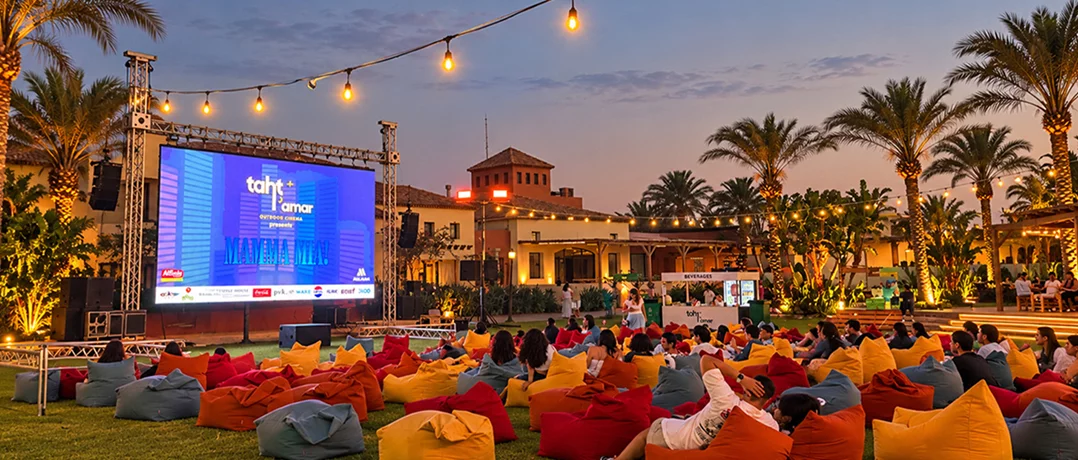
The screen glows against a darkening sky. Strings of warm bulbs hang overhead, palm trees frame the view and rows of colorful beanbags spread across the grass. Somewhere beyond the audience, the sea is catching the last rays of light from the day.
This is cinema in Lebanon right now, with the walls taken away.
Across the country, outdoor screenings are appearing in gardens, beaches, rooftops and open-air venues, each one adding its own setting to the film. Some audiences come for a classic they already love, others for the sunset, food, music, company or the chance to spend an evening somewhere different.
As autumn settles in, the question is whether this is a summer trend or the beginning of a new way of watching films.
The seat changes everything
For Raquel Sfeir of What The Fun, the setting is central to the experience. Her first outdoor cinema in a Hazmieh backyard combined a film with an evening outside, with audiences encouraged to dress up for older movies such as “Grease.”
“The whole experience, being outside with your friends,” she says. “Our location in Hazmieh backyard helps us to create this outdoor cinema where people can come and enjoy themselves.”
The same idea is being tested in very different surroundings. At Taht El Amar, co-founder Ryan Dandachli and his friends Jude Chahine and Berj Hadjinian have moved screenings between locations, including Batroun and a rooftop venue in Beit Meri, treating the venue itself as part of the event.
“For the beanbags, we arrange them in a certain way. And then after that, of course, people, when they come, whether they’re a couple together, friends together, they can arrange it,” he explains.
The result changes the rhythm of a traditional cinema visit. Someone can get up, grab a drink, take a phone call or walk around without having to cross an entire dark cinema room. Food kiosks sit away from the seating, while couches, lounge chairs, beanbags and even sunbeds create different ways to settle in.
The film is only one part of the night
The choice of movie still matters. Organizers are turning to audience polls, requests and familiar titles, with nostalgia proving especially useful.
Dandachli says Taht El Amar began with classics because they offered an immediate point of connection. Its screenings have included “Mamma Mia,” “How to Lose a Guy in 10 Days” and “Grown Ups,” with audiences also encouraged to dress according to the movie.
“People are coming not necessarily for the movie choices; it’s more about the experience,” he says. “Even if you’re not a movie fan, you can take small breaks, speak on the side, call on your phone, do whatever you want.”
At Bouble Events, Rawan El-Boubou found a similar response during a children’s screening of “Toy Story” in Saida. She expected around 20 children and welcomed 36, with parents staying nearby rather than just dropping their children off.
“I thought that ‘Toy Story’ was from our time,” she says. “When it was released, even the adults were interested.”
The social side keeps expanding around the screen: drinks, popcorn, music, themed outfits, decorations and food all become part of the night.
From beach sunsets to autumn plans
Wassim El Hajj of WH Worldwide approached the format through Pangea in Jiyeh, where screenings were paired with the sea, sunset and open space. For him, the environment can change the emotional effect of the same film.
“Imagine having this on a beach,” he says. “The same way that we had in Pangea. And imagining having this in a mountain, in the core of a mountain with a whole tree forest … Same experience, different feeling, different outcome, different emotions.”
His first screenings drew a larger audience than expected, prompting changes to the seating and setup. He had initially planned for around 30 people; the first event eventually attracted around 150 across two screenings.
El-Hajj sees room to carry the format into colder months, with different venues and a more sheltered setting. “Maybe later in winter, different location to give it a cozy vibe, to give it with entertainment, to give it with a performance,” he says.
Dandachli is thinking along similar lines. Taht El Amar is planned as a year-long project, with the team looking at venues that remain open-air in spirit while offering protection from rain and cold.
“It can become a cozy event,” he says, imagining possibilities such as Halloween screenings where the film, dress code and setting work together.
A night people remember
There are practical limits. Outdoor cinema depends on weather, equipment, licensing, seating and costs. El-Boubou had to postpone one August event because of the heat. El-Hajj points to the logistics of arranging comfortable seating, clear sightlines and pathways for staff, while Dandachli keeps scouting new locations as part of the experience.
Still, the strongest evidence comes from what audiences ask for next.
Sfeir says her Hazmieh event will not be her last. El-Hajj has already had people asking for more screenings and interactive activities. Dandachli says some customers have told him they will return regardless of the next film choice.
That may be the clearest sign that outdoor cinema is moving beyond a novelty.
The autumn air is cooler now, but the screens are still going up.
-
-
-
Rayanne TawilCultural writer
-
