The labeling of Pen League pioneers including Gibran Khalil Gibran as “Syrian poets” on a New York monument has sparked outrage and renewed debates over Lebanese cultural identity and historical memory.




The labeling of Pen League pioneers including Gibran Khalil Gibran as “Syrian poets” on a New York monument has sparked outrage and renewed debates over Lebanese cultural identity and historical memory.

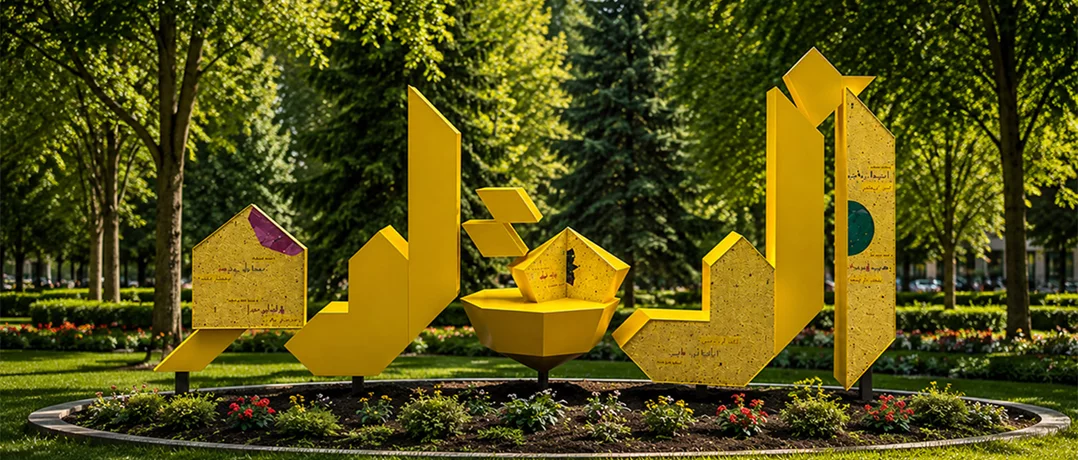
A public park in New York City has become an unlikely battleground over Lebanese cultural identity. The recent inauguration of a monument honoring the Pen League one of the most influential literary movements in modern Arabic literature has ignited fierce protests after its founders, among them Gibran Khalil Gibran, were identified in the monument's inscription as "Syrian poets."
The Washington Street Historical Association initiated the monument in New York, celebrating the legacy of the Pen League, a diaspora literary movement that fundamentally reshaped modern Arabic literature in the early twentieth century. Alongside the metal structure stood a plaque titled "The Pen: Poets in the Public Garden," engraved with quotations from Amin Rihani, Mikhail Naimy, Gibran Khalil Gibran, Elia Abu Madi, and Afifa Karam. The plaque described them all collectively as "Syrian poets."
The historical facts are not in dispute. Gibran was born in Bsharri, Lebanon. Naimy hailed from Baskinta. Rihani from Freikeh. Abu Madi from Al-Mhayedseh. Afifa Karam, a pioneering figure in Arab women's journalism in the diaspora, was equally Lebanese. Together, they founded and defined intellectual movement.
The Lebanese Historical Society an institution dedicated since 1986 to preserving Lebanese heritage issued a statement contextualizing the controversy within Lebanon's broader vulnerabilities.
"Lebanon has faced difficult challenges threatening its destiny as a free and united nation," the society said. "We deeply regret this matter and consider it a distortion of historical truth."
The society called on the Lebanese Ministry of Culture, alongside cultural, academic, and national associations, to defend Lebanon's historical figures and urged the relevant authorities to correct the inscription, listing those named as "Lebanese Poets and Intellectuals."
In search of answers, The Beiruter contacted the Gibran Khalil Gibran Committee, which maintained that concrete steps had already been taken to address the mislabeling, among them, an official letter dispatched to Lebanon's Ministry of Foreign Affairs." The committee requested that the ministry contact the Lebanese consulate in New York, which would then formally engage with the municipality and seek an official correction.
The source also confirmed that the Ministry of Culture had been notified, though the ministry indicated the matter falls primarily under the Foreign Ministry's jurisdiction.
On the diplomatic front, the source revealed that the Director General of the Ministry of Culture has already established direct communication with the Washington Street Foundation, the organization behind the project, through a former Lebanese consu, Mr. Majdi Ramadan, who previously served in New York and remains connected to the foundation's network. Through that channel, the foundation reportedly acknowledged the error and indicated it would be corrected, with further details expected within days.
In a statement to The Beiruter, Lebanon's Ministry of Foreign Affairs confirmed it is actively engaged on the matter: "The Ministry of Foreign Affairs is following up on this issue in coordination with the Ministry of Culture, and our consul in New York has been tasked with handling it."
The brief but direct statement signals that the controversy has reached the highest levels of Lebanon's diplomatic apparatus, and that the push to correct the labeling is no longer limited to cultural institutions and civil society, it has become an official state concern. With the Lebanese consul in New York now formally assigned to the case, pressure on the Washington Street Foundation to amend the plaque is set to mount through official diplomatic channels.
George, a Lebanese demonstrator who joined the small protest outside the cultural gathering in New York, said the issue went far beyond terminology. For him, it was about recognition, memory, and a history he believes is constantly being rewritten.
“We didn’t stand there because of a word on a wall,” he says. “We stood there because that word changes everything. If you erase where Gibran comes from, you erase what he stood for.”
He described the moment he first saw the plaque as “violent.” “It looked harmless at first. Just a label. But then it hits you, if even our writers can be reassigned so easily, then nothing about our history is safe.”
“We are not saying others cannot share in this legacy. We are saying: don’t take it away from where it was born. Lebanon is the origin.” He paused when asked what he hoped would change. “I don’t expect history to be fixed in a day,” he said. “But I do expect it not to be rewritten without us even being consulted.”
Gibran Khalil Gibran was born in Bsharri, carried Lebanon within him, and turned its soul into words that moved the world. Mikhail Naimy, Amin Rihani, Elia Abu Madi, and Afifa Karam also carried Lebanon across oceans and gave its culture to the world. To reduce them to a false label on a public monument is an insult. It is a theft.
Lebanon’s most enduring contribution to human civilization, has always been its people and their words. When you erase the nationality of Gibran, you are reaching into the soul of a nation and telling it that even its deepest pride, even its most luminous legacy, does not truly belong to it.
And if there is one thing our country has proven across centuries of invasion and erasure, it is that it does not disappear. Lebanon has always found a way to survive. Its memory will too.