



The ongoing war in Lebanon leads musicians and cultural centers to confront two challenges: whether to maintain silence or their vital need to keep making music.
Lebanon’s music scene in wartime

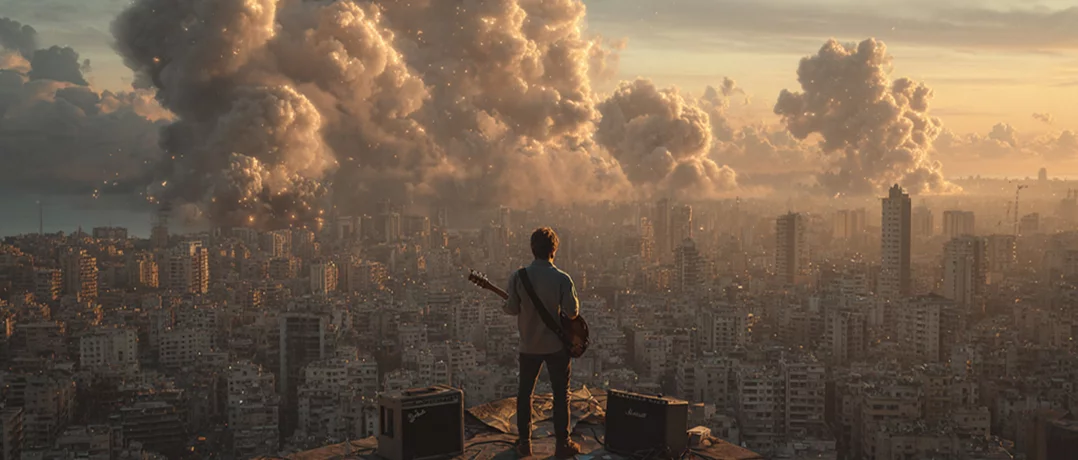
In Lebanon, music rarely exists in isolation from reality. Songs drift through cafés, rehearsal studios, and cramped performance halls, threading together everyday life. But when war intrudes, that rhythm falters. Stages go dark, rehearsals slow down, and musicians across the country find themselves negotiating an uneasy question: what role does music play when the world outside is unraveling?
For some venues, the answer is silence. For others, it is persistence in quieter forms. And for artists scattered across the diaspora, music becomes a way to process distance and worry from afar.
In moments like these, Lebanon’s music scene doesn’t disappear. It shifts.
When the stages fall silent
The war has forced cultural spaces throughout Lebanon to either suspend their operations or completely cease their activities. Venues and artists currently experience an uncertain situation which results in postponed concerts and rescheduled workshops and suspended program activities.
In Beirut’s Hamra district, Metro Al Madina, one of the capital’s most beloved performance spaces halted its programming entirely. The venue normally runs a packed calendar of concerts and theater productions, but war has forced an abrupt pause.
“This war, just like the previous ones, directly affected our programming,” says communications manager Lara Nohra. “We are obliged to close the space and postpone our shows until further notice.”
The decision leads to severe repercussions. Metro Al Madina relies almost entirely on ticket sales to operate and employs around thirty-five full-time staff members. Performance cancellations result in lost revenue for both the venue, its musicians, technicians and performers. The disruption extends its effects to all areas beyond the stage. Some musicians have been displaced from their homes while others are helping relatives relocate or searching for safer areas.
“Right now it’s about survival and safety,” Nohra says. “The entertainment field is the first to get affected.”
Between ethics and uncertainty
Further north in Tripoli, the same dilemma is unfolding. Rumman, which operates as a cultural hub and performance venue in Mina, had planned various concerts and events when the situation forced the team to change their plans.
Founder Mohamad Tanir says the decision to cancel shows was not only about safety or attendance. It was also about empathy. “It’s a national catastrophe,” he says. “People are being displaced. Houses are being destroyed. The least we can do is respect people’s pain.”
Tripoli has not experienced the same intensity of attacks as Beirut or the south, but Tanir says the emotional atmosphere across the country makes entertainment feel out of place. “There’s an element of ethics, compassion for people’s feelings,” he explains. “We are part of this country’s fabric.”
Practical realities also shape the decision. During previous escalations, Tanir recalls organizing a concert where only four people showed up. “When rockets start flying, people don’t come,” he says. “You don’t know when they will hit or where.”
For small venues, those empty rooms translate into financial strain. The main source of income for both organizers and artists comes from ticket sales, which creates difficulties for events that need to be canceled because organizers must choose between operational practices and customer support obligations.
Creating through crisis
Other spaces are trying to maintain some level of activity, even if quietly. In Achrafieh, Onomatopoeia – The Music Hub has slowed its events but continues operating whenever circumstances allow. “Flexibility has become part of our daily reality,” says co-founder Alain Osta. “Artists, students, and audiences are all navigating uncertainty.”
The hub serves as a performance space and an educational center, which opened its doors in 2013. The facility has rehearsal spaces recording studios and a music school together with a café which serves as a gathering space for artists to work together. The current emergency situation does not stop musicians from coming to practice and record whenever they have the opportunity.
Audiences feel the shift as well. Small gatherings carry a different emotional weight. “People listen with more attention and emotion,” he explains. “Music provides a moment of reflection and shared feeling.”
A song from afar
While venues inside Lebanon grapple with silence and uncertainty, artists abroad are processing the war from a distance. London-based Lebanese singer Vincent J experienced that tension firsthand. Having just returned to the United Kingdom after spending the summer in Lebanon, he was struck by rising tensions. “I remember having a show in London,” he recalls. “Right before I went on stage, my mom texted me. She was very scared about everything.”
In 2024, Vincent began writing “Why,” a song shaped by the anxiety of watching events unfold from afar. “I wanted to write from my perspective,” he says. “Being abroad, constantly worried about my family, my friends, my favorite places.” The track includes broken news segments which show news recordings together with audio from a journalist friend who reported from Beirut and the south. The 2024 war reached its highest point when he arranged a fundraising show in London and took part in an online event which supported War Child UK to raise funds for children in conflict areas throughout Lebanon and Gaza.
Still, he believes music serves different emotional purposes. “Some songs are an escape,” he says. “Others help you stay with the feeling.”
Across Lebanon’s music scene, the current moment feels suspended. Concert posters remain online for shows that may never happen. Venues wait for the day they can reopen. Musicians write, rehearse, postpone, adapt.
For now, the country’s soundtrack has grown quieter. But the music itself has not disappeared — it has simply changed shape, carried through rehearsal rooms, distant stages and songs written in the middle of uncertainty.
As Vincent J puts it: “Some songs are an escape. Others help you stay with the feeling.”
-
-

-
Rayanne TawilCultural writer
-
