



Cosmetic procedures have become increasingly normalized among young Lebanese women, raising questions about beauty standards, social pressure, and where self-care ends and insecurity begins.
Lebanon’s normalization of cosmetic surgery at a young age
Lebanon’s normalization of cosmetic surgery at a young age
By Jenna Geagea | August 20, 2026

Reading time 4 min
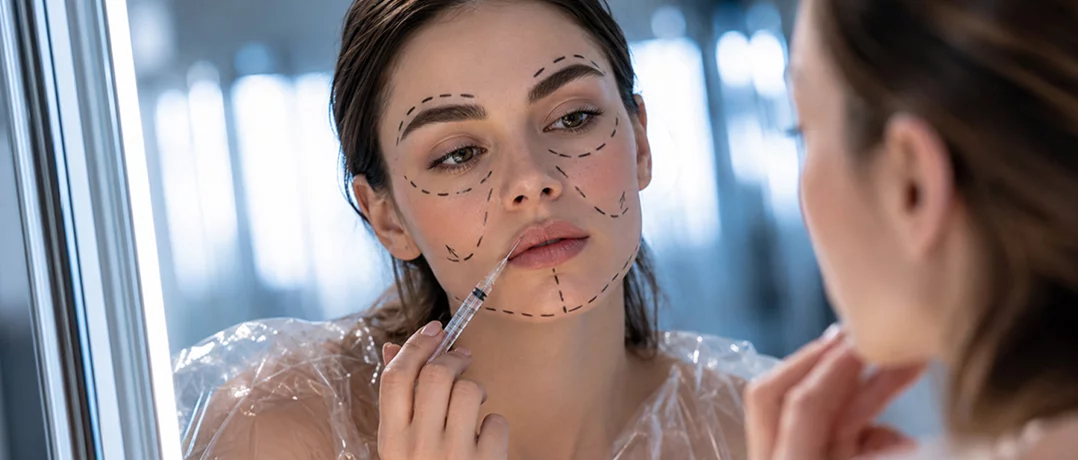
There was a time when altering one's face required a genuine defect and a difficult decision. Today, for many young Lebanese women, it requires little more than a free afternoon and the sense that everyone else has already done it. Fillers are discussed with the casualness once reserved for haircuts; Botox appointments are traded like restaurant recommendations. Somewhere in that shift, the line between personal choice and social pressure has grown difficult to locate. To understand both sides of that blur, The Beiruter spoke with a leading plastic surgeon and two young women standing on opposite ends of the same cultural moment.
Professor Simon Semaan: "It's a very poorly regulated environment"
For Professor Simon Semaan, Consultant Plastic Surgeon, the core problem who is performing the cosmetic procedures. "There is far too much reliance on non-specialists on social media," he said. "Anyone can make claims because there is very little regulation." The scale of that problem is severe, "I have information from the Lebanese Ministry of Public Health indicating that 90% of those working in the cosmetic field in Lebanon are not specialists." Some, he added, aren't doctors at all, yet still perform Botox and filler injections.
He distinguished legitimate need from trend-chasing, citing a 16-year-old patient with a genuine nasal deformity: "If there is a genuine defect, it should be corrected." But absent a real defect, he draws a firm line. "If a patient's request is unreasonable... we have to say no."
He also rejected the idea that natural beauty has fallen out of fashion. "The concept of beauty is a classical concept... based on symmetry, harmony, and proportion," distinct from fashion, which "changes over time." His approach hinges on permanence, temporary treatments can accommodate a passing trend, but for anything surgical and lasting, he counsels restraint. "If you're performing a procedure that will last a lifetime, you shouldn't simply follow a temporary trend."
Lara, 25: "Your eye gets trained"
Lara's first filler appointment came at 21, prompted less by dissatisfaction than by comparison. "My friend had done her lips, another friend had done her cheeks, and I felt like I was the only person who hadn't." Since then, filler, Botox, and jaw contouring have become routine. "We don't say, 'I'm changing my face.' We say, 'I'm maintaining it.'"
What unsettles her most, in retrospect, is how thoroughly her sense of normal has shifted. "I can look at a girl and immediately notice that she hasn't done anything... Your eye gets trained." She traces her original insecurity to a moment on Instagram at 17, describing a widening gap between her online and unedited face, "once you learn how to edit a picture, you start seeing your real face as the unedited version of something." Even results she initially loved eventually stopped feeling like enough, "three months later, I looked at old pictures and thought my old face looked flat again. Nothing had actually changed. My perception had." Asked whether she fears aging, she didn't dodge it. "I'm already afraid of looking 30. And I know how ridiculous that sounds." Pressed on whether she'd want a daughter to start fillers at 21, her answer was immediate, "Definitely not... But then I'd have to explain why I needed them. And I don't know if I'd know what to say."
Maya, 24: "I don't want to spend my life looking for problems"
Maya has made the opposite choice, though not out of immunity to insecurity. "There are days when I look at a picture and think my nose looks huge," she admitted. "Then I open Instagram and there are 400 women telling me what I should fix. That's when I put my phone down." The pressure among her friends rarely feels aggressive, which makes it harder to resist. "Nobody says, 'You're ugly, go get fillers.' It's much subtler... Eventually, you start wondering whether you're the weird one for not doing it."
Her resistance is rooted partly in her mother's unaltered, expressive face. "You could see her life on it," she said. "Now we're taught to erase the evidence that we've lived." What worries her isn't vanity but homogenization. "Everyone used to have a different face... Now you can walk into a clinic and ask for a face using three adjectives, lifted, sculpted, symmetrical."
She's equally clear-eyed about social media's role. "Social media industrialized insecurity... The algorithm doesn't show you ordinary faces. It shows you faces that perform well." Her advice to younger women is patience, "wait, because she deserves to find out what she actually dislikes about herself before someone else tells her what needs fixing. Because once somebody gives you the solution, you start looking for the problem."
The brutal truth
Between Semaan's warnings about unregulated practitioners, Lara's confession that her perception keeps moving the goalpost, and Maya's determination to leave herself unedited, a single pattern emerges, the pressure arrives as maintenance, as a friend's casual suggestion, as an algorithm deciding what counts as beautiful. Whether a young woman in Lebanon ends up in the clinic chair or walks past it, both interviews suggest the same negotiation is happening underneath, between the face she was born with and the one she's told she could have instead.
-
-
-
Jenna GeageaReporter/Writer
-
