



As war displaces over a million, shelters and rescuers scramble to care for a surge of abandoned animals.
Lebanon’s pets left behind

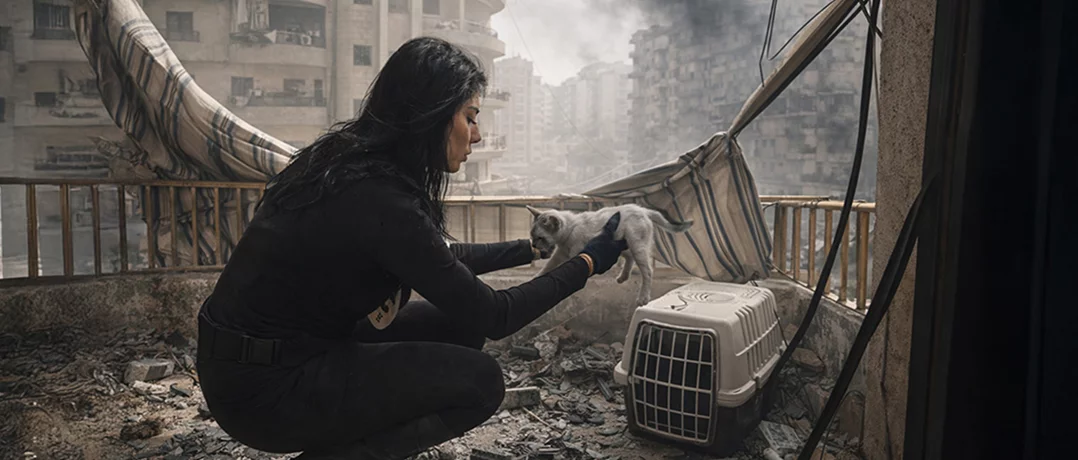
The messages come in rapid succession. A pinned location. A blurry photo. A voice note sent in panic: there’s a dog still tied on the balcony … there are cats trapped inside … we had to leave.
The conflict areas of Lebanon experience a high level of pet separation from their owners, which rescuers describe as unprecedented. These organizations’ operations depend on a fragile network consisting of shelters, volunteers and independent rescuers who work in the field to help thousands of animals survive.
Houssein Hamze, owner of Mashala Shelter, moves through deserted southern villages to search for abandoned animals that he hopes to rescue. After returning from abroad to Lebanon, he opened the shelter, which is now the home to more than 200 animals: dogs, goats, donkeys, birds, even camels — many of them left behind when their owners fled.
“Before the war, we had around 150,” he says. “Now they just keep coming. Some we can’t even reach. They’re running from the shelling, hiding near the borders. We know they’re there, but we can’t always catch them.”
The challenge is not only the growing numbers. It’s the conditions. Reaching animals often means moving under bombardment, with limited time and information. “People send me locations,” he explains.
I go straight there. There’s no time to search. Planes are overhead.
The fear doesn’t pass when the sound fades. Some of the dogs, he says, shake uncontrollably during airstrikes. Others lose control entirely. “They urinate from fear,” he says. “The moment they hear the sound.”
What stays with him are the ones he cannot reach. The dogs still tied up. The animals locked inside buildings. “This is the hardest part,” he says. “You know they’re there, but you can’t get to them.”
Further along the border, rescuer Kassem Haydar has shifted his focus entirely. Shelters, for now, are no longer the priority. Survival is.
“Food is the most important thing,” he says. “If they don’t eat, they turn on each other. We’re trying to stop starvation on the ground.”
He travels back and forth between Beirut and southern villages on the front line, sometimes covering hundreds of kilometers just to distribute food. There are no teams, no large operations, mostly just him, his car and whatever supplies he can gather.
“I don’t see them all,” he admits. “But I know they’ll come when they smell the food.”
The scale of abandonment has changed the way rescuers work. Haydar, who used to run a shelter for special-needs dogs, now avoids keeping healthy animals confined. “Dogs should live among people,” he says. “The shelter is for the ones who can’t survive alone.”
With that, the emotional toll is still unavoidable.
They’re like us. Same fear, same hunger. You see them lost, waiting and you understand.
Shelters under strain
In Beirut, the pressure is showing up differently. At Animals Lebanon, the calls don’t stop. Maggie Shaarawi, the organization’s vice president, says they receive around 100 requests a day from people trapped in conflict zones, from displaced families, from strangers trying to help animals they’ve found.
“The biggest challenge is the influx of cases versus our capacity,” she explains. “We simply can’t take them all in. We need foster homes. We need donations. … Even sponsoring food or medical bills makes a difference.”
They’ve learned from past wars. Instead of absorbing every animal into the shelter, a strategy that once led to overcrowding and disease outbreaks, they’re now working to keep animals with their displaced owners whenever possible.
“We’re giving people cages, food, supplies,” she says.
If they’re in a hotel, a tent, even on the street, they can keep their pets with them. It’s better for everyone.
Inside the shelter, numbers are tightly controlled. “We had around 120 animals already. We’ve only taken about 40 more. Only extreme cases.”
Outside, the needs are far greater. Stray animals, suddenly cut off from the informal networks that once fed them, are starving. Volunteers now leave food in abandoned streets during rescue missions, small, scattered lifelines.
At the same time, donations are down. “People are tired,” Shaarawi says. “The whole region is in crisis. It’s affecting how much support we receive.”
A network of care
Emerging alongside the stretch is a low, grassroots effort to bridge the gap. The presence of youth volunteers arrives at the shelters. People who do not know each other provide temporary homes for pets for three weeks. Some individuals provide food and financial support for medical expenses, while others use social media to spread their message until they find their target audience.
Hamze uses this network as his main resource. “If it wasn’t for people helping, I wouldn’t exist,” he says. “They send food, they support the shelter. There is love.”
Veterinarians assist by reducing fees and medical costs. Every individual who contributes to the system creates a valuable impact.
The system still exists in its current unbalanced state. Too many animals. Not enough space. Not enough hands.
“We need foster homes,” Shaarawi says.
We need people to step in, even temporarily. It makes a huge difference.
Because the crisis isn’t only about animals. It’s about the people attached to them — the families who delay evacuation, the ones who call daily asking if their pet is safe, the ones who have nothing left but still try to find a way to keep their animals close.
“Helping these animals is also helping people,” she adds. “They’re part of the same story.” Keeping them alive depends on whoever is still willing to help.
As evening falls back in the south, Hamze returns home. The animals hear him before they see him. A camel shifts by the gate. Dogs gather, restless, waiting.
“They recognize my voice,” he says. He steps inside, surrounded. That’s how he knows they’re still there.
-
-

-
Rayanne TawilCultural writer
-
