



Maamoul has a deep history across the Levant and has evolved into a shared Easter tradition, involving gifting, hospitality and community, and containing symbolic meanings behind its shapes and fillings.
Maamoul, the taste of Easter in the Levant

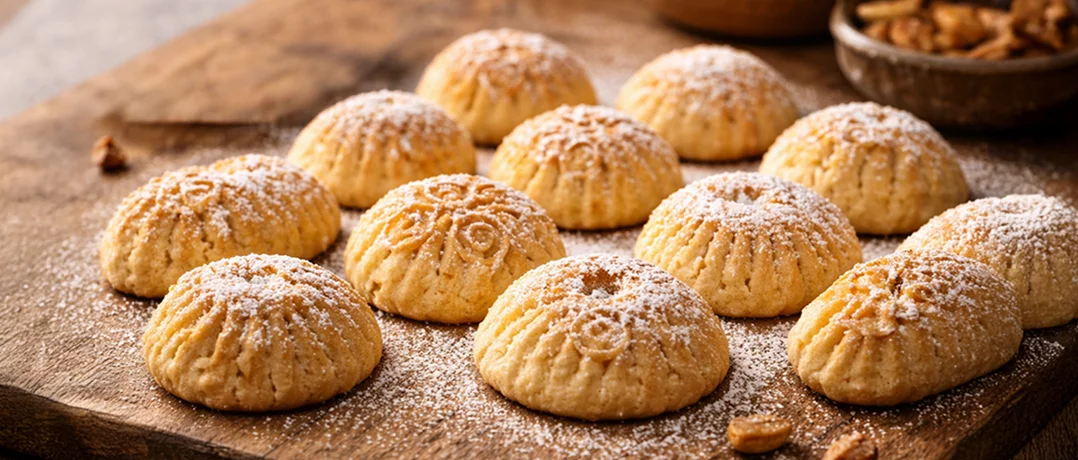
Every spring, as Easter approaches, Maamoul returns to center stage across Lebanon.
Bakeries stack trays high with the semolina pastry; households begin placing orders or preparing their own and boxes start circulating between families, neighbors and friends. Maamoul exists during specific seasons through religious customs which define the holiday the same way church bells indicate Sunday services.
At its simplest, Maamoul is a filled cookie — dates, walnuts, or pistachios encased in a delicate, crumbly shell. But its significance runs far deeper than its ingredients. Behind each piece lies a long, layered history shaped by movement across the Levant, evolving religious traditions and a culture of sharing that has outlived generations.
“The Levant is more a crossroads than a point of origin,” explains food researcher Manal Mourad. She points to a much older lineage, tracing Maamoul back to Egyptian kahk, itself rooted in ancient traditions. As these recipes moved across regions, they transformed, absorbing local ingredients and customs while keeping their core identity intact. “Maamoul and its purpose remained,” she says, “but the religion changed.”
That fluidity is part of what makes Maamoul so enduring. Medieval food expert historian Charles Perry connects it to earlier Persian traditions. "I assume the pastry itself is descended from the ancient Persian khushknanag,” he says, describing it as “a rich, delicate sort of pastry.” He adds that the name “ma’mul” may have emerged later, referring to the “worked” version of that earlier form.
A ritual that outlived its origins
Long before it was tied to Easter or Eid, Maamoul or its earlier forms, was already associated with ritual. Mourad notes that these kinds of pastries were often prepared for ceremonial occasions, distributed as offerings and shared among communities.
When Christianity and Islam spread across the region, those existing food traditions didn’t disappear; they adapted.
The connection to religious celebration predates both Islam and Christianity. The customs remained, and they absorbed existing food traditions.
Today, that legacy plays out most visibly during Easter. In many Christian households, Maamoul is inseparable from the holiday. Fouad Doueihy, whose family has been making sweets since 1919, says,
Maamoul is the blessing of Easter. If someone doesn’t eat it, they feel like they didn’t take the blessing.
The idea of blessing runs through the practice, not only in eating the pastry, but in sharing it. Boxes are prepared, sent to relatives, neighbors, churches. It’s a gesture that sits somewhere between hospitality and obligation, a way of saying you are remembered.
Kitchens that turn into workshops
Before it’s gifted, Maamoul is made and that process is rarely solitary. “Maamoul making is a very communal practice,” Mourad says.
Women gather across families and neighborhoods to prepare it.
In a region where many traditions have become individualized or outsourced, this one has held on.
Lebanese-Palestinian author Hisham Assaad recalls how these gatherings were. “They would go from home to home during the week before Eid,” he says. “You spend time together, you work together.”
Even as families grow and scatter, that instinct to gather persists. Siblings return, mothers would give advice, as neighbors would teach them new ways of pressing and designing the Maamoul.
Assaad points out that fewer people are making it.
It might be disappearing from the home tradition; less people know how to make it. We don’t have time sometimes, so it’s easier not to make anything at home.
Still, the ritual is not gone. “I think we can credit sweet shops for keeping it alive,” Mourad adds. “I don’t know if we would still be making it if it wasn’t for them.”
The language of shape
Part of what defines Maamoul is its form. Each piece carries a distinct shape: oval, round, ridged and often pressed into wooden molds that imprint intricate patterns on the surface.
At the most practical level, these shapes function as a code. “They’re used to distinguish between the fillings,” Doueihy explains. Each nut displays a different visual characteristic which allows people to identify all three. The fillings themselves underwent historical development through different time periods. Early versions focused on dates and walnuts, with pistachios introduced later as a more expensive addition. The shapes followed suit, adapting to both ingredient and presentation.
Although among Christians, those forms carry additional meaning. Mourad points to oral traditions that link certain shapes to Easter symbolism. A ring-shaped maamoul, for instance, is sometimes interpreted as representing the crown of thorns.
These interpretations are not universally documented, and even within the industry, they’re debated. Doueihy himself dismisses some of these associations as later additions.
Between tradition and reinvention
If Maamoul has survived this long, it’s partly because it hasn’t remained static.
Across Lebanon, a new generation is experimenting with the form. At Levant Café in Beirut, owner Joseph Sayegh serves Maamoul by the piece, a departure from the traditional kilogram boxes alongside coffee and matcha. His menu includes variations like honey-filled and rose-infused Maamoul, as well as seasonal experiments.
“The idea was to make these sweets available all the time,” he says, “and to mix being rooted with being open to something modern.”
While customers are curious about new flavors, many still gravitate toward the classics during holidays. Tradition, it seems, has its own timing.
Even so, innovation doesn’t necessarily weaken the ritual. Mourad sees it as part of a broader revival, particularly among younger generations and the diaspora. In moments of instability, she notes, people often return to what feels familiar, even if they reinterpret it along the way.
“I think people are trying to preserve as much as they can right now,” she says. Maamoul continues to do what it has always done: adapt, travel, and gather people around it.
-
-

-
Rayanne TawilCultural writer
-
