

Lebanese pianist Marc Hanania’s unconventional journey from conservatory training to viral success is a story of risk, resilience, and choosing emotional truth over technical perfection.
Marc Hanania found his voice at the piano

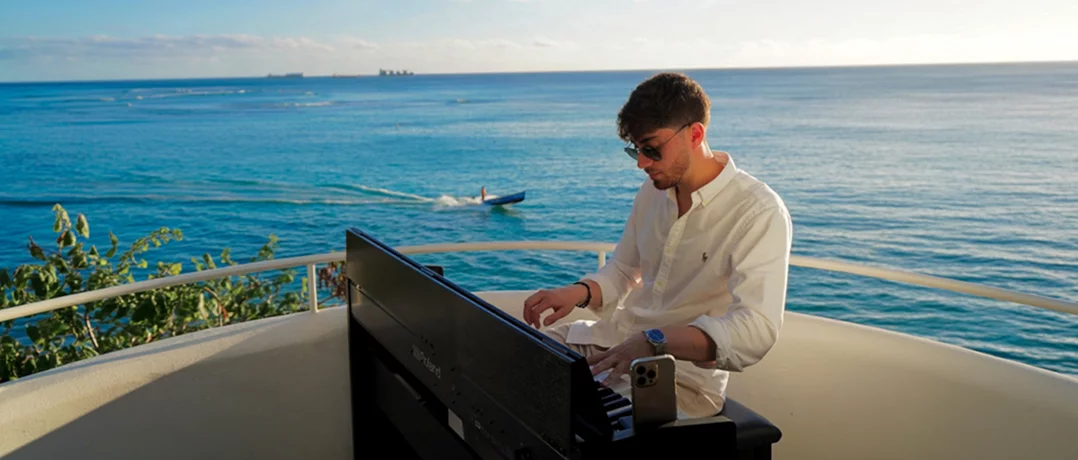
Every so often, a piece of classical music breaks out of its niche and finds an audience that never set foot in a conservatory. In the past few years, that piece has been "Starfall," a piano composition by Montreal-based pianist Marc Hanania that has been streamed millions of times and performed live at Place des Arts as part of Montreal's International Jazz Festival. Behind the viral clip, though, is a unique story, one involving a gamble on a new country that nearly didn't pay off. Hanania's rise, in his own telling, has never really been about talent alone. It's been about a refusal to let technique substitute for truth.
Redirecting a profound passion
Hanania's relationship with the piano began without his input. At seven years old, his mother placed him in front of an instrument with no warning and no discussion. "She just put me in front of it and said, 'you're starting.' And something clicked immediately," he recalled. "I didn't know it then, but that moment changed everything."
What followed was seven to eight years of rigorous classical training at Lebanon's National Musical Conservatory, structured, disciplined, and demanding. His teacher, he told The Beiruter, saw real promise in him. "She told me I was talented and didn't want me to leave," Hanania said. But the very rigor that built his technical foundation began to erode his relationship with the instrument itself. "The exams, the pressure, the strict system it was slowly killing my love for the instrument. So I left." Rather than abandoning music, he redirected it entirely. "I found my real education alone, at the piano, improvising for hours with no one watching."
That decision looked, to outside observers, like the end of a promising career rather than its true beginning. "When I dropped out of classical training, people thought I was finished," he said. "But I was just beginning." The years of unstructured, private improvisation that followed became the real foundation of his sound. "My identity isn't a style I chose. It's what was left when I removed everything that didn't feel like me."
Hanania's move to Canada put that self-taught foundation to an immediate, unforgiving test. He arrived with $2,000 and made a purchase that said everything about his priorities. "I bought a piano before I bought furniture," he said. The gamble didn't pay off quickly. "My views dropped to 200 per post for months. There were nights I genuinely didn't know if I should keep going."
The turning point arrived during the recording of what would become "Starfall." "I remember recording my song Starfall, desperate, and I cried and prayed, if this is meant to be, show me a sign," he said. The resulting video eventually reached an audience of roughly 50 million. But what Hanania points to as the real moment of validation was a single comment left by a stranger on SoundCloud, "The Lord hears your work. Phenomenal job. Keep going." As he put it, plainly, "That was my turning point."
What he carries into every performance
What defines Hanania’s sound, he expressed, is Lebanon, and what the country taught him about coexistence. "Lebanon gave me fire," he said. "Growing up there taught me that beauty and struggle coexist, sometimes in the same moment. That's exactly what my music sounds like." Despite building his career an ocean away, largely through a TikTok and YouTube presence under the handle @piano_hub, he insisted that origin never left his playing. "I carry Lebanon in every note I play, even if nobody knows it. Being Lebanese means I don't take anything for granted, not the music, not the audience, not the moment."
That sense of gratitude coexists with a personality that looks nothing like the brooding-artist stereotype. "I'm extroverted, I talk too much, I'm very into sports and traveling, I make people laugh," he explained. Music, in his account, operates on a separate register entirely, one that has reshaped how he relates to other people. "Music made me more empathetic. I hear people differently now." Every performance carries the full weight of his lived experience, whether or not an audience can name it. "The loneliness of moving to a new country. The joy of seeing my parents cry listening to me play. The fear of not being enough. I don't leave any of that at the door when I sit down at the piano."
That philosophy extends directly into how he defines success at the keys. "They think it's about technique. It's not," he said, describing a common misconception about his playing. "Technique is the vehicle, but emotion is the destination. The most technically perfect pianist in the room is often the least interesting one to listen to." What actually reaches an audience, in his view, has little to do with precision. "What people respond to is truth. When you play something you actually feel, people feel it too." Even with a viral hit and millions of streams behind him, he frames his own craft as unfinished. "I'm still learning how to get completely out of my own way and let the music be honest. That's what I'm still chasing."
Marc Hanania's career, so far, is a powerful argument against the idea that mastery and honesty are interchangeable. He had the technical grounding early, handed to him by a conservatory that believed in his talent. What he's spent the years since building is something else entirely, a case that the far harder skill isn't playing correctly, but playing honestly.
-
-

-
The Beiruter
-
