

At an older age, Amo Adel is cooking dishes that many young Lebanese only remember from their grandparents’ tables. Inside his modest apartment in Basta, he serves food and stories from a life spent crossing continents, always returning to the kitchen.
Meet Amo Adel

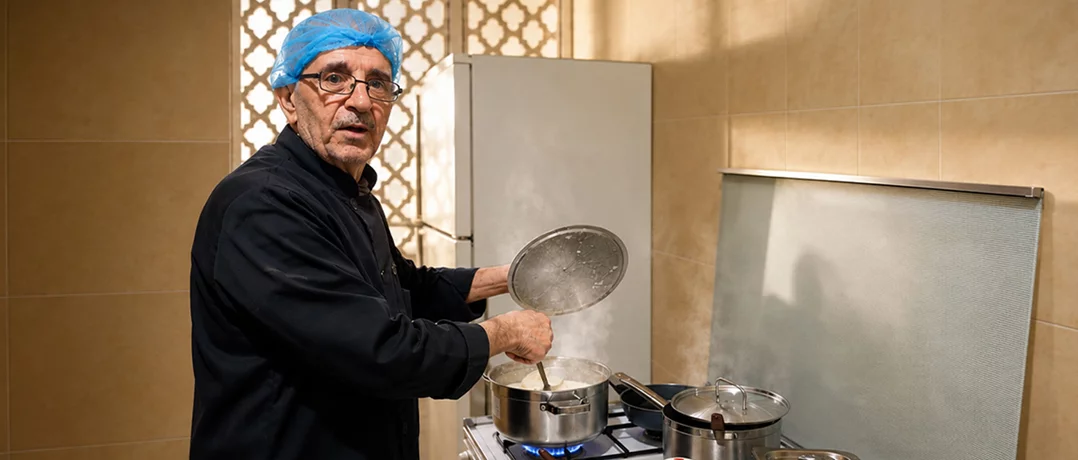
Prayer time was approaching.
He stood in the middle of his kitchen, wearing a dark chef’s coat and a blue hairnet, glancing at the clock with the gentle urgency of someone who has followed the same rhythm for decades.
“It's almost time,” he said. “I need to pray.”
When he finished, he settled onto the old sofas of his apartment in Basta. Outside, Beirut was being Beirut. Vegetable sellers called out from the street below. Cars pushed through narrow roads, horns blaring constantly. Voices bounced between balconies.
Inside, the apartment carried an entirely different pace. Warm tea, family photographs and the smell of simmering food. Amo Adel spoke with the ease of a grandfather settling in to regale anyone who would listen with a long story.
From the Bekaa to half the world
At 81 years old, Amo Adel has spent more than six decades in kitchens.
His story began in the Bekaa Valley. “When my mother used to get cabbage to make a salad, I used to do the same,” he recalled, laughing. “I always wanted to help in the kitchen.”
He did not formally study cooking, he just followed what he loved. When he turned 17, he left for Beirut to continue his passion. “I started with everything I loved,” he said. “And it became natural.”
One kitchen led to another. Restaurants became hotels. Beirut became Dubai. Dubai became Saudi Arabia. Germany followed. Latin America passed through the journey as well.
For nearly twenty years he worked in Saudi Arabia, building a career around Lebanese food long before the cuisine became fashionable abroad.
The memories arrive in fragments. One minute he is describing a restaurant from the 1970s , the next he is talking about a market visit that happened that morning. The years seem to sit right side by side, like nothing in between.
The apartment restaurant
The idea of cooking from home arrived recently.
After years of working in restaurants and hotels, retirement never truly appealed to him. “The year is legal,” he joked about his age.
I still want to work.
The decision was practical as much as anything else. “I don't have money to open a restaurant,” he explained. So, he turned part of his apartment into a small operation for preparing homemade meals for customers who send orders online. “Your house becomes upside down,” he laughed. “The house is a different world.”
Restaurants have teams. Home kitchens have husbands and wives.
And that is where Amo Adel’s wife enters the story.
The real boss of the kitchen
Watching them together feels strangely familiar. The teasing, the complaints, the affection hiding inside every argument.
When asked whether his wife helps him, he answered immediately. “Of course she helps me with everything.”
The response came from across the room. “He puts ten spoons in the sink,” she protested. “Then I have to wash them!”
Everyone burst out laughing. “He has two spoons,” she continued. “Maximum three. Then suddenly I'm washing everything.”
Amo Adel smiled through the accusations like someone who had heard them a thousand times before. Together they prepare meals and manage orders. She rolls the Waraq Enab (Grape leaf) while he handles most of the cooking.
His 22-year-old neighbor pitched in as well, helping Amo Adel with social media. “It's one family,” he said. “It's a community.”
In many ways, that sentence explains the entire project; nothing about it feels corporate or calculated. It feels like a neighborhood helping one another survive.
A taste of grandparents’ Lebanon
Amo Adel wakes up at four every morning. First comes prayer, then the markets.
By 5 a.m., he is heading to Barbour for vegetables. After that comes the butcher. Then the dairy supplier. Every ingredient has its own destination.
“Each thing has its place,” he explained. The routine sounds exhausting, but he speaks about it with enthusiasm.
His most requested dish is Kibbeh Bi-Laban.
During the visit, he insisted that everyone eat. Soon plates began appearing on the table: Kibbeh Bi-Laban, Mloukhiyeh, Waraq enab.
Refusing was never an option, just like with any Lebanese grandparent.
The food tasted like family gatherings, like long drives to visit relatives, like the meals waiting on dining tables before smartphones and food delivery apps arrived.
At one point, he looked up and asked proudly, “Did you eat the kibbeh?” When told it was incredible, he grinned.
Many of his customers are young people living away from their families. “People are happy to eat,” he said. “Sometimes you don't find this food unless you're with family.”
Still moving forward
For someone who has lived through so many chapters, Amo Adel remains remarkably forward-looking.
When asked where he finds the energy, his answer was instant. “From the Quran,” he said. Then he added another thought.
It's not a shame to work.
There was this 81-year-old man, waking before dawn, walking through Beirut with vegetables, then cooking for strangers and building a fresh business out of his apartment.
There is this slightly unsettling feeling about it that doesn’t sit right.
When people discover Amo Adel's age, they usually react with surprise. He laughs about it himself. Yet, underneath the jokes, this reality feels familiar to many older Lebanese people, they spent decades at work and still can’t really afford to stop.
“What can I do?” he said with a shrug. “Beirut needs money.”
For most of his life, Amo Adel spent years feeding other people, building businesses that were never his own. Now, at an age when a lot of people imagine slower mornings and grandchildren somehow filling the day, he’s there working it out vegetable prices before sunrise, lugging the ingredients home through the streets of Basta.
Lebanon has become a place where getting older feels more like continuing a race far beyond the finish line than like arriving somewhere. The person just keeps going, even if the endpoint was supposed to show up already. Pensions disappear into inflation. Savings lose their value. Experience, despite all its worth, rarely pays the bills.
Yet Amo Adel refuses to sit still. He speaks about hardship as though it were another ingredient to work with, another challenge that requires patience and persistence. No grand speeches. No complaints
Just the quiet determination of a man who has spent a lifetime finding ways forward.
-
-

-
Rayanne TawilCultural writer
-
