



At KED, Egna Legna’s Christmas initiative turned the venue into a warm, feminist gathering led by migrant women speaking for themselves.
Migrant women take center stage

It started on a rare Sunday morning when Beirut’s streets were mostly empty, the kind of quiet that feels eerie. We arrived at KED, a space more commonly associated with stand-up comedy punchlines and late-night parties, but this time the mood had shifted. Egna Legna Besidet held its annual Christmas event on Sunday, December 15, and the place was alive even prior to noon.
Founded in 2017, Egna Legna is a feminist, women-led NGO created to give migrant women in Lebanon the power to speak for themselves and defend their rights. The organization supports vulnerable migrant women and their families by covering legal fees, emergency aid, food, shelter, and access to skills training. This year’s Christmas initiative focused on something painfully basic and urgently needed: collecting donations to provide essential winter clothing, books, and toys for 200 displaced children under the age of 10, most of them migrants and African refugees who receive little to no support elsewhere.
Volunteers clad in black T-shirts bearing the organization's logo were hard at work at 9:30 am, bringing in supplies and serving drinks. The dancers on the rooftop were soaked with sweat while practicing for the performance. Children were playing hide and seek, running around the building. It was not chaos, but only a beautiful noise, the noise of people who were so at home that they could fill the entire area.
‘We wanted to speak for ourselves’
Inside, on the ground floor, a small market unfolded. Handmade accessories, tote bags, candles by migrant women who had gone through Egna Legna’s skills workshops. There was an important distinction: Egna Legna itself had a table, but nothing on it was for sale. Only the women who learned the skills sold their work. The NGO doesn’t sell on their behalf. The point is autonomy, not branding.
Around the room, languages blended easily. Ethiopian, Sudanese, Sri Lankan, Filipino, and Cameroonian voices moved between laughter and music. This wasn’t representation for the sake of it, it was presence.
At the center of it all was Banchi Yimer, founder and director of Egna Legna. Calm and grounded, she moved through the space like someone who had lived through everything the room held, because she had. Yimer spent seven years working as a migrant domestic worker in Lebanon before founding the organization.
Her motivation, she explained, came from noticing who was missing from the conversation. Most migrant domestic workers in Lebanon are Ethiopian women, yet leadership spaces were often dominated by men who were not domestic workers themselves. “So this makes me like … I want us to speak for ourselves,” she said. “I want the women to be empowered.”
Migrant women don’t need to be spoken for, she stressed; they need to be listened to. Allies matter, but leadership must come from lived experience. “We are feminists, and we do face abuse inside the house. So we should be able to speak for ourselves. Not foreigners, not people with no experience,” she added. Combined with cultural barriers, especially around women’s health, the gaps became impossible to ignore.
“I saw the gap underneath,” she said. “At least I want to focus on human rights and women’s issues.”
A panel rooted in reality
By noon, the panel began, watched both in person and live on Facebook and TikTok. The discussion brought together women from grassroots organizations supporting migrant workers.
Representatives from Together Forever, a Cameroonian women-led organization founded in 2017, and Tres Marias, created by Filipino community leaders in Lebanon and recently awarded the Tulip Award for Human Rights Defender Organization, took part in the audience. For the panel, a migrant woman from Kenya, Sylvia Obwoge, who lived through the war also shared her story, grounding the conversation in lived reality.
The stories were heavy. Aloel Manyok, from the Sudanese community, spoke about women being left on the streets during the war, trapped in abandoned buildings, unreachable because of power cuts and movement restrictions. One story brought the room to a stunned silence, a woman in labor calling the NGO while bombs were falling, asking to be rescued.
Yet there was a shared refusal to sensationalize trauma. As one speaker put it, they didn’t want to relive the pain. They were grateful to be alive, while still acknowledging loss and grief.
A space to breathe
For Yimer, the event was about more than closing a skills program. “Everyone is depressed and traumatized from the war, the kids especially,” she said. This year, around 95 percent of attendees were migrants and refugees. The goal was simple: to give people space to relax and exist without explanation.
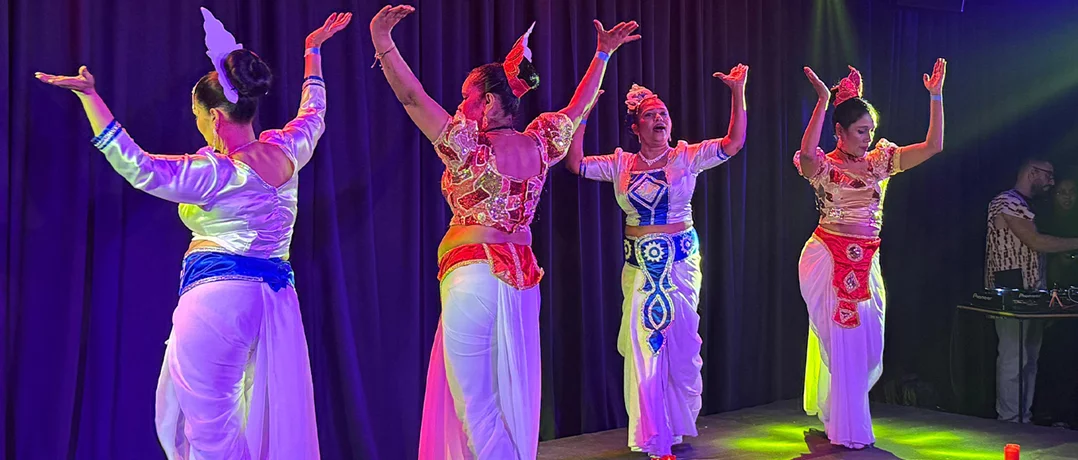
The event doubled as a cultural exhibition. Sri Lankan women danced in bright traditional costumes. Before the Ghanaian performers took the stage, and presented their country. The Sudanese dancers exhibiting in white and light blue made an energetic dance to the end of the floor. The Filipino performers used yellow cheer props while the Ethiopian women dressed in white gowns with traditional embroidery patterns concluded the performances.
At the end of the afternoon, certificates were given out and the buffet was opened. The aroma of Sri Lankan, Sudanese and Ethiopian foods wafted through the air. Kids ran between tables. Lebanese attendees joined, bought handmade goods, and stayed to talk.
Before leaving, Yimer spoke quietly about the Christmas initiative. Winter clothes for 200 children were still being prepared. “The basics now are very necessary,” she said.
She ended on hope, wishing a peaceful year ahead for migrants and Lebanese alike. For a few hours on a quiet Beirut Sunday, that future felt possible.
-
-
-
Rayanne TawilCultural writer
-
