



A tradition going on nearly 100 years, the streets of Mina- Tripoli have filled with paint, feathers, noise and laughter on the eve of Orthodox Lent.
Mina marks the start of Lent with Zambo carnival
Mina marks the start of Lent with Zambo carnival
By Rayanne Tawil | February 24, 2026

Reading time: 3 min
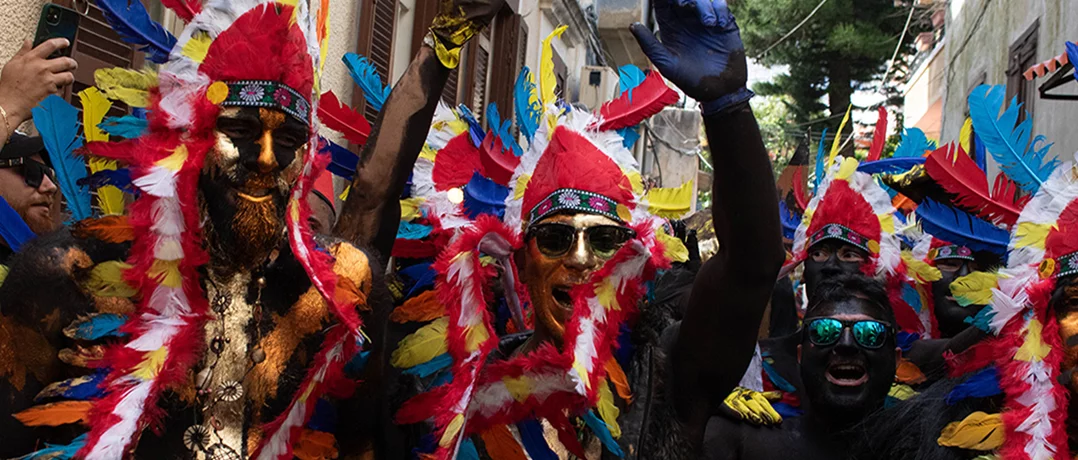
By the time you hear it, it’s already too late to step aside.
A drum hits somewhere behind you, off-beat and insistent. A whistle slices through the morning air. Then Mino Street, once Souk al-Kharab, fills in a single surge. Balconies lean forward. The noise arrives before the bodies do: Dance moves refusing rhythm, zamour slicing through, chants that don’t need meaning to carry.
Color follows. Bodies painted black, smeared with browns and reds. Feathers explode from headpieces. Plastic spears, bones, beads, masks, a gorilla suit shoving through the crowd. Someone spins in circles. Someone howls. Children freeze, then laugh. Adults lift their phones, then think better of it.
This is Zambo, a carnival that exists only here, only once a year, and only because people keep showing up.
For almost a century, the city has marked the day before Orthodox Lent this way. Not because the church demands it, and yet people show up. They dress up, paint themselves, reclaim the old streets together, and finish the only way that makes sense: by jumping into the sea, letting the colors wash off, and beginning again.
It looks chaotic. It is. But it is also precise.
A city that absorbed the world
To understand Zambo, you have to understand Mina. “Zambo comes from Mina’s diversity,” says Historian and retired Lebanese University professor Jean Touma, tracing the ritual back to the city’s beginnings. This was always a port that absorbed arrivals: Greeks, Italians, Cretans, Armenians, people from Antioch, Mersin, Morocco, Sudan, Senegal. “They came by sea and by land. And with them came customs, music, movement.”
Long before it was called Zambo, the carnival existed as al-La‘oubeh, the Game. Groups dressed in color, moved through homes, sang, ate, laughed. Bodies were already part of the language. “The connection to the sea was always there,” Touma says. “Livelihoods, stories, traditions, everything passed through it.”
What changed over time was form, not instinct. Costumes shifted. Cinema entered the picture. Cowboys, superheroes and monsters replaced earlier disguises. “They imitated what they saw,” says Dr. Samer Annous, Director of Programs, Tripoli Institute for Policy Studies.
The port had cinemas. People watched films, then brought those images into the street.
Even the name he believes is borrowed, likely from a 1970s Italian film. “The name is modern. Nothing was written down. It was oral, visual, physical.” Zambo, Annous insists, has evolved from a purely religious ritual to a more cultural one. “The priests don’t participate. Nobody claims it’s church practice. It’s cultural. Completely.”
That cultural looseness is what allowed it to survive the Civil War and subsequent Syrian occupation of Lebanon, disappearing, then returning altered. Leaner. Louder. Black paint instead of elaborate costumes. “It was easier,” Annous says. “Cheap materials. You wash it off in the sea. And that ending matters.”
Keeping it alive now takes work. And money. And stubbornness.
Bashara Hassan remembers when he used to participate in Zambo 40 years ago. “I was seven or eight,” he says, laughing. “I used to run away from school to join it.” Now he’s one of the people making sure it happens. Buying costumes online when local shops can’t. Collecting donations house to house. Paying out of pocket when needed. “Of course, the more money we raise or have, the more beautiful it becomes,” he shrugs.
What hasn’t changed is who it’s for. “Mina has a strong coexistence,” Hassan says. “There is no difference between people.” Zambo used to last a full week. Now it’s one day; Sunday, people are free and the streets are full. Afterward, whatever donations they gathered, those in costume eat together, just like they always did.
If you ask what Mina is known for, they say Zambo.
After the war, the line kept moving
For the younger ones, there’s no nostalgia, only obligation.
“I’ve been going for nine years,” says 21-year-old Ivan Dona. “I never skipped it.” He says it like a rule you don’t question.
If you live in Mina, you would never miss it.
What keeps him coming back isn’t spectacle. It’s anticipation. “People are waiting for it every year,” he says. “And now people come from Beirut, from Saida, from everywhere.” To him, that doesn’t dilute Zambo. It confirms it. “It teaches culture,” he says. “It shows what’s special about Mina and its people.”
By the afternoon, the crowd begins to drift toward the shore. Paint is cracking. Feathers droop. Someone slips, laughs, keeps running. One by one, bodies hit the water; cold, shocking, necessary. Black paint dissolves into salt. Masks come off. Noise softens. When Lent begins, order returns and the street behaves once again.
For a few hours each year, Mina remembers itself, not as a postcard, not as heritage, but as a living body that knows when to break the rules and exactly how to wash them away.
-
-

-
Rayanne TawilCultural writer
-
