



Mona, the woman keeping Lebanon’s textile craft alive
Mona, the woman keeping Lebanon’s textile craft alive
By The Beiruter | October 02, 2026

Reading time: 4 min
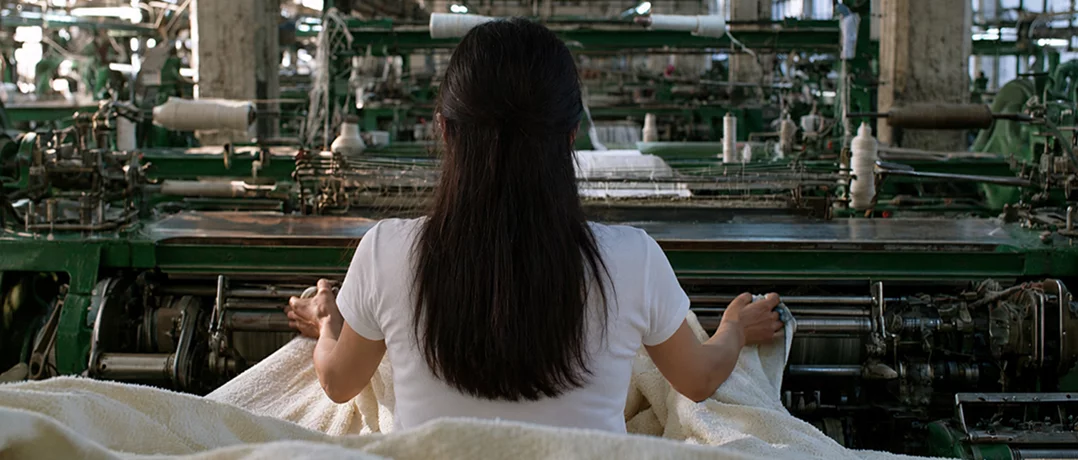
Before a towel reaches a bathroom shelf, it passes through stages of labor. A clean, even edge is what separates a towel that survives years of washing from one that frays within a season. It is exacting work, done on heavy industrial machines that demand a trained eye and a steady hand, and it belongs to a wider Lebanese tradition of sewing and textile manufacturing, a craft handed down through workshops and families rather than classrooms.
Much of that knowledge has never been written down. It lives in the fingertips of the people who practice it, and when they retire, it goes with them.
In a factory in Katbe, that reality has a name. Every working day, Mona sits down at a Schmale Duratex 510 and hems towels. The machine hums, the fabric feeds through, and a piece of Lebanese industrial expertise continues in the hands of one woman. By her own account, and by the account of those around her, she is the only person in the country who knows how to run it.
A machine she never forgot
Mona was born in Beirut. When the civil war made the city unsafe, her family withdrew to Baalbek and remained there until calm returned. Back in the capital, she found work at a towel factory owned by a man named Mark, an employer known for his strict hand and his intolerance of error.
Then the machine arrived. A technician traveled from France to install and calibrate it, and he taught her to operate it. She was frightened at first. "Our boss was exacting, and he had no patience for mistakes," she recalled with a laugh. The pressure sharpened her concentration. Within fifteen days, she told The Beiruter, she had committed every part of it to memory. She worked that machine for thirteen years. Then Mark closed the factory and left for France, and her work ended with it.
Years later, the Katbe factory owners, went searching for someone who could operate this exact model. They asked around, obtained Mona's number, and called her. She was spending the summer in her village, with a week remaining before her return to Beirut. He led her to the machine and asked whether she still knew how to run it. "I know every part of this machine as I know the back of my own hand," she told him. She sat down, began to work, and has remained at it ever since. "I am very comfortable working with them," she explained. "They are good people. What more could I ask for?"
The difficulty of the Duratex 510 lies in its complexity, the needle, the linked mechanisms at the front and back, the heavy loading from underneath. It rewards concentration and precision, and it punishes anyone who lacks either.
Mona has tried to pass that knowledge on. She offers to teach the young men and women who work beside her, but they decline. The machine intimidates them, as does the patience it requires. "No one operates it except me," she stated plainly.
Mona is single and has no children. She lives in Dahieh with her brother. The recent war reached her neighborhood. As the bombardment intensified, the family fled and spent five months in Bolonia. When they finally returned, they found the house half-damaged, its windows gone. The structure, however, had held.
"We kissed the ground and lifted our hands in gratitude," she said of the homecoming. "It was only the glass, thank God." For a family that had braced for the worst, a house in need of nothing more than new windows felt like mercy.
A fading craft
When workers like her step away, industries like hers are at profound risk. Mona intends to keep working. She pointed out that she is still healthy and strong and has no plans to collapse tomorrow.
Her true concern lies elsewhere. In her experience, fewer and fewer people want to sew at all. Those who love the craft have become rare, and that scarcity is what unsettles her. "Sewing is beautiful work," she noted. "But it needs people who understand it."
Her worry reaches beyond a single machine. When a factory's output rests on one person's skill, that skill is fragile. Illness, retirement, or a shift in circumstances could open a gap that no manual can fill, because so much of what Mona knows resides in her hands rather than on paper.
Her counsel to younger Lebanese is simple and generous. She believes sewing has no equal among professions. It can provide a living and a measure of security, and she believes every woman should learn it, whatever else she has achieved.
A woman with every qualification should learn that sewing is still worth having.
It is a vision of the trade as both practical and dignified, and it comes from someone who has spent her working life proving the point. Mona has endured war, displacement, a shuttered factory, and a long absence from the machine she loves. She returned to it without hesitation, and she still runs it with care.
Sewing, a craft built on patience, precision and knowledge passes from one pair of hands to another. In Lebanon, much of that knowledge has survived through workshops, factories and families, even as the industry around it has changed. Keeping the craft alive means preserving and protecting a part of Lebanon’s textile heritage before the skills that shaped it become forgotten.
-
-

-
The Beiruter
-
