



Nabatieh, the historic heart of Jabal Amil, is a city shaped by centuries of trade, culture and collective memory, whose identity remains deeply intertwined with the surrounding villages and the repeated destruction it has endured.
Nabatieh, a city of markets and memory

Nabatieh (al-Nabatiyeh) sits above the Litani River valley, about 420 meters above sea level and roughly 70 kilometers south of Beirut. It is the capital of the governorate that bears its name and one of Lebanon's larger cities, with a core population usually estimated at around 40,000. For centuries it has been the commercial and cultural heart of Jabal Amil, the Shia-majority land of the south.
Human presence there is old. Archaeological finds on a mound between Upper and Lower Nabatieh point to settlement reaching back to the Bronze and Hellenistic ages. The name is often linked to the Nabataeans, according to local tradition.
The town enters the written record clearly under the Ottomans. Tax registers from 1596 list "Nabatiyya al-Tahta" (Lower Nabatieh), distinct from "Upper Nabatieh," as a village of about 150 households in the subdistrict of Sagif, within the district of Safad. That doubled name survives today in the neighborhoods Nabatieh al-Tahta and al-Fawqa. Only in the nineteenth century did the settlement grow into a real town, drawing farmers and traders from the surrounding countryside.
Nabatieh's identity was built around its souk. Tradition places the market's origins in the Mamluk period, and its buildings were renovated in late Ottoman style around 1910. It served as a weekly center where villagers sold produce and crafts, and traders came from as far as Palestine. Among its landmarks was the Zahra al-Janoub boarding house, remembered as the oldest hotel in the city.
Under the French Mandate, Nabatieh was attached first to the Sidon district and later to the South Governorate. It became the seat of its own governorate only in 2003.
The linguist and Arab nationalist Ahmad Rida, who compiled one of the first modern Arabic dictionaries, was born here. So were the historian Muhammad Jaber Al Safa and the scientist Hassan Kamel al-Sabbah, Rida's nephew, whose inventions earned him international recognition. Religious scholars of Jabal Amil also shaped the town's intellectual life, linking it to the wider Shia seminary networks of Najaf and Iran.
The villages around Nabatieh
The district is a patchwork of olive terraces, stone villages and river valleys. A few stand out.
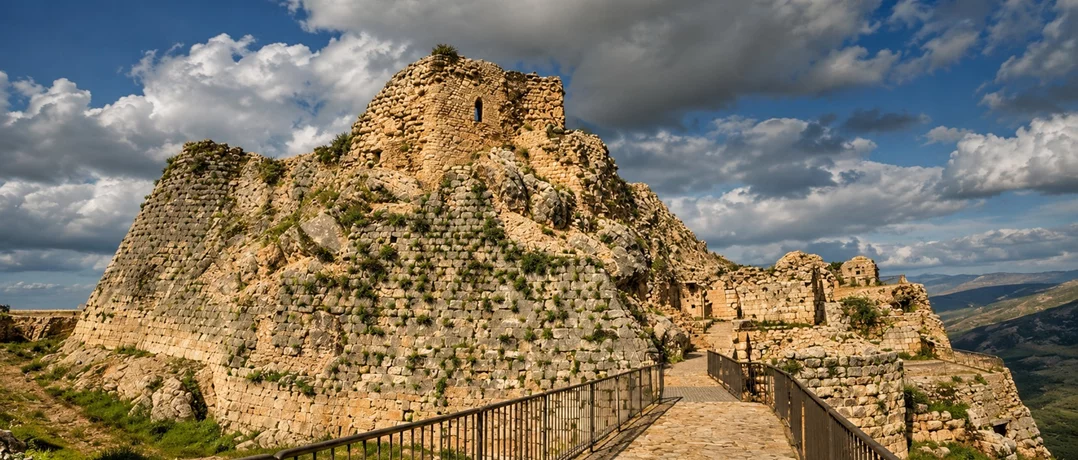
The village of Arnoun, about seven kilometers south-east of the city, lies at the foot of Qalaat al-Shaqif, known to Westerners as Beaufort. The name Shqif is Syriac for "high rock," and Arnoun is said to derive from an Aramaic word for "little top." The Crusaders fortified the castle in the twelfth century, and it later passed through the hands of Saladin's forces and the Ottomans. It was held by the PLO and then by Israel until 2000. UNESCO gave it enhanced protection in 2024.
East of the city lie Yohmor al-Shaqif, Zawtar al-Sharqiyah and Zawtar al-Gharbiyah. Their lives are tied to the Litani; as one resident put it, the river is everything to them. Zawtar al-Sharqiyah has been struck repeatedly, including its Husseiniya and mosque.
Kfar Tebnit, Mayfadoun and Shoukin look down on the river and have long been agricultural communities with strong family and religious ties to Nabatieh.
Habboush, Kfour, Doueir and Jbaa, larger towns and suburbs, some with populations in the thousands, form an urban fringe of mixed farming, small trade and commuter life. Habboush alone is estimated at around 15,000 people. They fed the city's market and sent their sons to its schools.
To the north and west, Deir al-Zahrani, Jebchit, Harouf, Zebdine and Toul connect Nabatieh to the Zahrani basin and the coast at Sidon.
Because of its position, Nabatieh has repeatedly suffered. It was heavily damaged in the Israeli operations of 1993 and 1996, lay beside the occupation zone from 1985 to 2000, and was hit hard in 2024. The market was badly damaged in October 2024, when Israeli airstrikes and the fires that followed destroyed much of the Ottoman-era quarter. Residents and local historians describe the loss as one of memory as much as of stone. Such houses hold the city's social, political and cultural history. Rebuilding began slowly in 2025.
In the war that began in March 2026, Israeli forces crossed the Litani, took the villages of Arnoun, Zawtar and Yohmor, and on 31 May announced the capture of Beaufort Castle, some five kilometres from the city. Hundreds of thousands of people were displaced across Lebanon.
Nabatieh is engrained in the history, identity and collective memory of Jabal Amil, with its future closely tied to the fate of the communities and villages that surround it.
-
-

-
Jenna GeageaReporter/Writer
-
