



Putin’s Beijing visit revealed a deepening Russia-China partnership increasingly shaped by Beijing’s growing leverage and global ambitions.
Putin's Beijing visit

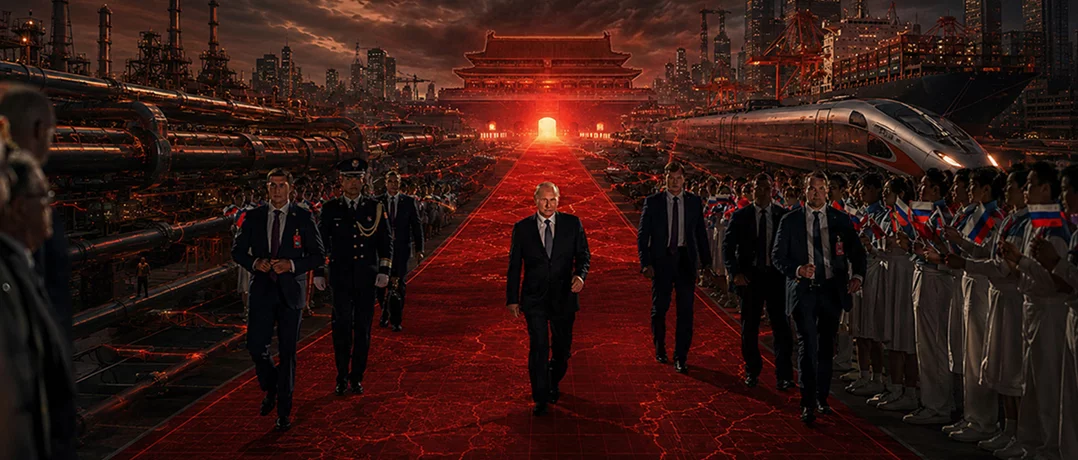
Russian President Vladimir Putin touched down in Beijing this week to a reception that mirrored, almost ceremony for ceremony, the one China had rolled out for U.S. President Donald Trump just days earlier, a red carpet on the tarmac, children clutching flowers, and a 21-gun salute echoing across Tiananmen Square. The optics were deliberate. For Chinese President Xi Jinping, hosting the two rival powers in rapid succession was itself the message: Beijing is indispensable, and it intends to stay that way.
The two leaders emerged from talks at the Great Hall of the People having signed more than 40 bilateral agreements spanning trade, technology, nuclear security, and media exchanges. Xi declared that relations between the two countries had reached "the highest level in history," while Putin described their partnership as "one of the key stabilizing factors on the international stage." Warm words, familiar rhetoric, but beneath the pageantry, the visit told a more complicated story.
Energy deals and growing trade
At the heart of the economic relationship is energy. China is Russia's largest trading partner and its single biggest customer for oil and gas, a dependence that deepened sharply after Moscow's full-scale invasion of Ukraine in 2022 triggered sweeping Western sanctions. Russian oil exports to China reportedly grew by 35 percent in the first quarter of 2026 alone, and with Middle East supply routes disrupted by the U.S.-Iran conflict, Moscow sees Beijing as an even more critical outlet for its resources.
Putin framed this explicitly during the summit, describing Russian-Chinese energy collaboration as the "driving force" of bilateral economic cooperation. He also positioned Russia as a dependable supplier amid regional instability, a pointed contrast, in his telling, to the volatility introduced by U.S. military operations abroad.
Xi, for his part, called energy cooperation the "ballast stone" of the relationship, essential, stabilizing, foundational. Both leaders also agreed to extend a friendship treaty originally signed in 2001, and reaffirmed military cooperation including joint exercises, air patrols, and maritime operations. On Taiwan, Moscow once again backed Beijing's "One China" position. On Ukraine, China reiterated support for a diplomatic resolution while endorsing Russia's territorial integrity, a formulation that critics note effectively validates Russian war aims without endorsing the methods outright.
Three key takeaways from Putin's Beijing trip
China holds the upper hand, and both sides know it.
The most revealing moment of the summit wasn't what was announced, but what wasn't. Russia had flagged before the visit that the long-delayed Power of Siberia 2 natural gas pipeline, a project Moscow desperately needs to redirect gas flows away from a now-shuttered European market, would be discussed "in great detail." It wasn't agreed upon. Russian press secretary Dmitry Peskov acknowledged that "some nuances remain to be ironed out," with no timeline given for the project.
As Anniek Bao reported for CNBC, Lyle Morris of the Asia Society Policy Institute called it "a huge setback for Russia and Putin," adding that Beijing appeared to be "playing hardball at a time when Russia has lost some leverage." The assessment was unsparing: "There is no way to sugarcoat it, Putin was embarrassed by the failure to agree to the pipeline." China imports Russian gas but is wary of over-reliance on a single supplier, giving Beijing considerable negotiating power over a project Moscow regards as strategically essential.
Xi is positioning China as the world's indispensable power.
The back-to-back summits with Trump and Putin were not coincidental. According to Evan Medeiros of Georgetown University, Xi is deliberately "positioning China as the indispensable external power in international politics." The guest list in Beijing in recent months, drawn from Europe, the Middle East, Africa, and now both Washington and Moscow, reflects a calculated campaign to establish China as the gravitational center of global diplomacy.
Both Putin and Xi used the summit to criticize what they called "unilateralism and hegemonism," and their joint statement condemned military strikes on sovereign states and efforts to destabilize governments — language that clearly targeted Washington without naming it. "They'll talk about the U.S. without naming the U.S., but we all know who they're talking about," Wall Street Journal China bureau chief Jonathan Cheng observed.
The partnership is real but asymmetrical
Russia and China have described their ties as "superior to Cold War-era alliances" and "without limits." In practice, the relationship looks increasingly like that of a senior and junior partner, with Beijing in the stronger seat. Russia accounts for only around four percent of China's total trade, limiting Moscow's leverage. China can afford patience on the pipeline; Russia cannot. Putin has visited Beijing more than 20 times during his years in power. Xi has visited Russia 11 times, and the United States just three.
The friendship endures. The balance of it, however, continues to shift.
-
-

-
Peter ChouayfatiPolitical Analyst and Researcher
-
