



Qamīs: Fragments of Dress explores Lebanon’s textile heritage through craftsmanship, industrial knowledge and the stories embedded in the making of everyday clothing.
Qamīs… the stories woven into Lebanon’s textiles
Qamīs… the stories woven into Lebanon’s textiles
By Jenna Geagea | September 23, 2026

Reading time: 5 min
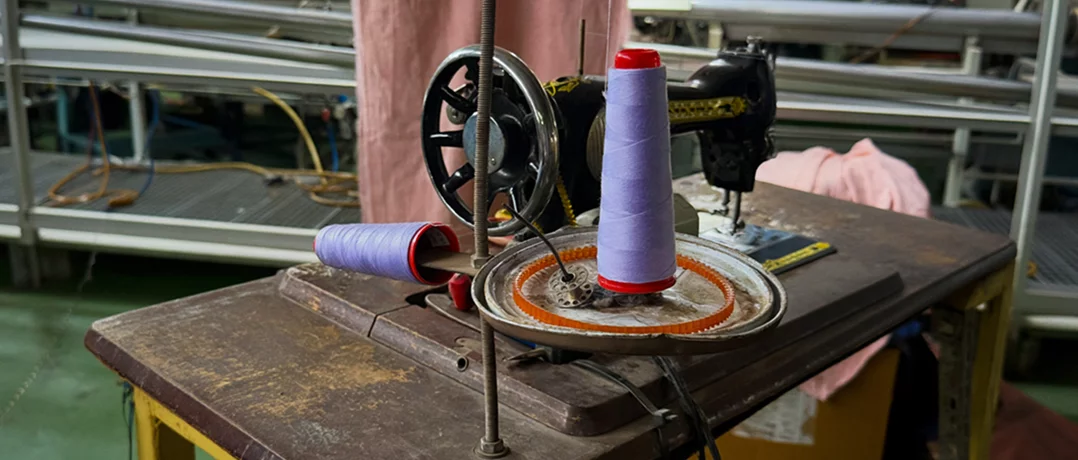
Textiles are among the most fundamental forms of material culture, molded by a profound history of knowledge and labor. From the spinning of fibers to weaving, dyeing, cutting and sewing, textile production brings together specialized craftsmanship, while carrying the histories of the people and communities who make and use it. It is this relationship between material, knowledge and memory that anchors Qamīs: Fragments of Dress, the second edition of Fragmenta, an independent cultural platform dedicated to exploring material culture, knowledge and making.
Using the shirt as its point of departure, Qamīs examines the material, industrial and human knowledge embedded in one of the most familiar objects of everyday life, opening a broader conversation around craftsmanship, memory, labor and Lebanon’s relationship with textiles. Ahead of the exhibition’s opening in November, the edition launched with a live demonstration exploring the process of textile creation. Fragmenta brought together figures from Lebanon’s textile, industrial and cultural sectors at Katbe Textile Factory for Threads of Knowledge: A Fragmenta Gathering, held under the patronage of Lebanon’s Ministry of Culture.
 Source: Fragmenta. Photo credit: Moe Krajem.
The story behind Fragmenta
"All of our lives, especially here in Lebanon, are completely fragmented," Fragmenta co-founder Nour Najem told The Beiruter. "Every time we think that we are okay and things are happening, something happens and everything is suspended for a few moments, and then we're supposed to reconnect and start again as if nothing happened." Fragmenta, now in its second edition after last year's focus on stone, exists to trace "fragments of identity, of lives, of livelihoods, of histories."
Textiles carry an unexpectedly personal resonance for almost everyone Najem and co-founder Guilaine Elias encounter. Conversations with designers and others involved in the industry repeatedly reveal the same connection to Lebanon’s textile heritage. “Every time we speak to a designer, or really anyone, we discover that textiles have touched their lives in some way,” she expressed. “There is always a personal story.”
 Source: Fragmenta. Photo credit: Moe Krajem.
A family four generations deep
Katbe Textile Factory was founded in 1997 in Hadath's Warwar Street with 120 employees, producing woven fabrics for shirting and uniforms, printed curtains, towels, bathrobes and slippers. Nearly three decades later, it remains a family concern, now in its fourth generation of Katbe stewardship.
"Katbe has gone from Gabriel, to Antoine, to my father Elie, and now to me," explained Tony Katbe, the factory's current Owner and Director, who studied Textile Technology and Management at UMIST, the University of Manchester, before returning home. "We are finding the courage to keep evolving. Fragmenta's presence here means this story gets told while the people who lived it are still here to tell it."
That sense of continuity runs through Katbe's account of the business. "What kept us going through the generations was our determination to never stand still," he asserted. "Legacy isn't a museum piece. We bought our last machine in 2017. We are not dinosaurs."
The factory's numbers trace the arc of Lebanon's industrial decline as starkly as any history book. Employee headcount held at 120 from 1997 to 2006, then fell sharply to 35 in the two years following the July 2006 war, a conflict Katbe's own records describe as having had "a devastating impact on the business, resulting in significant losses." By 2008, headcount had settled at 25, a level it has held ever since.
Output tells a similar story. Between 1997 and 2006, the mill ran three shifts around the clock, six days a week, turning out 240,000 meters of fabric and 216 tons of towels annually. That level of activity carried through to 2019, though towel volume had already been nearly cut in third, to 72 tons a year, reflecting a widening product mix. Since 2020, amid Lebanon's economic collapse, the factory has operated a single 12-hour shift, producing roughly 150,000 meters of fabric and 30 tons of towels a year. Exports to Saudi Arabia have stopped; orders now lean toward Africa, Dubai and Qatar.
Today, shirting fabric, the thread that ties the factory directly to Fragmenta's new exhibition, makes up 40% of what Katbe produces, with towels, hospital textiles and other lines filling out the rest.
Inside the making
For Tony Katbe, the quality of a finished shirt is decided long before it is cut and sewn, it is decided in the yarn itself. "If the quality of the yarn is high, we will make a great fabric at the end, and we will make a great shirt," he explained, walking the factory floor where that transformation begins.
The process starts with warping. Spools of yarn are arranged in a precise sequence and wound onto a beam, the pattern determined entirely by what the finished cloth is meant to look like. A striped design follows the same logic in miniature, with the ratio of threads fixed at this stage, long before the fabric takes shape on the loom. Katbe described the visible beam as the essential link between warping and weaving.
From there, the fabric moves to washing, a stage built entirely around a single continuous roll of cloth rather than loose fabric. "It's always only with a roll," Katbe confirmed, describing how the material moves back and forth through the machine as water passes over it, a cycle that takes about an hour. The fabric then goes into a high-speed spin cycle, not unlike a household washing machine, to remove excess water before drying. Under high heat, the cloth is spread flat and dried.
The final stage is finishing, where the character of the fabric is set according to what it will become. Once the finish is applied, the fabric is dried a second time, then rolled, ready to leave the factory floor as cloth, on its way to becoming, as Fragmenta's founders put it, "someone's shirt."
 Source: Fragmenta. Photo credit: Moe Krajem.
The people who carry the knowledge
If machines explain how Katbe keeps producing, the people explain why it has survived at all. Fadwa, who began working alongside Tony Katbe's grandfather before 1975, is still on the factory floor five decades later. "Her parents didn't want her to, she cried until they let her," Katbe recalled. "Fifty years later, she's still here. Her experience is priceless and invaluable.”
Then there is Mona, tracked down almost by accident after the factory bought a loom from a mill that had closed. "Nobody could tell me who used to run it until someone remembered it was Mona," Katbe explained. "No one had her number. It turned out she was related to Fadwa. We finally found her in her village in the Bekaa and asked her to come work with us in Hadath." Mona now operates the factory's Schmale Duratex 510, hemming towels on the same machine she once ran elsewhere. "That's how this factory survives," Katbe acknowledged, "one worker remembering another."
That continuity of people is inseparable from a broader commitment. "This started with my grandfather, and I've kept it because I believe it matters. When you invest in people, you're holding a community together." He may already have an eye on a fifth generation, his six-year-old daughter, Chloe, is already passionate about spending time in her father’s factory.
Seen end to end, the journey from yarn to shirt at Katbe is a chain of small, exacting decisions, from how tightly to wind a beam to how long to hold cloth in water, each one accumulating into the quality of an object most people put on without a second thought. It is this chain that Fragmenta's Qamīs sets out to make visible, by tracing them back to a floor where the work, the machines, and the people who understand both are still very much present. In that sense, Katbe is proof of the Fragmenta’s central claim that the knowledge behind an ordinary object survives only as long as someone is keeping it alive.
-
-

-
Jenna GeageaReporter/Writer
-
