

The Lebanese diaspora in New York through the Niyū Yūrk exhibition, exploring migration, nostalgia, cultural memory, and the enduring ache of departure.
Reflections on the Niyū Yūrk exhibition during conflict
Reflections on the Niyū Yūrk exhibition during conflict
By Tala Semaan | May 10, 2026

Reading time: 3 min
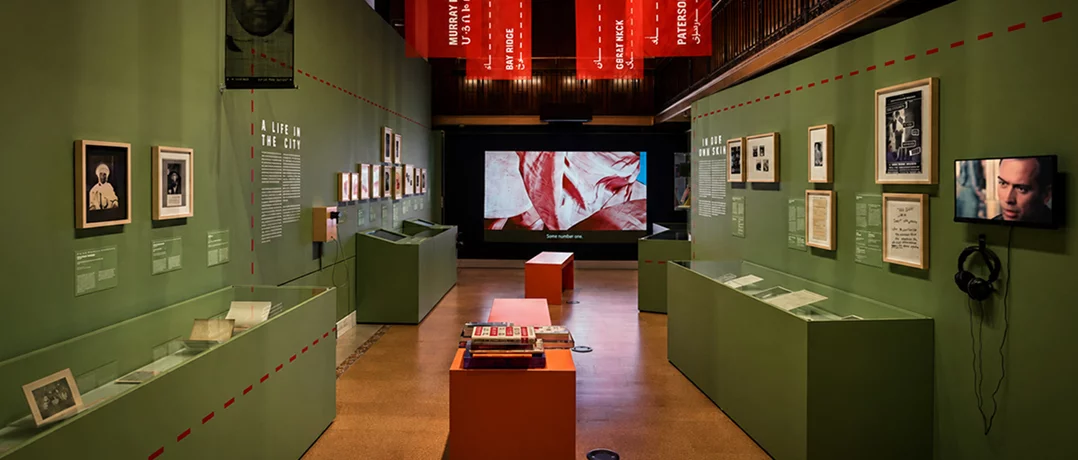
The grief of leaving builds cities. In New York, the legacy of its Lebanese diaspora exemplifies this. The New York Public Library hosted an exhibition titled Niyū Yūrk: Middle Eastern and North African Lives in New York City, which opened in October 2025. The exhibition’s closing in early March this year coincided with the first week of Lebanon’s recent war. The exhibition, displaying the achievements of Middle Eastern and North African communities across the city, felt personal. While looking back, the timing of its run felt prescient, seemingly foreshadowing the escalation.
The exhibition spotlighted the social barriers impacting Arab and Muslim communities in New York following 9/11, and how these were reflected in the city's art and community life. It chronicled the rise of Little Egypt in Astoria, Queens, while displaying how even the smallest everyday interactions in New York were shaped by Middle Eastern communities, particularly the dominance of the bodega, comparable to a dukkan, by Yemenis, who succeeded earlier waves of Latin American, Italian, Greek, and Jewish owners.
Notably, the exhibition traced the creation of the Al-Funoon magazine, the first literary and artistic magazine established by the Arab immigrant community in 1913. Al-Funoon was critical in the formation of the Pen League, which had been formally referenced in a June 1916 issue. The exhibition turned to key contributions by members of the league, including Gibran Khalil Gibran’s writings and drawings. Gibran designed many illustrations for the magazine, including the iconic “hand with flame” cover image, having later adapted it for the cover of The Prophet. The exhibition focused on the works of pioneer Ameen Rihani, including The Book of Khalid, which is inspired by his American experience and considered the first English novel written by an Arab-American. Viewed as the father of the Adab Al-Mahjar movement, Rihani introduced free verse into Arabic poetry while pioneering an entirely new literary movement based upon his experiences abroad.
However, these weren’t the only examples of Arab immigrant literature. The exhibition drew attention to Mikhail As’ad Rustumal al-Shuwayri, believed to be the first Arab poet to immigrate to the United States, who arrived in Philadelphia in the 1880s. He remained closely connected to New York’s Arab literature movement and had his work, The Stranger in the West, published by the Oriental Press. Serving as one of the earliest Arabic travel accounts of the U.S., the book begins with poems narrating al-Shuwayri’s departure from Lebanon, romanticizing his longing for his country and family while noting the stark differences in American cities and the contrasts between American and Arab customs. This continuous tension reveals that migration has always emerged less as a desire than a necessity, with departure becoming a shared cultural memory. This feeling, the same unresolved pull toward home, is nothing new.
And yet, with the exhibition now over, its meaning remains unsettled. How can it be interpreted in the midst of conflict, at a time when renewed instability diminishes any prospect of return for the diaspora, while also causing additional migration? The exhibition illustrated how the burden of migration is shared across generations, while addressing the pull of return and embedding this feeling within history and culture. Nostalgia acts as a powerful force, and while the desire for return is deep enough to shape cities, New York shows how the creation of its immigrant communities is the result of the ache caused by distance.
When reflecting on this exhibition, it’s bittersweet to see that the struggle of leaving continues to shape some of the country’s greatest literary achievements. This isn’t to say that this departure is productive or that this condition should be romanticized. Rather, what emerges from this dynamic carries a desire to document and to remember, and perhaps there is solace in this shared grief. What the exhibition leaves behind is not resolution, but a testament to the surviving memory of a place that distance cannot erase.
