



Rumman’s fifth edition brought Tripoli into focus through two nights of live music, new collaborations and a space where artists and audiences could meet.
Rumman turns Tripoli into a stage for sound and memory
Rumman turns Tripoli into a stage for sound and memory
By Rayanne Tawil | September 07, 2026

Reading time: 5 min
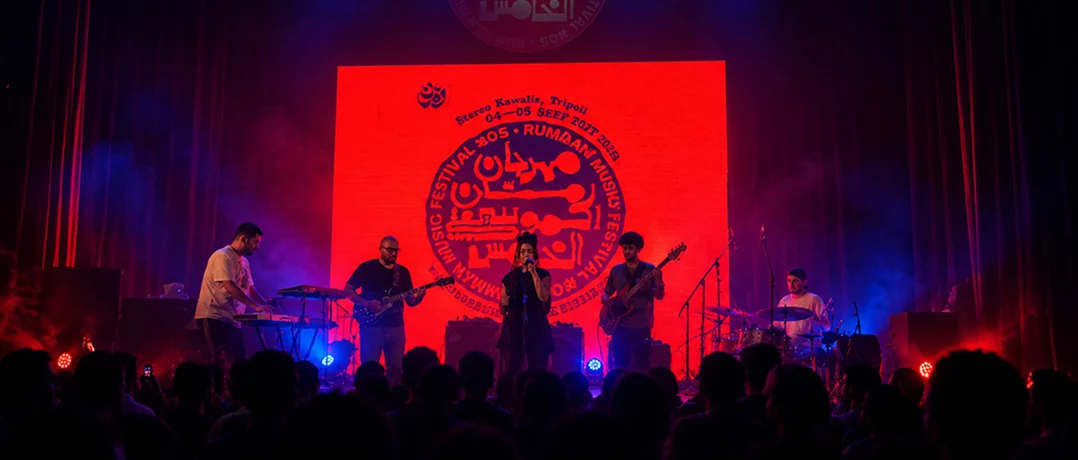
Red and blue lights spilled across Stereo Kawalis (Rumman’s venue) in El Mina, turning the historic cinema into a pulsing room of music, images and bodies.
Above the stage, the Rumman sign watched over two nights that brought together sounds from Tripoli, the south and across the Arab region, moving from experimental and electronic music to hip-hop, folk and audiovisual work. It was the fifth edition of the “Rumman Music Festival,” and for a couple of nights the space felt like it belonged entirely to the music.
The night brought together SANAM, ALSILK, SHAM LHAWA and Black Mouse: Deconstructed, with the latter turning Ahmad Naboulsi’s film into a live audiovisual performance featuring Lebanese soprano Mona Hallab, musician, producer and sound engineer Joy Moughanni, and scenography and spatial direction by Firas El Hallak.
For Naboulsi, returning to “Black Mouse” after six years meant returning to the film with different eyes. “Before, our issue in 2019, as Lebanese, was how to reclaim public space. Now, public space is facing more violence than hegemony,” he told the Beiruter.
The film itself grew from his childhood relationship with the Rachid Karami International Fair, a place he remembers seeing from outside. “For me, the relationship with it was the child's relationship simply not being able to enter a place and wanting to enter it,” he says. The live version turns that memory into something that can be entered, questioned and experienced again.
Changing the shape of a place
That question of space carries into Hallak’s work. For him, the performance was an opportunity to alter how an audience encounters a place through scenography.
“Scenography can tell the story, it can change how we see spaces, how we see our city, how we see each other,” Hallak says.
The audience could choose how to experience the work, from different sides of the room, sitting or standing, allowing the projection and the surrounding space to become part of the performance itself. The old cinema became more than a backdrop. It became something the artists could reshape for an evening.
Hallak describes the project as “a re-imagination,” one that carries an emotional awareness through Mona’s voice and Joy’s music while deconstructing the original film and asking new questions around reality.
For Naboulsi, there is also something larger in leaving artistic traces behind. “An artist will come back after a thousand years digging underground in Tripoli and he will have a voice that he will not hear but will enter his heart, and he will come back to accumulate new art,” he says.
Saturday changed the rhythm
If Friday moved through cinematic images and experimental sound, Saturday arrived with a different pulse. Colorful lights washed over the room while music blared from the speakers, setting the atmosphere for Emsallam (Msallem Hdiab), Ma-Beyn, Jamul and Bilel.
Bilel opened his set with the confidence of someone speaking directly to his city. At one point, he brought his mother onto the stage, introducing her as the inspiration behind “Zaatar,” a song he said he wrote while travelling in the van to see her.
Then came Jamul, whose performance carried another weight. Behind him, images of martyrs from the south appeared across the screen as he performed “Aa Amal.” For an artist from Nabatiyeh, the moment landed differently. The crowd raised their phones, recording the images and the song as they moved through the room.
Jamul even turned the mood into a joke, reminding the audience that he was an engineer before becoming a performer, with his engineer ID appearing on the screen behind him.
Music crossing borders
Saturday also brought Ma-Beyn, whose music moves between hip-hop, jazz, alternative rock, electronic music and experimental pop. Performing with Kubbara, Saadeh Katouh, Jad Kamareddine and Oliver Hajj and also staying at a guest house in Byblos beforehand, she described the collaboration as something that keeps changing with every person involved.
“The project itself is always changing. It takes on new forms. It depends on what I'm inspired by these days and what I really want say.,” she says. “I like that my work is not in a box.”
For her, Rumman itself became part of that exchange. “Thanks to Rumman, we got to know each other and became really good friends.”
Alongside the performances, Emsallam brought his practice as a visual artist into the festival. He describes music and painting as overlapping languages, where color, composition, lines, light and negative space can carry musical equivalents. The Jordanian-Palestinian artist, rapper, painter and audiovisual artist moves between music and visual art, often using both to challenge taboos and comment on the political and cultural history of the region.
“I like to champion freedom,” he says. “If it feels like liberty and attacking the norms, let it be. If it feels like resistance, let it be.”
Keeping the festival moving
For Rumman co-founder Mohamad Tanir, reaching a fifth edition is an achievement in itself. “The fact that we're still moving on doing the 5th edition is an achievement by itself,” he says, pointing to the importance of activating not only the festival space, but the surrounding neighborhood.
Dana Muhajer, Rumman’s communications manager, sees the festival as a way of reconnecting places that have spent years feeling separated. Artists come from the south, the north and the wider Arab region, creating encounters that extend beyond the stage.
This year's festival continued with a two-day professional program developed in partnership with Tiny House Music, giving emerging artists access to mentorship, workshops and networking opportunities. Sessions addressed intellectual property, publishing and licensing, as well as production, marketing and career management.
Rumman also continued working with partners including Oakenhouse, Tunefork Studios and Tiny House Music, alongside other music, cultural and local partners.
For Muhajer, one impact is already visible: audiences from northern Lebanon are gaining access to music they often travel to Beirut to see, while visiting artists are discovering Tripoli for themselves.
Two nights were enough to turn Stereo Kawalis into a room where those distances disappeared. Onstage, beneath the Rumman sign, hundreds of phone screens stayed raised toward the music.
-
-
-
Rayanne TawilCultural writer
-
