



Saghbine, where the mountain meets the lake

In the heart of Lebanon's West Bekaa, sits a village whose old stone houses have watched over the valley for centuries. Saghbine, is not one of Lebanon's famous tourist names, but it offers a rare combination of layered history, natural beauty, and a culinary tradition that has outlived war and displacement.
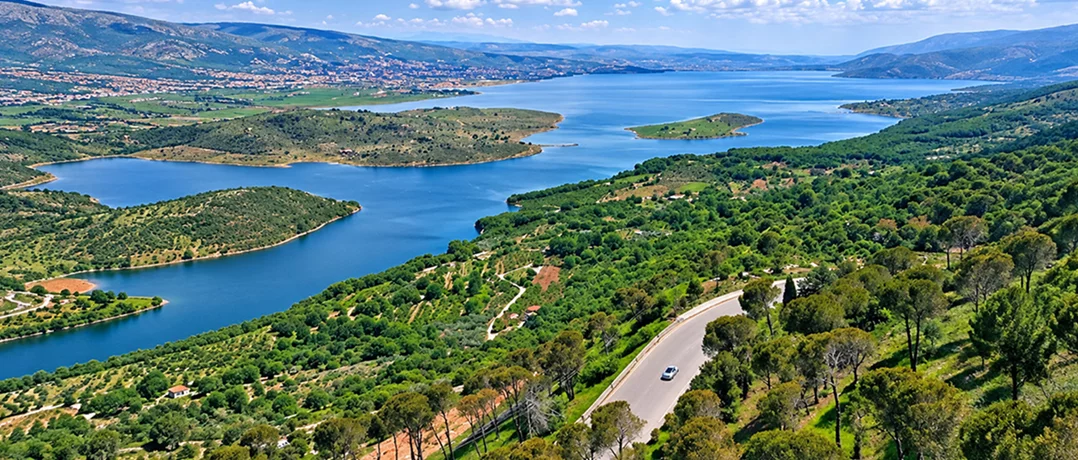
Saghbine sits on the eastern slope of the Western Lebanese Mountains, at the foot of Mount Niha, right beside the Litani River, roughly 1,145 meters above sea level. It lies about 73 kilometers from Beirut, around a 90-minute drive, and looks out north over Qaraoun Lake, the largest artificial lake in the country. That lake, along with the Litani snaking below the village, gives Saghbine some of the most striking views in the Bekaa.
Even the village's name is disputed, and the debate says something about the layered peoples who have passed through this corner of Lebanon. One popular explanation ties "Saghbine" to the hardness and stubbornness of the village's men, while the another instead traces it to an Aramaic root describing "rugged mountain trails." A separate theory, circulated by Syriac-heritage researchers, derives the name from a shared Aramaic and Hebrew root meaning anger, sharpness, and prudence, rendering Saghbine roughly as "the angry" or "raging people." Locals are quick to note that whatever the etymology, it has nothing to do with the character of the village today, which residents and visitors alike describe as unusually calm and hospitable.
Before modern roads existed, Saghbine functioned as a vital link between two very different worlds. The village served as a central point of communication between the Chouf mountains and the Bekaa Valley, and mountain trails still connect it to villages such as Mrosti, Jbaa, Baadaran, Aamatour, and Bater. A nearby area called Hanouti, from the Syriac word for "stores", points to its past as a waystation where caravans moving between the Chouf and the Bekaa would stop. That deep antiquity is written into the landscape itself, from Byzantine tombs to Roman remains scattered through the surrounding mountains and plain, and one ancient Aleppo oak in the area said to date back to the Roman era.
By the 19th century, Western travelers had already taken note of the village. In 1838 the American missionary and orientalist Eli Smith recorded it as "Sughbin," describing it as a Maronite Catholic village on the western edge of the Bekaa Valley. That Christian identity, rooted in the Maronite tradition, has largely persisted into the present day.
A village marked by war
Saghbine's strategic position, overlooking routes between the Bekaa and the Chouf, made it a flashpoint during Lebanon's darkest years. In the early stages of the Lebanese Civil War, the village became a strategic objective in the Western Bekaa, and on November 25, 1975, joint forces of the Palestine Liberation Organization and the Lebanese National Movement captured it; twelve Christian civilians were summarily executed during the takeover.
The violence returned seven years later. On June 8, 1982, as Israeli forces advanced through the region during the 1982 Lebanon War, retreating PLO and LNM fighters passed back through Saghbine, and between fourteen and twenty residents were killed in what has been described as a retaliatory action during that retreat, just a day before the aerial battle known as Operation Mole Cricket 19 unfolded in the nearby skies. These episodes remain a somber thread in the village's modern memory, even as Saghbine has rebuilt and reclaimed its identity as a peaceful agricultural community.
Orchards, wheat, and a village ice-cream man
Agriculture remains the backbone of daily life. Saghbine is known for producing wheat, pulses, and onions, alongside orchards of apples, grapes, figs, and almonds. The surrounding hills host small forests of pine, cypress, cedar, and oak, home to owls, partridges, goldfinches, turtledoves, wild boar, rabbits that wander over from the Shouf Cedar Reserve, foxes, and hyenas. Migrating white storks even stop near the Qaraoun dam to breed on their way to Africa, adding another seasonal rhythm to village life.
Food carries the village's identity as strongly as its stones do. Traditional dishes worth seeking out include zenkoul, potato-and-walnut kebbeh, winter tabbouleh, and fwerigh, alongside a famous local lemonade. Perhaps most distinctive is the goat's-milk ice cream still made by hand in the village, a specialty tied to one well-known local producer who serves it in a range of natural flavors. Today, Saghbine is best experienced on foot. Guided walks through its narrow old streets reveal stone houses built long before modern construction reached the Bekaa, while short trips into the hills lead to the Byzantine tombs still scattered across the mountainside.
Between its Roman ruins, its wartime scars, its orchards, and its ice cream, Saghbine tells a profound Lebanese story, of a small mountain village that has absorbed everything that passed through and still kept its own character alive.
-
-

-
Jenna GeageaReporter/Writer
-
