



Exclusive interview with EU Ambassador to Lebanon Sandra De Waele on the new EU civilian-military mission, strengthening Lebanon’s state authority, and expectations of the Lebanese government on sovereignty, security and reforms.
Sandra De Waele to The Beiruter: Sovereignty and reforms must translate into action
Sandra De Waele to The Beiruter: Sovereignty and reforms must translate into action
By Joanne Naoum | November 20, 2026

Reading time: 5 min
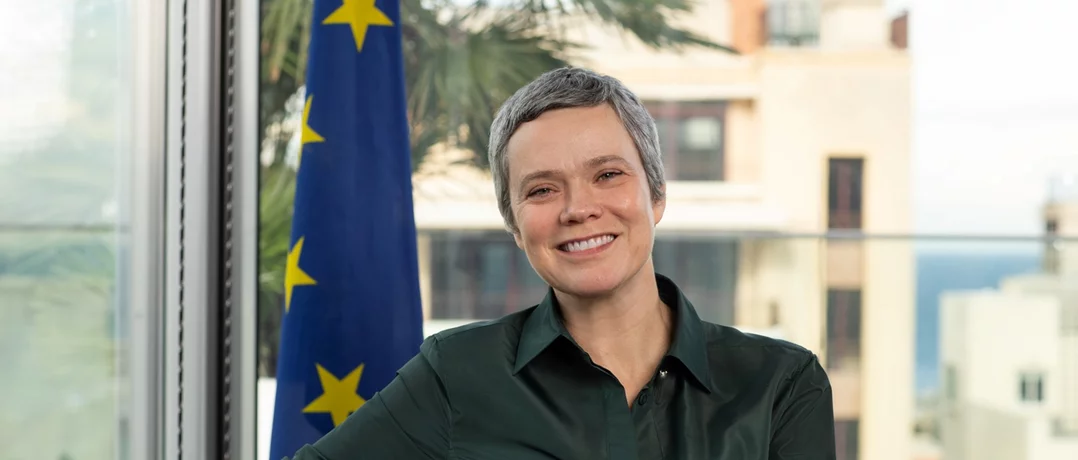
With €220 million mobilized for Lebanon’s security sector since 2023, the European Union is expanding its support for the country’s armed and security forces while preparing a new civilian-military mission.
In an exclusive interview with The Beiruter, EU Ambassador to Lebanon Sandra De Waele discussed the mission’s mandate, the EU’s assistance in strengthening state authority, and the first organized voluntary return of Syrian refugees. She also outlined Brussels’ expectations of Lebanon as the country navigates mounting political, economic and security challenges.
Supporting the state’s authority across Lebanon
With the EU having mobilized €220 million for Lebanon’s security sector since 2023, Ambassador to Lebanon Sandra De Waele reiterated that the EU’s support has increased significantly in recent years. It includes direct bilateral assistance to the Lebanese Armed Forces (LAF), the Internal Security Forces (ISF) and General Security, as well as support to both the LAF and ISF through the forthcoming EU civilian and military mission.
De Waele highlighted that the EU Member States also provide bilateral assistance to the LAF and contribute through the European Peace Facility (EPF). The objective of that support, she said, is to assist the Lebanese government in its efforts to extend state authority across the territory and to be the sole provider of security for its citizens.
EU Support to the LAF covers several areas, including training and essential equipment, such as trucks, ambulances, tactical vests, prefabricated houses, armored vehicles and drones.
Other initiatives include establishing a joint search and rescue center for maritime emergencies; equipping agencies with vessels, diving gear and communications equipment; and helping Lebanon develop related policies.
The EU, she added, also supports the LAF’s Engineering Regiment and the Lebanon Mine Action Center through the provisions of cranes and heavy equipment to protect deminers and clear mines and explosive remnants. This includes direct support to survivors, including prosthetics. In addition, the EU is helping security institutions transition from costly diesel generators to solar and wind energy, reducing costs and ensuring the continuity of security operations.
A new civilian-military mission with 200 experts
EU Ambassador to Lebanon pointed out that the EU is strengthening Lebanon's security institutions through the newly announced EU Support Mission in Lebanon (EUSM). Which will initially have a three-year mandate.
The Mission will provide advice and training to the Lebanese Armed Forces and Internal Security Forces, notably on managing the Lebanon-Syria border, counterterrorism, cybersecurity, maritime security, and port security. This aims to strengthen their capacity and contribute to lasting stability, in line with UN Security Council Resolution 1701
The EUSM will comprise around 200 experts, De Waele told The Beiruter, including specialists in non-military or policing functions, such as judges, port security experts, and other. It will complement the €182 million provided to the Lebanese Armed Forces, since 2023 through the European Peace Facility.
The EUSM will not replace UNIFIL, will not operate in the south, and will not work on disarming Hezbollah.
De Waele noted that the EU currently has 22 similar missions around the world, with more than 3,500 military personnel and 1,300 civilian personnel deployed.
The first organized voluntary return of Syrian refugees
The first organized voluntary return of Syrian refugees took place on November 18, through the Abboudiyeh-Daboussiyeh crossing.
Since January 2025, more than 711,000 Syrians known to UNHCR have returned from Lebanon to Syria, De Waele explained. The process is not viewed as a one-off operation. Nearly 100,000 returnees have sought and received assistance through the programme, while 21 organized return movements have been funded by the European Union and its Member States.
The €80 million Durable Solutions, Assisted Voluntary Returns and Reintegration (DAR) Programme, funded by the EU and implemented by UNHCR, IOM and ILO, supports the safe and voluntary return of Syrian refugees and their sustainable reintegration in Syria, while strengthening Lebanon–Syria cooperation, the ambassador said.
Support includes counselling, legal assistance, health screenings, transport and USD 100 in pre-departure cash assistance per person, with an additional USD 300 for particularly vulnerable families. Eligible returnee families may also receive around USD 600 in reintegration assistance, alongside support with housing, livelihoods and essential services.
Implemented in cooperation with the relevant national authorities and fully aligned with the plans and priorities of the Lebanese and Syrian governments, the programme also contributes to strengthening border management and monitoring, while bridging immediate humanitarian assistance with longer-term recovery and development efforts.
The expectations
At a time when Lebanon is facing mounting security, political and economic challenges, the European Union’s message to Lebanon is clear: it remains steadfast in supporting the country, EU Ambassador to Lebanon Sandra De Waele told The Beiruter.
For the benefit of the Lebanese people, necessary and concrete results will need to be delivered, including tangible progress in restoring state sovereignty, ensuring security and stability, and implementing the structural reforms needed to put the country on a path to recovery.
On the security front, she affirmed that the EU stresses the need to implement the Government’s decision on the state monopoly on arms and to strengthen the capacities of the Lebanese Armed Forces and security forces, enabling them to extend the State’s authority across the entire Lebanese territory. The EU will continue to support Lebanon’s security institutions through training and capacity-building.
On the economic and institutional fronts, Da Weale emphasized that
The EU expects the Lebanese authorities to make concrete progress on long-overdue structural reforms, particularly in the financial sector, judicial independence, the rule of law and public administration reform. These reforms are essential to restoring confidence, unlocking Lebanon’s economic potential and strengthening the EU-Lebanon partnership.
Ultimately, De Waele stressed that the EU remains a committed partner of Lebanon, but the country’s recovery and its ability to realize the full potential of its partnership with Europe depend on the Lebanese authorities’ capacity to translate their commitments into concrete and sustained action.
-
-
-
Joanne NaoumHead of Political Desk
-
