



Sidon, one of the world’s oldest continuously inhabited cities, has endured millennia of conquest and conflict while preserving its rich Phoenician heritage, historic port, and enduring role in Lebanon’s coastal life.
Sidon, the ancient harbor that outlived its empires
Sidon, the ancient harbor that outlived its empires
By Jenna Geagea | October 22, 2026

Reading time: 4 min
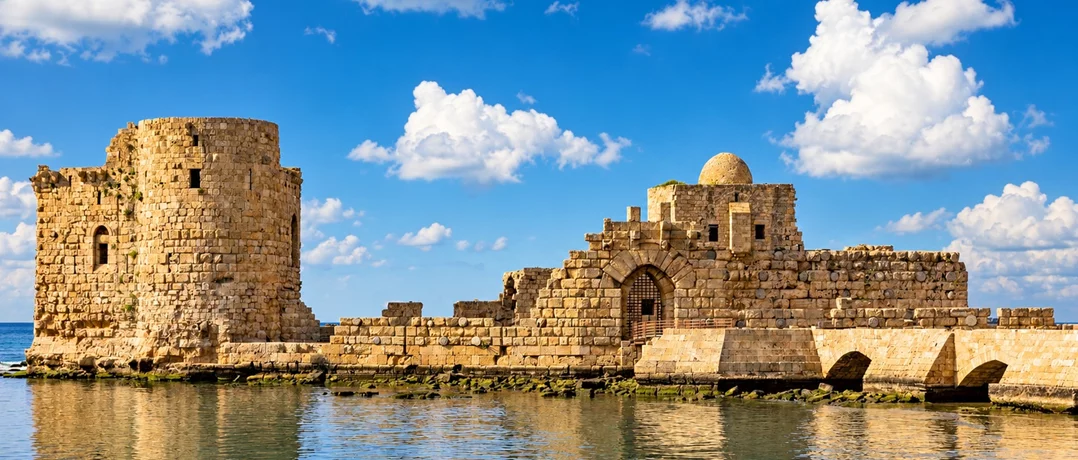
On Lebanon’s southern coast, about forty kilometers south of Beirut, sits one of the oldest continuously inhabited cities in the world. Sidon, known in Arabic as Saida, has been a port, a fortress, a merchant hub, and a seat of governors for more than five thousand years. Its story is a compact version of the Mediterranean’s own.
Archaeological digs at the site known as Sidon College Hill show settlement reaching back to the Neolithic period, roughly 4000 BC. The city’s name is often linked to a Semitic root connected with fishing, a fitting origin for a town built around a sheltered bay and a small offshore island that formed a natural double harbor.
By the Bronze Age, Sidon was a leading Canaanite and then Phoenician city-state. Its sailors carried cedar, glass, linen, and purple dye across the Mediterranean, and its craftsmen were prized for metalwork and glassmaking. Homer used “Sidonians” as a general word for Phoenicians, a sign of how famous the city had become. The Hebrew Bible echoes this fame, naming Sidon as a son of Canaan and describing Jezebel as the daughter of a Sidonian king, Ethbaal.
Around 1000 BC, neighboring Tyre began to surpass Sidon in power, yet Sidon never faded. It remained a wealthy, self-governing kingdom, even as larger powers pressed in.
Conquest, rebellion, and royal tombs
The Assyrians were the first great empire to crush Sidon. After revolts, King Esarhaddon destroyed the city in 677 BC and rebuilt it as an Assyrian administrative center. Babylon followed, then Persia, under which Sidon enjoyed a remarkable revival. Persian rulers valued its fleet, and Sidonian ships served in their wars against Greece.
This era left some of the city’s most extraordinary treasures. In 1855, workers uncovered the sarcophagus of King Eshmunazar II, carved with a long Phoenician inscription that warns against disturbing his rest. It is now in the Louvre. Another royal necropolis, found in 1887, held a group of magnificent marble coffins, among them the so-called Alexander Sarcophagus, now in Istanbul. Despite its name, it likely belonged to Abdalonymus, a king installed by Alexander himself, and its carved battle and hunting scenes rank among the finest works of ancient art.
Under Hellenistic rule, Sidon became a center of learning and trade, and philosophers and poets from the city were known across the Greek world. The Romans later made it a thriving provincial town with a theater, a hippodrome, and a famous glass industry. The New Testament places both Jesus and, later, the apostle Paul in the city’s orbit; the Book of Acts records Paul being allowed to visit friends there.
A series of earthquakes and a catastrophic tsunami in AD 551 devastated the Lebanese coast, and Sidon declined during the late Byzantine period. Arab forces took the city in the seventh century, bringing it into the early Islamic world.
Sidon’s fortunes turned again in the early seventeenth century under the Druze emir Fakhr al-Din II, who treated the city as a commercial gateway to Europe. He invited French merchants, who settled in the Khan al-Franj, a handsome caravanserai with a courtyard and arcades that still stands. In 1660, the Ottomans made Sidon the capital of a province stretching along much of the Levantine coast. Silk, cotton, and soap flowed through its markets, and its traditional soap-making industry survives today in a museum housed in a restored workshop.
The old city preserves the character of this era, a maze of covered souks, mosques such as the Great Omari Mosque, bathhouses, and merchant mansions like the Debbane Palace.
Modern Sidon
Sidon’s modern economy was built around oil. The Trans-Arabian Pipeline, known as Tapline, was a joint venture of American oil companies. It began operating in 1950 and was the largest oil pipeline of its time, carrying Saudi crude from the Gulf fields to a terminal at Zahrani, south of Sidon, from where it was shipped to European markets and the eastern United States. The pipeline was not planned to end in Lebanon. It was originally meant to run to Haifa in Palestine, but the final route passed through Jordan and over the Golan Heights in Syria before reaching Sidon. The change followed the 1947 partition of Palestine.
The pipeline’s life was cut short by regional politics. After the 1967 Six-Day War, disputes between Saudi Arabia, Syria, and Lebanon over transit fees, the rise of supertankers, and pipeline breakdowns led to the section beyond Jordan ceasing operation in 1976. Today the thermal power plant and fuel port at the site still work, and the state uses the port to import oil.
When Israel invaded Lebanon in June 1982, Sidon lay directly on its path up the coast. Israeli forces reached the outskirts of the city but met heavy resistance in the main streets and in Ain al-Hilweh, and a paratrooper attempt to take the center failed at first. Armor and troops with heavy air and artillery support then cleared a route through central Sidon. The occupation lasted a long time. Israeli troops stayed in Sidon for 31 months, until their withdrawal in February 1985.
When war broke out in July 2006, the city became a refuge for people fleeing the south. Its normal population of 125,000 swelled as more than 100,000 people arrived from war zones farther south. Schools, mosques, and a local university were turned into shelters. The Syrian war that began in 2011 put a new strain on the city. Lebanon has hosted roughly 1.5 million Syrian refugees since then, and Sidon’s services, rents, and labor market felt the pressure. Then came the collapse of the economy. The latest regional war has added to this. After Lebanon was drawn into it on 2 March 2026, Sidon again became a refuge for people fleeing the violence in the south. Through all of this, the city’s markets, harbor, and port have kept working, as they have through earlier crises.
Few places offer such a continuous record. Sidon’s survival through fire, revolt, earthquake, and siege suggests a city whose strength lay in its harbor and its merchants, who kept rebuilding no matter who held power.
-
-

-
Jenna GeageaReporter/Writer
-
