At just 15, Elsa Kahwaji is redefining Lebanese alpine skiing, balancing sacrifice and ambition as she sets her sights on international competition and the Olympics.




At just 15, Elsa Kahwaji is redefining Lebanese alpine skiing, balancing sacrifice and ambition as she sets her sights on international competition and the Olympics.

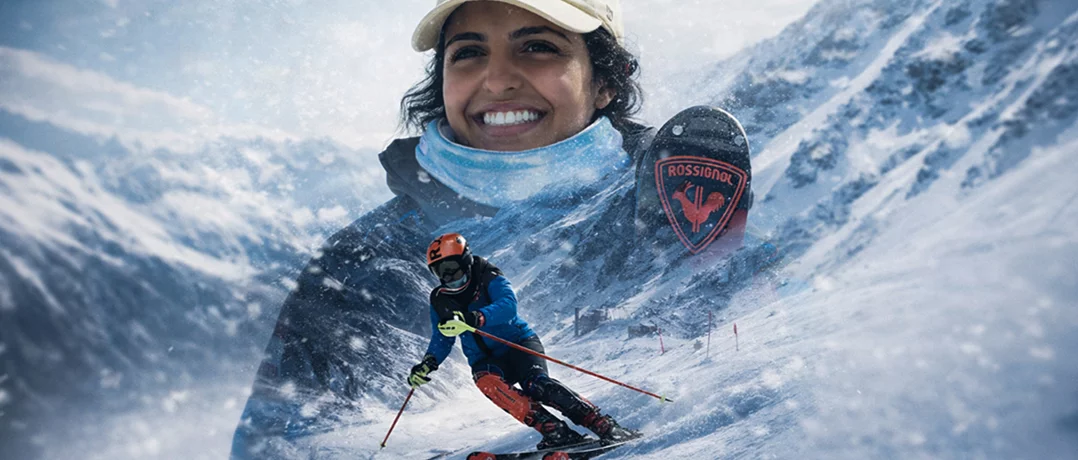
At only 15 years old, Elsa Kahwaji has already swept all three national titles in Lebanon's 2026 alpine ski championships, by margins that, in a sport where races are decided by fractions of a second, were nothing short of staggering. On day one, she finished 6 seconds ahead of the next competitor. On day two, 12. On day three, 9. Her father put it plainly: "In ski, usually the top three or four are within the same second. That's how tight it is. This year, the gap was just remarkable."
Already crowned Lebanese U16 champion in 2024, Kahwaji races under the colors of Club des Sports Faraya Mzaar. She clicked into ski boots for the first time at age 4, taken to the slopes by her father, who skied himself. It became clear almost immediately that she needed no convincing. She had no fear, and the talent announced itself early.
For most of her early years, Elsa's training looked like that of any young Lebanese skier, weekends on the snow, occasional camp weeks, roughly 30 skiing days per year. Then, last year, everything changed. "Last year was a turning point for Elsa," her mother explained.
She made the decision that she wanted to dedicate herself and work as a committed, dedicated athlete, an alpine skier.
The first step was leaving her traditional school, where she had spent years alongside the same friends since nursery. She enrolled instead in Eastwood Global, an online school based in Switzerland, which allowed her to train in the mornings and study in the afternoons. The effect on her schedule was immediate and dramatic. "Before, she would train mainly during weekends, and sometimes she'd skip school, and sometimes she'd do a ski camp," her mother said. "All of those combined came to around 30 skiing days per year. Now, she's doing around 100 skiing days."
Off-snow conditioning saw an equally significant leap. "Before, because she had school and classes and everything in the morning, she could maximum do 2 to 3 hours of physical conditioning per week," her mother noted. "Now she can do up to 5 hours per week, and that's the minimum."
Those numbers do not come without cost. While her former classmates moved through the rhythms of adolescence, afternoon outings, weekend plans, the ordinary freedoms of being fifteen, Elsa was on slopes, in gyms, or in bed early ahead of the next morning's session. "She had to sacrifice a lot of her social life," her mother said. "When her friends go out in the afternoon, she's studying. When they have outings on weekends, she's training, and she has to sleep early because she needs to wake up early to train the next day."
The academic pressure, too, remained non-negotiable. "She's under a lot of pressure," her mother acknowledged, "because both her father and I agreed that her grades have to stay at a good level, otherwise we can't continue. Sports is very important to us, but we also have to be realistic. Her education matters too."
And yet, when asked whether any of it feels like too much, whether she ever wonders if it's worth it, the answer was immediate. Her mother smiled:
If you put Elsa on snow from morning to night, she'd have no problem with that. Her eyes light up when she wins. Even in training, if she makes a small mistake, you can see it on her face. To her, it is very, very much worth it.
The 100 training days and the pre-dawn alarm clocks have translated into results that would have seemed implausible just two years ago. At Pra Loup-Le Sauze in the French Alps, competing at the 20th FIS CIT U14-U16 International Cup, a field spanning 27 nations and 50 to 60 competitors, Elsa claimed third place in the U16 women's slalom. She had earned her spot on the start list automatically, as Lebanon's national champion. She left with a podium.
The performance was part of a broader trend her parents had been tracking closely. "In international races in previous years, the gap between Elsa and the leader was never less than 10 seconds per run," her father explained. "This past year, that gap came down to around 2 seconds. They are now in the same ballpark."
The training camps, 8 across 5 countries, played a crucial role. "The great thing about those camps was that she was exposed to different snow conditions, and every snow condition requires a different technique," her mother said. "Because she trained on all of them, she gained experience, and that experience gave her confidence in races. She knows: whether the snow is icy, whether it's slushy, whether there are bumps, she can handle it."
The next chapter is already taking shape, though the road is neither simple nor short. Elsa will register with the FIS for the first time this summer, starting from zero points, at a structural disadvantage to rivals who have been accumulating rankings for years. The 2028 Youth Winter Olympics are on the horizon, and the national qualification piece is done. "That part is behind us," her father said.
She's the Lebanese champion. But now we're waiting for the federation to publish the qualification criteria, the points she'll need to earn through international races to make it to the Youth Olympics.
The longer dream, the 2030 Winter Olympics, involves a different and more open competition. "For the regular Olympics, there are no age categories," her father explained. "A 25-year-old woman with ten more years of experience could come to the Lebanese nationals, beat Elsa, and take that spot. So the first barrier is winning the overall national title, across all ages, and the second is reaching the FIS points threshold required to qualify internationally." The family was careful to note that exact qualification figures should be confirmed with the federation, as the criteria can be sensitive and are subject to change.
Asked what she would say to young Lebanese athletes who look at her story and feel limited by the constraints of a country that has given them so much beauty and so little infrastructure, Elsa's answer, relayed by her mother, who recalled it word for word, was instinctive.
"Do the sport that you love, not the one someone else loves. And once you're competing, never give up. Some days you win. Some days you learn. There is no such thing as losing, there is only experience."

