



They survived the blast. They are still waiting for justice. Six years after Aug. 4, The Beiruter brings together survivors' testimonies and an exclusive explanation of the legal process as the Beirut port explosion case reaches its most consequential stage yet.
The blast, the survivors, the trial ahead

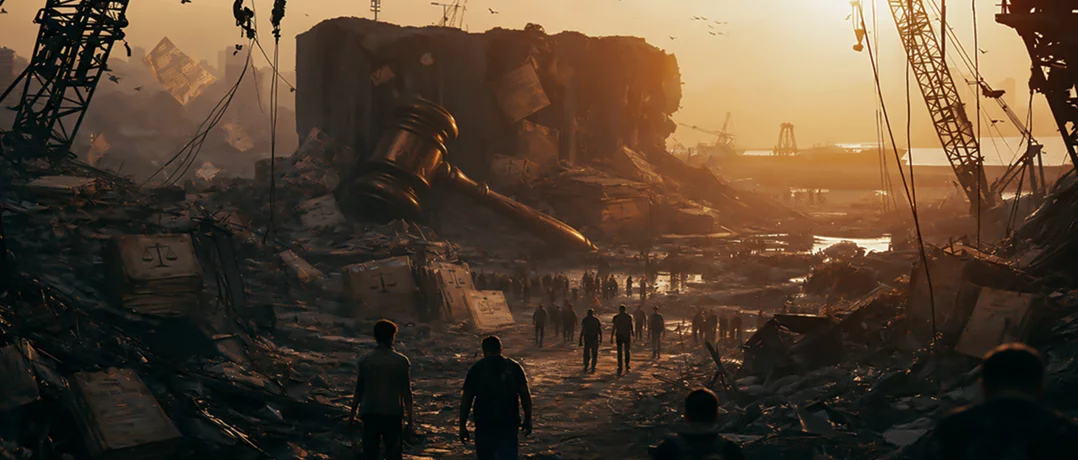
On Aug. 4, 2020, thousands of people were simply living an ordinary day. At 6:07 p.m., in a matter of seconds, their lives exploded, quite literally. Some survived by inches, but others never made it home. Six years later, Beirut still carries the scars of that day, so do its people. Behind every shattered building was a family forever changed, a body marked by injury, or a mind haunted by trauma.
We will never stop telling these stories. The memories endure, the wounds remain, and for those who lived through Aug. 4, forgetting has never been an option.
Fireworks, flames and the apocalypse
When the fire first broke out at the Beirut port on August 4, 2020, Wadih Sayegh was with friends at a restaurant overlooking the harbor.
"A waiter came over and told us to look at the port," he recalled. "He said it looked like fireworks." They stood watching the flames, unaware that, within seconds, their lives would be irreversibly altered. Then came the sound of what Wadih described as "a missile."
Unlike his friends, who instinctively ducked, he remained standing, unable to imagine that the explosion would unleash devastation across half the city.
"At the very last second, I felt something coming toward me," he told The Beiruter. "I tried to throw myself to the ground, but it was too late." The blast hurled him across the restaurant. His head slammed into a metal pole. He survived, but only after receiving 168 stitches to his head.
"I cut that pole and took it home," he said. "I still have it today. My blood is still on it."
Bleeding heavily, Wadih began walking through the shattered streets of Mar Mikhaël. Hospital after hospital turned him away, overwhelmed by the thousands of wounded flooding their emergency rooms. He kept walking, witnessing the magnitude of the catastrophe with every street he crossed, until he finally reached a hospital in Dekwaneh, where doctors stitched his wounds. Six years later, the physical scars remain. So does the emotional wound left by years of delayed justice. The explosion also changed the course of his life. Before August 4, Wadih never imagined leaving Lebanon. He had built a successful business and believed he had every reason to stay.
"I was living well. I had no reason to leave." But after the blast, he made the painful decision to emigrate. Today, he lives in the United Arab Emirates. Ironically, he said, even during periods of regional tension, including the recent Iranian attacks targeting the UAE, he has felt safer there than he ever did in the country he once called home.
 The aftermath of the Beirut Port explosion on the streets of Mar Mikhaël. Photo credit: Wadih Sayegh.
Inshallah
For Wadih, the scars of August 4 are engraved into both his body and his life. For others, the explosion became a race against time to save those who could still be saved.
Etienne Sabbagh, Secretary-General of Lebanon's Syndicate of Restaurant Owners, was at home in Ashrafieh with his wife and child when the blast shattered every window in their apartment.
"The house exploded," he told The Beiruter. "Glass covered me, but thankfully my wife and my son were unharmed."
Sabbagh rushed to Mar Mikhaël, where he owns a restaurant. The journey, which normally takes five minutes by bike, lasted 45 minutes through streets buried under rubble, abandoned cars and panic. When he finally arrived, he found his restaurant devastated.
"Three of my employees were injured, and the restaurant was completely wiped out." The destruction stretched far beyond his business.
"On our street alone, six people were dead. On the parallel street, another twenty had been killed."
Like countless residents that evening, Sabbagh became an impromptu first responder. Together with others, he helped pull the wounded from the debris and transport them to hospitals, both nearby and farther away, as Beirut's medical system buckled under the weight of thousands of casualties. In the weeks that followed, assistance came, but not from the state.
"The Lebanese Army came to assess the damage after the explosion, but we didn't receive anything from the government, he said.
Instead, Lebanon's Syndicate of Restaurant Owners, working alongside NGOs and with support from the World Bank, helped around 65 restaurants rebuild. Additional initiatives were launched to assist small and medium-sized businesses in recovering from one of the worst non-nuclear explosions in history.
The aftermath exposed a painful reality that has become all too familiar to Lebanese citizens. In Lebanon, people always end up relying on outside help because the state does not. Six years later, as expectations rise once again over the long-awaited indictment in the Beirut port investigation, hope remains tempered by years of disappointment. Asked whether he believes justice will finally advance this August, Sabbagh answered: "Inshallah."
While survivors continue to bear the scars of the explosion, the investigation is now approaching its most consequential legal stage.
 Etienne Sabbagh's restaurant completely destroyed by the blast.
The legal process
“Once the Public Prosecution has completed its review of the file, the Judicial Investigator will issue an indictment identifying the accused individuals and refer the case to the Judicial Council” lawyer Youssef Lahoud, a member of the Beirut Bar Association's Office of Public Prosecution, told The Beiruter.
At this stage, those named in the indictment are accused persons, not convicted criminals. They only become convicted once the Judicial Council issues a guilty verdict.
The Judicial Investigator cannot indict more individuals than those already charged by the Public Prosecution, Judge Sawan (the first lead judge, Fadi Sawan, was removed from the case by a court in 2021) and Judge Tarek Bitar, Lahoud explained. “The publicly reported number is around 70 defendants. However, the investigator may indict fewer than 70 if he finds insufficient evidence against certain individuals. In such cases, he may issue a decision of no grounds for prosecution (or dismiss the charges) instead of referring them to the Judicial Council”.
“Only the Judicial Investigator knows whether all 70 individuals will ultimately be indicted or whether the number will be lower,” he noted. “Even the Public Prosecutor at the Court of Cassation does not know. The prosecution merely submits its legal opinion after reviewing the file; it does not determine who will ultimately stand trial before the Judicial Council.”
According to Lahoud, it will become clear which defendants have fled the country once proceedings before the Judicial Council begin. “After the Judicial Council schedules its first hearing, all defendants who have become formally accused will be notified. Any accused who has been duly served but fails to appear may be considered a fugitive from justice.”
If, instead of appearing personally, the accused is represented only by counsel submitting procedural objections, the court will then determine whether the individual should legally be considered a fugitive, he added.
Lahoud further explained that “the Judicial Council allows a lawyer to appear without the accused in only one circumstance: to raise preliminary procedural objections.
This opportunity may be exercised only once. If such objections were already submitted before the Judicial Investigator, they cannot be raised again before the Judicial Council.
“While those objections are under review, the accused is not required to appear personally and may be represented by counsel”, Lahoud said. “If the Judicial Council rejects the objections, its decision is final and cannot be appealed or challenged before a higher court, as the Judicial Council is Lebanon's highest criminal court for cases within its jurisdiction.”
At the subsequent hearing, however, the accused must appear in person, he said. “Failure to do so results in the accused being declared a fugitive from justice, an arrest warrant is issued, and the trial proceeds in absentia, Lahoud said, adding “at that point, the accused forfeits important civil rights, including the right to administer or dispose of personal property, among other serious legal consequences.”
Lahoud described the conclusion of the investigation as a major milestone after years of delays and political interference “the investigation has now been formally concluded, marking a major milestone given the unprecedented obstacles it faced. The case endured years of political crises, institutional paralysis, legal challenges, obstruction, threats directed at investigators, and successive wars affecting Lebanon.”
Despite the lengthy process, he argued that the timeline is not unusual for a case of this magnitude.
“Considering the complexity and magnitude of a crime of this scale, the duration of the investigation has not been unusually long by international standards. All that remains now is for the Public Prosecution to complete its review of the case file and for the Judicial Investigator to issue the indictment, allowing the case to move into the trial phase before the Judicial Council.”
 The magnitude of the explosion on the streets of Mar Mikhaël. Photo credit: Etienne Sabbagh
For those who never made it home on Aug. 4, and for those who continue to live with the scars, visible and invisible, the pursuit of truth is far from over.
The case has finally reached its final stretch. The Public Prosecution's review of the file, the long-awaited indictment, and, ultimately, the trial now lie ahead. Justice delayed is not justice denied, at least not yet. For the victims, the survivors, and the families who have waited through years of grief, obstruction and uncertainty, the hope remains that the truth will finally be heard, and that accountability will no longer be deferred.
-
-
-
Joanne NaoumHead of Political Desk
-
