



The capital of Lebanon's Greek Orthodox heartland
The capital of Lebanon's Greek Orthodox heartland
By Jenna Geagea | September 10, 2026

Reading time 4 min
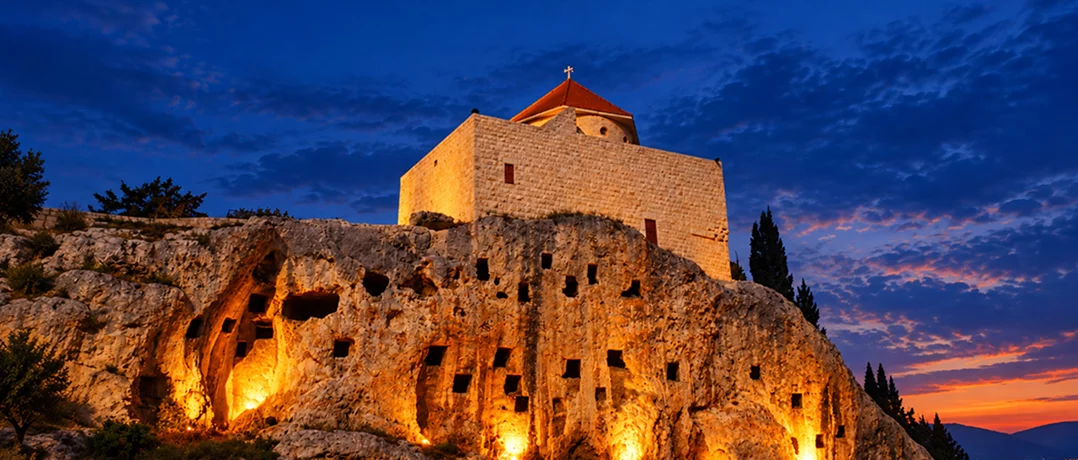
Amioun is both the administrative capital of the Koura District and the largest Greek Orthodox town in the country, a place where nearly four thousand years of continuous settlement have layered Bronze Age ruins beneath Byzantine churches beneath a modern town of olive groves and Ottoman-era stone houses.
Amioun's history begins long before Christianity, or even before writing itself spread across the Levant. Archaeological work on the town's tell shows it began as a modest rural settlement in the Early Bronze Age before growing, by the Middle and Late Bronze Ages, into a genuine political center dominating the inner Koura plain and rivaling other prominent cities of the region between the 16th and 13th centuries BCE. The town's ancient name, Amia, appears in the 14th-century BCE Amarna letters, diplomatic correspondence sent by local governors to the pharaohs of Egypt, placing Amioun squarely within the political networks of the Late Bronze Age Levant. Its prominence continued into the Iron Age, with possible Assyrian pottery finds hinting at the town's relevance as Assyrian power expanded through the region, and it went on to attract imperial interest through the Classical and Medieval periods alike.
The name itself carries competing explanations. Most trace "Amioun" to the Aramaic "am Yawan," meaning "place of the Greeks", a fitting label for a town that would centuries later become the country's foremost center of Greek Orthodox Christianity. Others, including linguist Anis Freiha, connect it instead to a Semitic root meaning "invincible fort," pointing to the fortified, elevated position the settlement has always occupied. Twenty-eight man-made caves carved into the old town's rocky cliffs add another layer to that ancient, defensible landscape.
The capital of Greek Orthodox Lebanon
Today, Amioun is home to roughly 10,000 to 11,000 residents, with Greek Orthodox Christians making up close to 90 percent of the population and Christians overall accounting for well over 97 percent of registered voters, figures that make Amioun not just the largest Greek Orthodox town in Lebanon, but reportedly the fourth-largest in the entire Levant, trailing only three towns across the border in Syria. The town falls under the Greek Orthodox Archdiocese of Tripoli and Al-Koura, and its residents are overwhelmingly affiliated with the Greek Orthodox Church of Antioch, one of the oldest patriarchates in Christendom, tracing its lineage to the original Apostolic sees that split from Rome in the Great Schism of 1054.
That religious identity is expressed architecturally on a remarkable scale. Amioun holds eleven to thirteen Greek Orthodox churches, an extraordinary concentration for a town its size. Among them are the Cathedral of Saint George el-Dahleez, the Church of the Dormition of the Theotokos (Al Sayyideh), St. John al-Sheer, and Saints Sergius and Bacchus, alongside dedications to St. Barbara, St. Marina, St. Simon the Stylite, and Our Lady of Breastfeeding (Mar Gala). The most architecturally significant is St. Phocas Church, built during the Crusader period by local architects working alongside Western artists, and constructed, as with several of the town's churches, directly atop the foundations of an earlier classical temple. Its interior once held extensive medieval paintings, considered among its most valuable features, though the structure suffered serious damage in an earthquake in October 1918 and required later reinforcement.
Education, emigration, and everyday life
By the early 20th century, Amioun had built a reputation as one of the most educated towns in Lebanon, a status reflected today in its public library, private hospital, several schools, and proximity to the University of Balamand, roughly 12 kilometers to the north. That same period saw many Amiouni families emigrate abroad in search of opportunity, a 1908 business directory already listed twenty individuals from Amioun running dry goods businesses overseas, early arrivals who laid the groundwork for diaspora communities that would grow substantially across the 20th century, echoing the broader wave of Lebanese emigration of the era.
The town's economy has long rested on its olive groves, which blanket the surrounding hills of Koura and support both high-grade olive oil production and traditional soap-making, industries that remain central to the district's identity well beyond Amioun itself.
What distinguishes Amioun is less any single monument than the sheer continuity of habitation stacked into its hill, Bronze Age fortifications beneath Iron Age pottery beneath Roman temples beneath Crusader-era churches beneath an Ottoman-influenced old town still standing today. Regional upheavals, from ancient imperial contests to the population shifts that followed Lebanon's modern conflicts, have repeatedly tested the town's continuity, yet Amioun has kept its role as Koura's administrative and spiritual anchor throughout. A hill that has been lived on, prayed on, and fought over continuously for nearly four thousand years, with the evidence of nearly every era still visible for those who look.
-
-

-
Jenna GeageaReporter/Writer
-
