



Two Lebanese women challenge the expectation that marriage must lead to motherhood, revealing the personal cost, uncertainty, and complexity behind choosing, or being unable, to have children.
The choice of motherhood

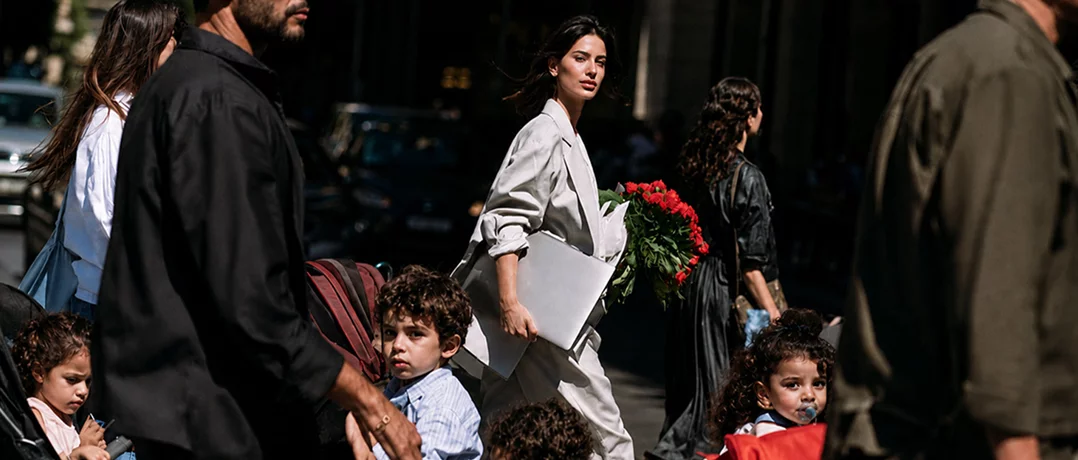
In Lebanese households, the questions arrive in a set order. When are you getting married? When are you having a baby? When is the next one coming? For generations, the sequence was never really up for debate, marriage and children were treated as a single package, reinforced by culture, family expectation, and, for many, religious teaching that frames marriage and procreation as intertwined purposes. But a growing number of Lebanese women are stepping outside that sequence entirely, and saying, simply, that they do not want children. It is a decision that may come with a cost. Here are two of their stories.
Marwa, 34: "I never had the desire in the first place"
Marwa describes her choice as an innate absence. "I don't think there was a specific day," she said of realizing she didn't want to be a mother. "That's actually what made it so difficult for everyone around me. If I had told my mother, 'I decided today that I don't want children,' maybe she would have understood it as a phase. But I never had the desire in the first place."
She traces it back to childhood, when other girls cradled dolls and she set hers aside. "I wanted to be the doctor, the teacher, the person going somewhere." What complicates her story, she said, is that people assume a woman who doesn't want children must be rejecting marriage, commitment, or family altogether. She isn't. "I love my husband. I wanted a partner. I wanted a home... I just never had the desire to bring a child into that life. For me, marriage and motherhood were always two separate decisions. In Lebanon, people treat them like one package."
That distinction rarely lands with her family. Her mother's response moved from disbelief, "You'll change your mind", to a sharper response, that Marwa was being selfish, that she didn't understand her own decision, and eventually, that her choice was a personal affront. "My mother would say, 'What is a woman's life without children?' And I would ask her, 'What is my life supposed to be then?' She never had an answer." Religion, too, was invoked less as theology than as a cultural script recited at her, "God gave women this ability for a reason." "What is the point of getting married if you don't want children?"
The estrangement deepened after Marwa moved abroad, distance, she thought, might ease the pressure. It didn't. "My mother started saying things like, 'You are going to wake up one day and realize what you've done.'" One line has stayed with her: "I didn't raise you so that you could grow up and refuse to become a mother." Marwa's answer, unspoken at the time, But you raised me to become myself.
Today, she and her parents barely speak. "My parents are grieving a grandchild they never had," she said. "And somehow, I became the person they blame for that grief." Still, she doesn't regret her clarity. "I don't think having a child to repair that relationship would have been less selfish," she said. "It would have been much more selfish, to bring a human being into the world because I was afraid of disappointing my parents."
Carla, 37: "My body had already made the decision for me"
Carla's story complicates the narrative further. For most of her life she was, in her words, "loud" about not wanting children, dismissing relatives who insisted she'd "change her mind when she met the right man." She watched friends and family members "disappear" into motherhood and wanted, instead, freedom, to travel, to work, to answer to no one. Like Marwa, she pushes back on the idea that rejecting motherhood means rejecting what's sacred about it, "Something being sacred to one woman doesn't mean it has to be sacred to every woman in the same way. I think that's where people get uncomfortable. They hear 'I don't want children' and interpret it as 'I don't value children.' Those are completely different statements."
Then, at 32, her sentiments towards motherhood shifted, she admitted. "I had spent so many years defending myself against everyone else's expectations that wanting a child felt like losing an argument." She and her husband decided to try, and discovered, after months of difficulty, that a medical condition made conceiving naturally impossible.
"The pain was realizing that something I had once rejected was now something I wanted, and my body had taken the decision out of my hands," Carla said. Some relatives couldn't resist an I-told-you-so. One comment stung more than others, "You should have started earlier", as if infertility were punishment for having once been certain. Her mother, by contrast, softened. "She actually apologized," Carla said. "She told me, 'I should have stopped pressuring you all those years.'"
Looking back, Carla no longer draws a clean line between wanting children and not wanting them. "Maybe I genuinely didn't want children then. Maybe I was afraid of motherhood. Maybe I simply hadn't reached the part of my life where I could imagine it. All of those things can be true."
Beyond the expectations
What ties Marwa and Carla's accounts together is a shared frustration with how little room Lebanese society leaves for women to simply decide for themselves, and, if needed, to change their minds without being punished for either choice. "There is no answer that satisfies people," Carla said. "If you say you don't want children, people tell you that you'll change your mind. If you change your mind, they ask why you waited. If you can't conceive, suddenly everyone has an opinion about your body."
Perhaps the most honest thing about these stories is that there is no single path. Motherhood can be sacred, while the absence of it can also be a part of a woman's life, whether chosen, unexpected, or shaped by circumstances beyond her control. What matters is recognizing that behind every decision, and every life that unfolds differently from what was expected, there is a woman living a story of her own.
-
-

-
Jenna GeageaReporter/Writer
-
