The Church of the Holy Sepulchre remains a sacred site shaped by centuries of conflict, where faith, power, and restricted access continue to collide in 2026.




The Church of the Holy Sepulchre remains a sacred site shaped by centuries of conflict, where faith, power, and restricted access continue to collide in 2026.

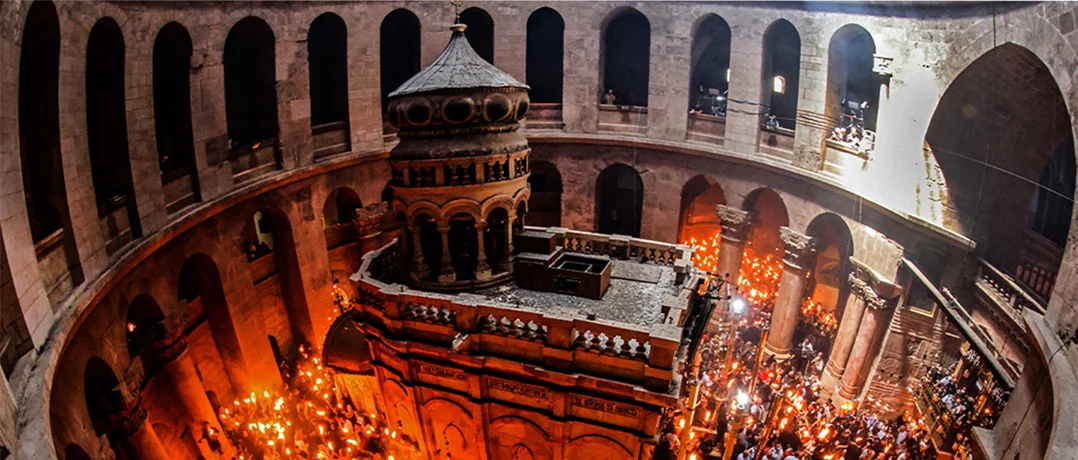
For nearly seventeen centuries, the Church of the Holy Sepulchre has stood at the intersection of devotion and domination, a site where empires have projected authority, denominations have fought for inches of stone, and believers have knelt at what they hold to be the most sacred ground in Christianity. In 2026, as regional conflict once again dictates who can enter, when they can pray, and how they can mourn, the church endures as it always has, a sanctuary of prayer and a refuge for peace.
Father Agapius Abu Saada, General Administrator in the Basilian Salvatorian Order, tells The Beiruter its meaning plainly:
it is where history meets theology, event meets hope, and death meets life.
Since the Emperor Constantine ordered the original church built in the 4th century after his mother Helena identified the site, the tomb has drawn pilgrims from every continent and every era. What they come to see is not a relic but a claim, that a specific death, in a specific place, was reversed.
In about 325 CE, the Roman emperor Constantine, who had recently legalized the practice of Christianity in the Roman Empire, sent his mother Helena on an official mission to Jerusalem to investigate the state of the Golgotha site. She found not only that the site was in disrepair, but that a Roman pagan temple had been built over it. Constantine had the temple destroyed, and during its removal, workers discovered a tomb that was thought to have belonged to Joseph of Arimathea. Constantine the Great first built a church on the site, which was dedicated around 336 CE. It was Christianity's first great imperial building project, faith and political power fused into stone.
The original Constantinian basilica was damaged by the Persians in 614 and partially restored, but the defining rupture came in 1009 when the Fatimid Caliph al-Hakim bi-Amr Allah ordered its near-total destruction. The act sent shockwaves through medieval Christendom. While historians debate how directly the destruction contributed to the launch of the First Crusade ninety years later, it unquestionably fed the narrative of Christian dispossession that the papacy would weaponize for centuries.
When Crusader forces took Jerusalem in 1099, they rebuilt the church on a grand scale, consolidating multiple holy sites under a single Romanesque roof, much of the architectural footprint visible today dates from that campaign. But Crusader control was temporary. After Saladin recaptured the city in 1187, he notably chose not to destroy the church, a decision rooted in both political pragmatism and Islamic reverence for Jesus as a prophet. The Ayyubid and later Mamluk administrations allowed Christian worship to continue under supervision, establishing the pattern that would define the church’s governance for the next eight hundred years: Christian ritual, Islamic sovereignty.
The Ottoman Empire formalized this arrangement. By the mid-19th century, escalating disputes between Christian denominations, some of which had erupted into physical violence inside the church itself, prompted the Sublime Porte to codify the Status Quo, a legal framework freezing the rights, spaces, and schedules of each community in place. Father Agapius notes that under this system, three principal communities share control: the Greek Orthodox Patriarchate, the Franciscan Custody of the Holy Land representing the Catholic Church, and the Armenian Orthodox Patriarchate. Smaller communities, Coptic, Syriac, Ethiopian, hold limited rights to specific chapels and hours.
The Status Quo endures to this day, enforced now by the State of Israel. Its most famous symbol is a wooden ladder that has rested on a ledge above the church’s main entrance since at least the 18th century. No one moves it, because no one can agree on whose permission would be needed. The ladder is often treated as a curiosity, but it is better understood as a warning: in this building, even the smallest change can detonate a crisis.
The pressures Father Agapius describes for 2026 are not new in kind, only in degree. He explains,
tensions between Israeli authorities and Palestinians make the Status Quo system even more sensitive, as any minor change in practices or maintenance can be interpreted politically and lead to disputes. Second, the political situation affects access to the church and the organization of pilgrims and worshippers, especially during major events like Easter. Third, political conditions impact funding and maintenance.
In 2026, Christian celebrations inside the Church of the Holy Sepulchre are affected by the tense security situation in Jerusalem due to the ongoing regional conflict. This directly influences how Holy week and Easter rituals are conducted. Father Agapius details, “agreements have been reached with authorities to allow core rituals to take place inside the church, coordinated between churches and police, ensuring that liturgies proceed according to tradition while respecting security conditions.” At the same time, restrictions on large gatherings remain in place due to the ongoing conflict, meaning celebrations are not as open to the public as in previous years.
The church does not exist apart from the people who worship in it. Father Agapius paints a stark picture of the Palestinian Christian community. As he notes,
Christians face ongoing waves of emigration due to insecurity, high unemployment, and limited access to basic services, leading to demographic decline and turning their presence into a more symbolic one in some areas, especially in historic cities like Jerusalem and Bethlehem.
At the same time, “security restrictions and recurring confrontations limit their ability to freely practice religious rituals, both in churches and during major occasions such as Easter, while access to holy sites is further complicated by checkpoints and movement restrictions.” Christians in the Holy Land, once a significant demographic presence in cities like Jerusalem and Bethlehem, now number in the low tens of thousands across the Palestinian territories. Their role, as Father Agapius observes, is increasingly “symbolic rather than demographic”, a living heritage whose continuation is no longer guaranteed by numbers alone.
The Church of the Holy Sepulchre remains a site of resurrection, of Christ and of faith itself, renewed in each generation that despite everything, insists on returning, standing, and praying. The site is shaped as much by fracture as by belief. Its stones bear the weight of empires and disputes, yet above all, they testify to the unwavering power of prayer, and the promise that faith will always rise again.