



Rashaya Citadel, built by the Shihab emirs in the 18th century, became the prison of Lebanon’s national leaders in November 1943 and a defining symbol of the country’s struggle for independence.
The citadel of independence, Lebanon’s fortress of freedom
The citadel of independence, Lebanon’s fortress of freedom
By Jenna Geagea | November 20, 2026

Reading time:4 min
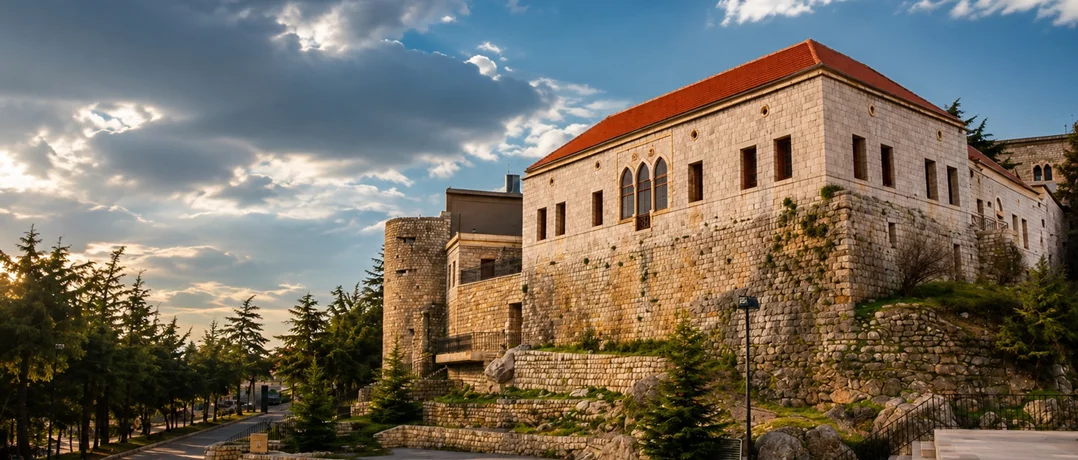
At dawn on 11 November 1943, French soldiers entered the homes of Lebanon’s
newly elected leaders and took them away. Their destination was a fortress on
the edge of the Beqaa. Within eleven days it would become the most famous
prison in the country’s history. This is the story of Qala’at Rashaya, the
Citadel of Independence.
Rashaya al-Wadi sits on the western slopes of Mount Hermon, overlooking Wadi
al-Taym, a natural corridor between the Beqaa, Damascus and the Lebanese
interior. That position explains the fortress. The citadel is said to have been
Canaanite, Greco-Roman, Arab, Crusader and Ottoman in turn.
The structure visitors see today is largely the work of the Shihab emirs,
the Ottoman-era ruling family of Mount Lebanon, whose branches held power in
Wadi al-Taym. It was completed in the 18th century. Thick stone walls, towers
and an inner courtyard make it as much a fortified residence as a military
post. It was a seat of local authority, which is why later rulers kept using
it.
The region was not spared the turmoil of the nineteenth century. The
sectarian violence of 1860, which began in Mount Lebanon, reached Hasbaya and
Rashaya as well, and the town’s fortress stood at the center of a landscape
marked by fear and reprisal.
After the First World War, France received the Mandate over Lebanon and
Syria, and Greater Lebanon was proclaimed in 1920. The French garrisoned
strategic points across the territory, and the Rashaya citadel, with its
commanding view and solid walls, served them as a military post. It became a
symbol of foreign control.
That resentment broke into open fighting during the Great Syrian Revolt.
Rebels, led largely by Druze fighters, challenged the Mandate across the
region, and in November 1925 they attacked Rashaya. The citadel was the scene
of a memorable defeat for French authorities. The French recovered in the
following days with reinforcements and harsh reprisals, and the revolt was
eventually crushed. But the battle showed that the Mandate could be challenged,
and it left the fortress with a reputation among nationalists.
The road to 1943
The Second World War changed the balance. After the Free French and British
took the Levant from Vichy forces in 1941, France formally proclaimed Lebanese
independence, though it kept real control. Lebanese politicians pushed for the
promise to be honored.
In the summer of 1943 elections returned a nationalist majority. Bechara
el-Khoury became president and Riad el-Solh prime minister, and the two sealed
an unwritten understanding, the National Pact, balancing Christian and Muslim
aspirations, no union with Syria, no Western protectorate. On 8 November,
parliament amended the constitution to remove the clauses that preserved
Mandate powers. It was a direct challenge to France.
The French delegate-general, Jean Helleu, replied with force. In the early
hours of 11 November he ordered arrests and suspended the constitution. The
detainees included Khoury, Solh, Camille Chamoun and Adel Osseiran. Other
ministers were seized as well. Helleu dissolved parliament and installed a
pro-French figure, Emile Eddé, as head of state.
The detainees were taken to Rashaya. They were held in the old fortress, cut
off from the capital, with little certainty about what would follow.
Beirut and other cities filled with demonstrators, shops closed, and French
forces fired on crowds, killing civilians. Members of parliament and ministers
who had escaped arrest gathered in Bshamoun in Mount Lebanon, where Habib Abou
Chahla served as acting president and Majid Arslan led a provisional
government.
Pressure came from abroad too. Britain, whose forces were essential to the
Allied effort in the Middle East, could not tolerate instability behind its
lines, and it made its displeasure with France clear. General Georges Catroux
was sent to Beirut to undo the damage. After national and international
pressure, the prisoners were released on 22 November 1943, and that day was
declared Lebanese Independence Day. Helleu was recalled, the constitutional
changes stood, and the French lost their last real claim to govern Lebanon.
French troops finally left in 1946.
The citadel’s importance lies in what it proved. France had assumed that
arresting the leadership would end the challenge, but the opposite happened,
and the arrests united a population that was often divided. Muslim and
Christian leaders were jailed together and freed together, an image Lebanese
have returned to ever since when they speak of national unity.
Rashaya’s fortress records the moment a modern nation asserted itself. On 22
November, Lebanon looks back to that hill.
-
-

-
Jenna GeageaReporter/Writer
-
