Discover Baskinta, one of Lebanon’s highest mountain villages, where ancient civilizations, centuries of faith, literary giants, and enduring traditions converge to create one of the country's richest cultural landscapes.




Discover Baskinta, one of Lebanon’s highest mountain villages, where ancient civilizations, centuries of faith, literary giants, and enduring traditions converge to create one of the country's richest cultural landscapes.

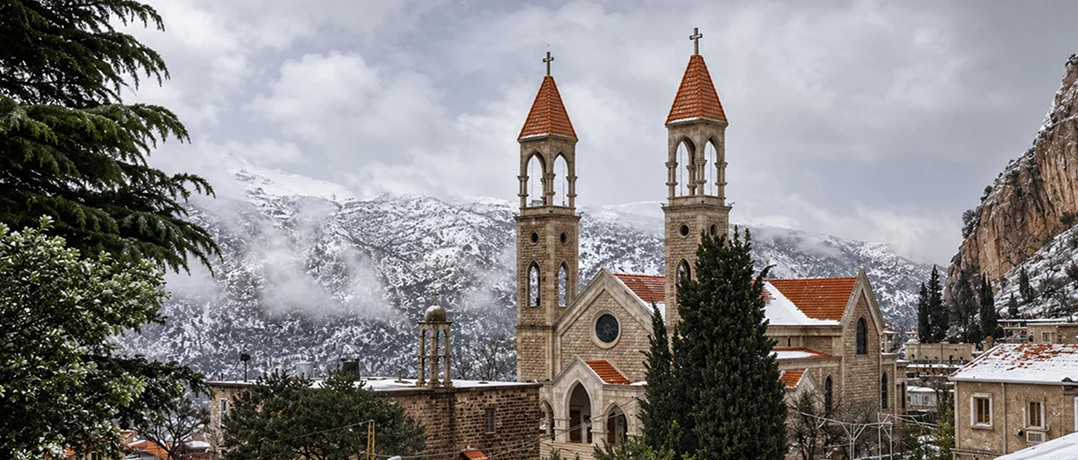
Baskinta, a village whose name simply means "the dwelling place," stretches across an altitude that ranges from roughly 1,250 meters to nearly 1,800 meters at its highest reaches. It is one of the highest continuously inhabited villages in Lebanon, and for thousands of years it has lived up to its name, a shelter carved into the mountains, home to layer upon layer of civilizations, faiths, and stories.
If Baskinta is known across Lebanon and beyond, it is largely thanks to the writers it produced. Its most famous son is Mikhail Naimy, born in 1889, a poet, novelist, and philosopher celebrated for spiritual works such as "The Book of Mirdad." Naimy co-founded the Pen League in New York alongside Khalil Gibran, and he wove Baskinta's landscapes into much of his writing. He is said to have drafted much of his major work in a hut near dramatic rock formations outside the village, a retreat now preserved as a museum and pilgrimage site for literature lovers.
Baskinta's literary legacy did not end with Naimy. The award-winning, French-nationalized author Amin Maalouf also traces his roots to the Baskinta area, and the celebrated haute couture designer Georges Hobeika was born there as well. The village has embraced this heritage formally: a 24-kilometer literary hiking trail now winds past 22 landmarks connected to Baskinta's acclaimed writers, letting visitors walk quite literally through the landscapes that shaped Lebanese letters.
The village also entails the Baskinta Literary Trail, often described as a route dedicated to the memory of Lebanese poets and novelists from the area. Among them as well is Abdallah Ghanem, a poet, philosopher, and journalist born in Baskinta in 1895, who drew much of the inspiration for his poetry from the surrounding countryside. His legacy is preserved today through the Abdallah Ghanem Cultural Center, a stop along the trail built in his honor.
Suleiman Kettaneh, a writer closely tied to the physical landscape of the trail, lived in a family home along the route between 1935 and 1965, and by other accounts continued residing in Baskinta until 2004, making his house one of the trail's most enduring literary landmarks, the family home stands near Roman-era inscriptions from the age of Emperor Hadrian, and the trail itself is often described as beginning or ending at his doorstep.
Georges Ghanem, another of Baskinta's poets, is remembered along the trail at his final resting place, as he lived from 1932 to 1992. Like his literary neighbors, his home is also marked as one of the trail's landmarks, part of a stretch of the route that groups several writers' houses close together within the village itself.
Rachid Ayoub rounds out this circle of local literary figures; his house, too, is preserved as one of the numbered landmarks along the full Baskinta Literary Trail, situated among the homes of Kettaneh and Ghanem in the heart of the village. In the United States, he emerged as one of the most prominent poets of the Arabic diaspora. Ayoub continued to write until his death in 1941.
Long before it became known as a literary haven, Baskinta was already a crossroads of ancient peoples. The village has been inhabited since ancient times by Phoenicians, Romans, and Greeks, all of whom left physical traces behind. Ruins include monuments, cemeteries, coins, and pottery that date back to the Phoenician and Greek periods. The remnants of ancient Greek palaces still stand in places, complete with massive stone blocks, pillar bases, and underground passages, hinting at a settlement of real importance rather than a simple mountain hamlet. Local lore even connects the area to Queen Helena, mother of the Roman emperor Constantine, with gold coins and jewels said to have surfaced from her era near the site now called Bakish canal, a name tied, according to tradition, to Bacchus, the Greek god of wine and revelry.
Geography did much to shape Baskinta's fate. To its south lies the aptly named Skull Valley, a narrow, nearly impassable gorge that for centuries acted as a natural fortress, shielding the village from invasions. That protection allowed communities to root themselves deeply in the mountainside, generation after generation, even as empires rose and fell around them.
Ottoman rule arrived in the region in 1516, though its grip on Mount Lebanon was loose. Baskinta fell under nominal Ottoman authority, administered mainly for tax purposes while real governance rested with local tribal and familial networks under semi-autonomous emirates such as the Ma'nids and later the Shihabis. This arrangement encouraged trade and, notably, drew Christian families southward into the Metn, a migration that shaped Baskinta into the predominantly Maronite Christian village it remains today, alongside a significant Greek Orthodox community. The nineteenth century brought sectarian strife across Mount Lebanon, including the upheavals of 1841, 1845, and the devastating conflict of 1860, and Baskinta, like much of the region, weathered periods of displacement and repopulation as Christian families fled violence and later resettled.
The village's oldest church, Our Lady of the Assumption, is said to date back roughly to the seventh century. Destroyed during a Mamluk invasion, it was rebuilt in 1650 and has been renovated repeatedly since, remarkably, it has long served as a single shared house of worship for Maronite, Melkite, and Greek Orthodox parishioners, each with a nave, an architectural testament to coexistence.
Baskinta's culture is inseparable from its orchards. Its cool mountain climate produces prized apples, cherries, and grapes. Cooperatives founded in the community process these harvests into kishk, carob molasses, and other traditional mouneh, preserved foods that sustain households through the winter and tie modern Baskinta to older, self-sufficient ways of mountain living, a resilience that resurfaced strongly during Lebanon's economic crisis of 2019-2020.
Baskinta's legacy is measured by the age of its churches, the ruins beneath its soil, and the orchards that blanket its hillsides. But it also endures in the words that left the village and reached the world, in a tradition of thought that transformed a remote mountain community into one of Lebanon's great cultural landmarks. Today, roughly 15,000 residents call Baskinta home, sustained by agriculture, tourism, and a deep, self-conscious pride in their village's role as one of Lebanon's enduring wellsprings of poetry, faith, and mountain resilience.