



From Lebanon’s early landscape pioneers to contemporary abstract and expressionist painters, generations of artists have transformed the country’s mountains, villages and light into evolving forms of artistic expression.
The evolution of landscape painting in Lebanon
The evolution of landscape painting in Lebanon
By Jenna Geagea | November 20, 2026

Reading time: 4 min
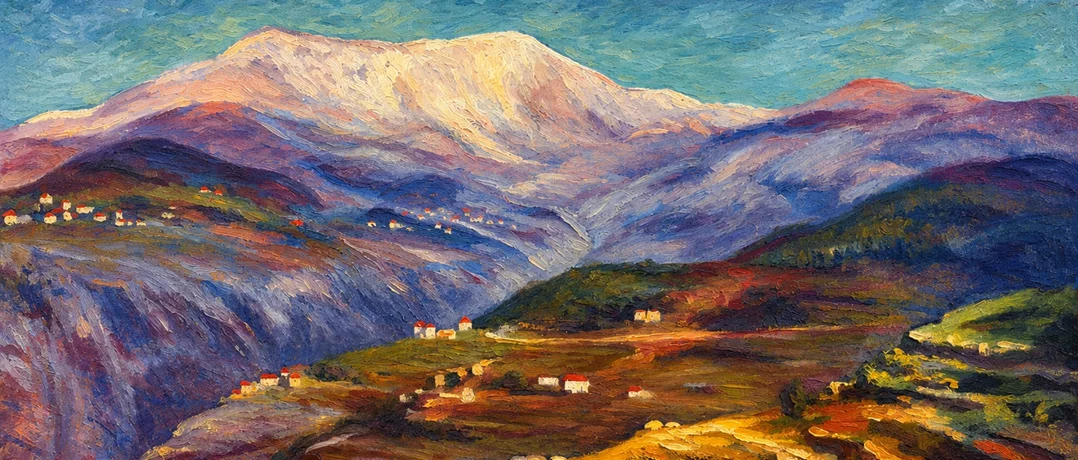
Landscape painting began as a discipline of academic rigor, built on careful observation and accurate representation. Over time, that foundation gave rise to more innovative forms of expression and inspired contemporary styles with abstract, minimalist, and expressionist elements. Classical subject matter gave artists room to explore their creativity without restraint. Nature became an active participant in the artistic process rather than a mere object of study, and painters used their brushes and imaginations to move beyond the boundaries of classical convention.
The first generation
The early pioneers, César Gemayel, Moustafa Farroukh, Omar Onsi, and Saliba Douaihy, were trained in Paris and Rome. Writers often call them the “Big Four,” although each painted very differently.
Gemayel was the most impressionistic. He often skipped preliminary drawing and went straight to color, using loose, bold strokes to catch light on village and countryside scenes.
Omar Onsi worked in watercolor and oil. He favored modest colors, textures, and shapes, and was skilled at accurately sketching whatever lay before him. His method was unusual. He described his ideal technique as hours of observation followed by rapid execution, with sure draftsmanship and direct brushwork. The result is spiritual and unforced. His small surviving works, such as a village painted in oil on plywood and a watercolor of figures in a lane, show everyday places treated with great restraint.
Moustafa Farroukh leaned toward naturalism and documentation. His rare paintings of Beirut avoid modern city life and instead favor old souks and seaside promenades. His landscapes, including an oil view of Tripoli from the 1940s, are carefully constructed and detailed. They contrast with Onsi’s softness and Gemayel’s bold brushwork.
Philippe Mourani brought a European-trained structure of underdrawing and glazing to Lebanese scenes. Georges Cyr dissolved outlines altogether and left large expanses of white that make mountains and country houses seem to drift. Olga Limansky painted villages and rooftops in unblended color after taking up painting at 55. Maroun Tomb combined watercolor with ink and etching to give his villages and olive groves a lyrical, nostalgic quality.
The clearest path from landscape to abstraction belongs to Saliba Douaihy. Born in Ehden in 1915, he began with careful, impressionist-influenced paintings of northern mountain villages, with houses and paths in the foreground and warm, soft light. His studies in Beirut and Paris then taught him to think about structure.
In his middle period, hills became broad planes of color in horizontal layers, with earth, mountain, and sky as distinct zones and villages reduced to subtle geometric forms. His mature work distills this further. Luminous horizontal bands of red, blue, green, and ochre stretch across a vertical canvas, still carrying the memory of the Ehden mountains and the intensity of Lebanese light. It is abstraction that never fully leaves the land behind.
The contemporary landscape
Today’s artists treat landscape less as a view than as an idea, and they use their forebears as a starting point.
Mazen Rifai (born 1957) is the most direct heir to Douaihy. His small paintings feature thick strokes running horizontally, interrupted by planes of color from pastel to night blue, with a thin powdery white line marking the skyline. They are abstract, yet they depict the Bekaa Valley. His move away from illusionism follows the modernist legacy of Douaihy, in which abstraction removes natural appearance while keeping the place it refers to.
Marwan Sahmarani (born 1970) works with heavy texture. His paintings draw heavily on early landscape traditions while absorbing abstract and expressionist tendencies. The surface itself becomes terrain.
Louma Rabah (born 1980) is known for color. She paints Lebanese landscapes, cityscapes, and towns with bold, expressive color within an abstract-expressionist approach. Her work shows how the landscape tradition now extends into the built environment.
Not everyone has abandoned the observed view. Canadian-Lebanese painter Samir Sammoun works in what is often called modern impressionism, painting willows, blooming apple trees, wheat fields, olive groves, and villages. His work shows that the impressionist line begun by Gemayel and Onsi continues.
Early artists observed and recorded. Modern art now ask what remains of a place once its appearance has been stripped away or rebuilt in paint. Through all of it, Lebanon’s mountains, valleys, villages, and light remain the constant reference point.
-
-

-
Jenna GeageaReporter/Writer
-
