



From a childhood in Liberia to breaking Lebanese sprinting records and becoming a voice against racism, Aziza Sbaity’s journey reflects the power of perseverance, ambition and finding belonging through sport.
The fastest woman in Lebanese history

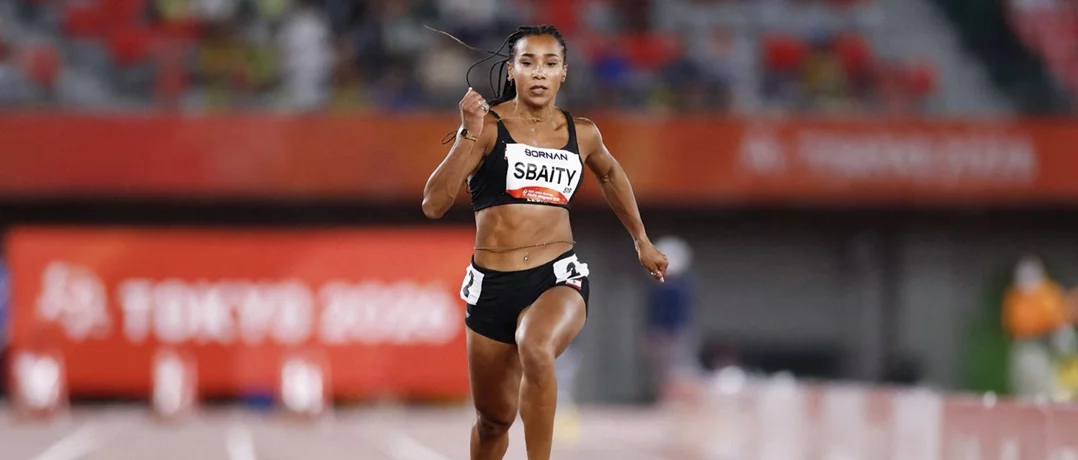
Aziza Sbaity, the fastest woman in Lebanese history, was born in Liberia on
the coast. “I grew up a very active child,” she told The Beiruter. Weekends
meant running around on the beach, and school meant games of double jump rope.
“I was a tomboy, so my body was always covered in bruises.”
That childhood ended when civil war forced her family to move to Lebanon.
She was eleven years old, and the move came before the school year was over.
The family settled in Hadath, and she enrolled at SABIS. She had spent summers
in Lebanon before, but this was her first time living there year-round, and she
was looking for a community.
She found it in basketball. The school ran tryouts in her first weeks, and
she made both the basketball squad and a track team that barely existed. “I was
the only one on the team,” she laughed. Track felt solitary, and in her mind
sport was supposed to be communal. “Those are the notions that I got from
Liberia.”
Her coaches saw something else. Every year from sixth grade to twelfth,
Sbaity traveled with her school to regional tournaments in Jordan, Syria, Egypt
and Dubai, and every year she won her races. Her coaches urged her parents to
get her into a club. She refused until her final year of school, when she
finally agreed to join Jamhour.
At first, she hated it. “Track is not really fun. It’s tiring. I used to
cry. I used to throw up.” But that summer, at the 2009 Lebanese National
Championship, she won both the 100 and 200 meters and earned a place on the
national team. Her first assignment was the Jeux de la Francophonie, hosted in
Lebanon, which came with a three-month training camp.
I think that particular event made me fall in love with running and track and field.
By then she had interest from basketball clubs too,
and the choice came down to one or the other. “I chose track. And that’s how
the world of track began.”
Learning what international racing demands
Her first trip with the national team was the Arab Championship in Syria,
where the squad traveled by bus and she placed fifth. It was her first real
taste of international competition. She had also just started at LAU, and
missed the first week of classes. “It was very much how the rest of my life was
going to look like. I just didn’t know it at all.” Balancing studies, then
work, with training would become a permanent feature of her career.
A year later she competed at the World Junior Championships. At the Arab
Junior Championship she took second, frustrated because she knew she could have
won, but her period arrived on the day of the final. “That was my first
experience with being a woman in sport and the extra struggles that we have.”
The medals came gradually: fourth, third, second, third, second. “Always almost there.” Injuries slowed her too, with one that began around 2011 lingering until nearly 2013. She blamed overuse and a lack of serious gym exercise.
My body was getting strong, I was getting really fast, but I didn’t know how to manage all of that.
By 2018, Sbaity was running close to the national record in the 100 meters,
her main event, but her life off the track was crumbling. She worked full-time
in the family business, which was struggling, then trained in the evening. She
endured a breakup after five years with a partner, and her mother was going
through a divorce. “I’d go to practice, I’d be crying,” she recalled, “thinking
it’s the end of the world.”
Then came the West Asian Championships in Jordan. She ran the 100 meters and
broke the Lebanese record. “I just felt this really huge push in me. I knew I
was going to do it. I was crying tears of happiness this time.”
She was not finished. Between 2019 and 2023 she broke the record again and
again, and she now sees that moment as a lesson in self-imposed limits. “I had
created boundaries in my mind. All those clichés about thinking big and aiming
for the moon, they are real.”
She went on to win her first Arab Championship, then the West Asian title in
the 200 meters. In all, she has competed at five world championships, indoor
and outdoor, beyond her junior appearances.
With time, success on the track grew into something larger, representation.
As a Black Lebanese woman, she faced racism when she arrived at school in
Lebanon. Classmates quizzed her about her religion, a question she had never
encountered growing up in Liberia with a Christian mother and a Muslim father.
“Everyone wants you to be on one side. What are you? Where do you belong?”
She began speaking out on Instagram, and once her audience grew, she took
the responsibility seriously. She started working with NGOs on racism and
bullying and visiting schools to speak with children. In 2019 she left the
family business and became a full-time athlete, “not knowing where it was going
to take me.” It took her to the BBC’s 100 Women list. “It wasn’t anything I had
on my bingo cards,” she laughed. “Track gave me the opportunity to speak up and
speak loud and maybe help people who felt they didn’t have a voice.”
Sbaity was frank about what running has revealed about her. She is “an
overachiever who doesn’t know how to operate in life without a goal.” Track is built
on numbers and measurable progress, and it taught her two seemingly opposite
lessons. The first is to trust intuition. “I paved out a path that I didn’t
know could exist for me, just because I followed my passion.” The second is the
power of a clear target. “Even though you don’t know how you’re going to get
there, it gives you so much clarity on what steps you could take.”
-
-

-
Jenna GeageaReporter/Writer
-
