



Nadim Mehanna discusses the challenges of bringing Saint Rafqa’s extraordinary suffering and 19th-century Lebanon to the screen while filming a universal story for audiences of all ages.
The film about Saint Rafqa

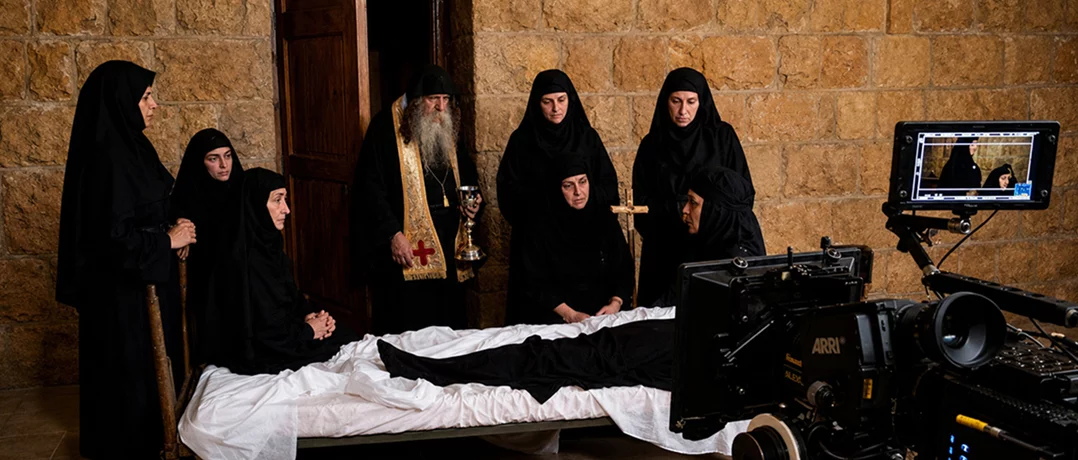
Few figures in Lebanese religious history carry the weight of Saint Rafqa, a nun whose life was marked by decades of physical suffering she chose to endure rather than escape. Bringing that life to the screen was never going to be a light undertaking. The Beiruter spoke with Nadim Mehanna, whose film on the saint is currently in post production through his company NMPRO in partnership with MTV.
A story too heavy to film lightly
Mehanna, now directing and producing his 9th film, has also directed a film on Saint Charbel, which is set for release soon. Speaking about the Saint Rafqa project, he described it simply as "a very heavy film, a weight rooted in the suffering at the center of the saint's life."
Rafqa, born Boutroussieh El-Rayès in Hemlaya in 1832, is one of the most physically harrowing figures in Maronite hagiography. In 1885, after praying to share in Christ's suffering, she began experiencing severe pain in her head that eventually spread to her eyes. When local treatment failed, she was brought to an American doctor passing through Byblos, who operated on her afflicted eye.
Rafqa refused anesthesia. During the procedure, the doctor's hand reportedly slipped, causing her eye to come completely out of its socket and fall to the floor. Disease subsequently affected her other eye, and for the twelve years that followed, she lived with relentless pain, eventually becoming completely blind. She died in 1914 at the age of 82, after 29 years of accumulated suffering.
It is precisely these details that made the story challenging to translate to film. Mehanna pointed to Rafqa's refusal of anesthesia and the physical ordeal she endured as examples of the extraordinary pain the film had to portray.
"We tried our best to make the scenes not very gory," Mehanna said. "We want to show her pain and her suffering, but not to an extreme. This is a film intended for a general audience, for the young and the old. So we had to make sure that the delicate scenes remained friendly to the eye."
The decision was also deliberate in its understanding of the audience the film hopes to reach.
"The percentage of people who want to see very heavy, bloody scenes is very small," he said. "This film is not for them. We want everyone to be able to watch it and understand her story without being pushed away by the way the suffering is portrayed."
A woman full of life before the suffering
Before the suffering that defined her final decades, Rafqa was remembered as beautiful, warm, serene and humorous. She was also fiercely independent. Sent to work as a domestic servant in Damascus at 11 after her father fell into financial hardship, she later rejected two marriage proposals arranged by her family and chose religious life instead, walking to a convent in Bikfaya on her own.
Her courage appeared again during the sectarian violence in Deir el-Kamar, where she was teaching catechism. While people were being killed around her, she hid a child under her robe and carried him to safety.
Teaching remained central to her life. She taught in Deir el-Kamar and Byblos, helped establish a girls’ school in Maad, and studied Arabic, calligraphy and arithmetic. As Mehanna suggests, Rafqa’s story is a life shaped by humor, courage, independence, hard work and care for others.
Filming throughout the war
Producing a film in Lebanon during wartime brought another layer of difficulty, although Mehanna said the locations offered the crew a degree of protection.
"It's always difficult to produce work during the war," he said. "However, luckily for us, we were always filming in mountainous areas where we were relatively safe. It's true that sometimes we could hear the sound of something, but we were fortunate that the locations where we were working kept us relatively removed from the danger."
The production, spanning pre-production, filming and post-production, is expected to take more than a year altogether, with the finished film scheduled for release in 2027.
Rebuilding a vanished era
For Mehanna, one of the film's most demanding tasks was recreating the world in which Rafqa lived. The production had to move beyond costumes and locations and reconstruct the details of everyday life in 19th-century Mount Lebanon, including elements that audiences might never consciously notice.
“We had to be extremely careful with everything that appeared in the frame," Mehanna said. "There were many things that simply did not exist at the time, from certain types of food, such as specific type of tomatoes, to technical objects, electricity cables and other modern elements. We had to make sure that anything that belonged to our time, rather than Rafqa's, did not find its way into the shots."
But the historical distance became even more striking when Mehanna considered how Rafqa herself would have experienced Lebanon. "There is a very huge difference between the Lebanon of her time and the Lebanon we know today," he said. "There were journeys that Saint Rafqa would take between villages that could take three days. Today, the same journey can take one hour."
That contrast, he said, helped put Rafqa's life into perspective. The distances, transportation and physical conditions that defined everyday life in her era were radically different from those of contemporary Lebanon, adding another dimension to the suffering and endurance the film seeks to portray. The role of Saint Rafqa was portrayed by four different actresses across the character's various stages of life, with Mehanna specifically highlighting Roula Hamadeh and Stephanie Atallah among the performers who carried the role.
Why Saint Rafqa?
Mehanna's decision to tell Rafqa's story is also tied to his personal connection to the saints he has chosen to bring to the screen. However, his interest in saints extends beyond personal geography or religious devotion. For Mehanna, the defining characteristic of these figures is what they accomplished.
"I believe these saints are heroes because of what they have done and the miracles they have performed," he said. "They have healed people from cancer. They have helped people come back from near-death experiences. They have had a real impact on people's lives, and they have also had an impact on my own life."
For him, that makes them something closer to superheroes than traditional religious figures. "These are the true superheroes," Mehanna said. "These are the true heroes whose stories deserve to be showcased." A third film centered on another saint is already in development, although the subject will not yet be revealed.
A universal story
Despite its explicitly religious subject, Mehanna is determined not to confine Saint Rafqa to a Christian audience.
"This is a universal film. It's a universal story. It's not just a Christian story," he said. "It's the story of a hero."
That universality, he believes, is what should allow the film to travel beyond Lebanon and resonate with audiences who may have no personal connection to Rafqa or to Christianity.
"Whether you are watching it in North and South America, in Europe or in the Middle East, or anywhere else, the story should have the same impact," Mehanna said. "It should still touch people."
The ambition is therefore not simply to reproduce the life of a Lebanese saint for a Lebanese audience, but to present a story whose central themes, suffering, endurance, sacrifice and heroism, can cross cultural and religious boundaries. The film's scale reflects that ambition. Mehanna has emphasized an approach to cinematography and production that aims to move beyond the limitations traditionally associated with local productions, treating the story with the visual scope he believes it deserves.
A saint worth the difficulty
Between the physical suffering at the heart of Rafqa's life, the challenge of recreating a vanished Lebanon and the realities of filming during wartime, Saint Rafqa has become one of Mehanna's most demanding projects.
Yet it is also one of his most personal. Through Rafqa, as through Charbel, he is attempting to bring figures he regards as genuine heroes from his own region to audiences far beyond Lebanon.
For Mehanna, the objective is ultimately simple, to make the story accessible without diminishing its weight. "We want people to see her pain and understand what she went through," he said. "But we also want them to be able to watch the film, regardless of their age, background or beliefs."
Scheduled for release in 2027, Saint Rafqa seeks to place one of Lebanon's most revered saints on a much wider screen, as a hero whose story, Mehanna believes, can touch everyone.
-
-

-
Jenna GeageaReporter/Writer
-
