The Hasroun Flower Festival celebrates the beauty of Lebanon's "Mountain Rose" while boosting local businesses, showcasing artisans, and highlighting the resilience and community spirit of one of the country's most picturesque villages.


The Hasroun Flower Festival celebrates the beauty of Lebanon's "Mountain Rose" while boosting local businesses, showcasing artisans, and highlighting the resilience and community spirit of one of the country's most picturesque villages.

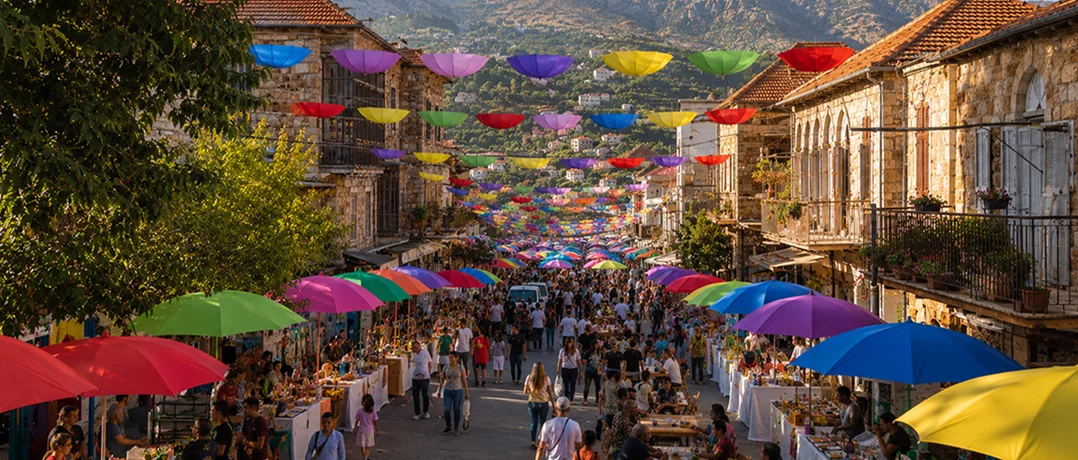
Situated in the Qadisha valley in the district of Bsharri, Hasroun is nicknamed the Rose of the Mountain, due to its stretch of thousands of red brick roof homes that have been depicted in various paintings for years.
This breathtaking village is one of the most beautiful summer destinations in Lebanon, well known for its refreshing climate, valleys, caves, monasteries and convents. From this charming village, a path descends to the ancient church of Mar Michael and the monastery of Deir Mar Yaqoub down into the heart of the valley.
The Hasroun Flower Festival has, over eight editions, blossomed into one of the largest community events in the Bsharri district.
"Hasroun is known as the 'Mountain Rose,' organizer Rana Louis Semaany, head of Hasroun's Women's Committee told The Beiruter. “We wanted the festival's name to reflect that identity, so we chose Hasroun Flower Festival," she said. The event has run for eight editions since, pausing for two years because of COVID-19 and Lebanon's economic crisis, but returning each time with renewed energy.
Today, the festival brings together more than 110 exhibitors including artisans, small business owners, painters, accessory makers, clothing vendors, and people selling handmade beadwork, bags, and hats. "There is a very wide variety of products for everyone: women, men, young people, and families," Semaany noted.
Behind the flowers and music lies a clear economic mission. "The main goal is to stimulate economic activity in Hasroun and the Bsharri district," Semaany said. "More importantly, it's about supporting local businesses."
Women's groups and young craftswomen from the area are actively encouraged to rent stands, while Hasroun residents receive special support. Exhibitors from outside the district do pay a participation fee, but it is kept to a minimum compared to other events.
The impact is measurable. Last year, the festival welcomed approximately 15,000 visitors over three days, generating an estimated $400,000 to $430,000 in direct spending across the area, according to statistics compiled by women working with the municipality. Local hotels, coordinated with the festival to offer exhibitors discounted rates, are booked solid.
The festival's program is built around variety and inclusion. Domestic tourism agencies routinely bring group visits, sometimes as many as 1,000 people in a single day, who spend their time at the food court and enjoy live entertainment. Visitors arrive by bus from across Lebanon, from Nabatieh and Sidon to Tripoli, Achrafieh, and Bouchrieh, and organizers tailor extra entertainment, including live music and saxophone performances, whenever large groups are expected.
Sundays are reserved as Family Day, featuring children's entertainment, a dedicated kids' section, painting activities, and healthy snacks. This year's offerings include sugar-free jelly and homemade custard, designed to appeal to children and parents alike.
What distinguishes the Hasroun Flower Festival, Semaany says, is not any single element but the collective effort behind it. The Women's Committee she leads is made up of around 16 women who set aside their jobs, children, and household responsibilities to volunteer, spending days decorating the streets and preparing exhibition stands.
The municipality, the mayor, municipal staff, and police all pitch in, alongside villagers themselves. "While we're hanging decorations, women in the village prepare breakfast for us and then come out to help. Young people volunteer to carry wooden panels, move barrels, install decorations," she said. "That's what makes Hasroun special. People genuinely care about their village."
This year's edition almost did not happen. Organizers had initially decided against holding the festival because of the war, and had planned to skip their usual "Summer Nights" events as well. Instead, they folded everything into a single festival, announced later than usual.
The response was immediate. "When we published the announcement on Thursday afternoon, by 7 p.m. we had already received more than 100 phone calls asking to participate. By Sunday, all the stands had been reserved," Semaany recalled. Around 50 more names now sit on a waiting list for future space.
For Semaany, the demand reflects something larger than commerce. "People don't just come to sell their products, they come for the experience," she said. "Despite all the war, hardship, and loss surrounding us, we Lebanese still love life."
Hasroun Flower Festival has become a testament to the resilience of a community determined to preserve its identity and create moments of joy. Through its support for local entrepreneurs, its celebration of craftsmanship, and the dedication of its residents, the festival reflects the spirit of Hasroun itself, a village rooted in tradition, yet constantly finding ways to bloom. As Semaany explains, the festival’s true success lies in the sense of belonging it creates among those who bring it to life.