



Caroline Chaptini embarks on her biggest Guinness World Record challenge yet, turning one million plastic plates into a 27-metre Christmas tree in Yahchouch.
The Guinness Woman’s next challenge

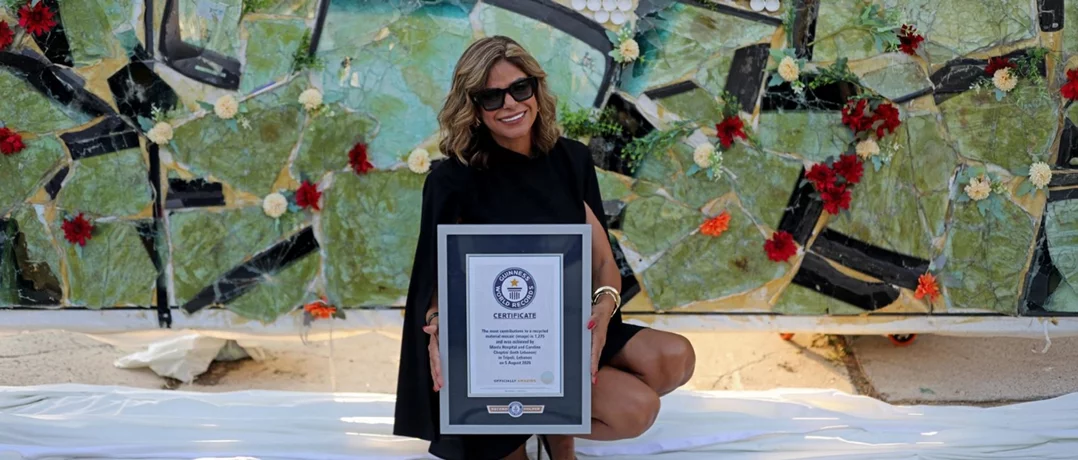
Art is the ability to create something extraordinary from the most unlikely materials Artists and activists turn discarded material into public works meant to be seen, photographed and talked about. Few have done it on the scale of Caroline Chaptini, a recycling artist known as “The Guinness Woman,” who has built a career on Guinness World Record installations made from rubbish. Her latest project is a Christmas tree in the town of Yahchouch, built from one million colored plastic plates.
Her first record came in 2019, at the height of Lebanon’s uprising. “It was during the revolution,” she told The Beiruter. “I made the largest Christmas tree, from 140,000 plastic bottles.” In May 2020 she built the largest crescent for Ramadan, a deliberate counterpart to the tree. “I wanted to show that we don’t stop,” she explained. In December 2020 she completed the world’s largest national flag, a 300-square-metre Lebanese flag made from recycled materials. Three records in a single year made her the first Arab woman to achieve that.
International commissions followed. In 2022, Sony invited her to Dubai for the PS5 launch. “Instead of putting up billboards on the road, they wanted to paint their Forbidden West artwork in plastic layers and enter Guinness, the way I do,” she explained. “They chose me.” Two months later she built the largest globe in the world in Africa, showing every country, as a message to the World Health Organization. In October 2025 she presented the Lebanese Army with the largest cedar in the world, made from 10,452 green bottles.
Her aim reaches past the titles. “My main purpose is to turn trash into art,” she explained. “I want to raise awareness with schools, with the new generation, with the youth and the universities, on how to create, how to keep going.”
The idea behind the tree
The new project grew out of a wall. She had just finished a 90-square-metre mural for IPT along a mountain highway, covering an eyesore with layered plastic. “If you get close, it’s plastic layers,” she recalled. “From a distance, it’s a painting.” That convinced her that color and layering could carry a far larger image.
She also wanted to rethink the Christmas tree itself. “Everyone decorates a tree with lights and garlands,” she noted. “I wanted to tell the Christmas story through the tree, using the stories of people who throw things away, things that are worth nothing.”
The design remains secret until the reveal, but the numbers are public. The tree will stand around 27 meters tall and needs a million plastic bottle caps. The campaign hashtag translates as “every cap is worth a million.”
Support is arriving from new quarters. Spinneys is now placing collection boxes in all its branches.
Local backing matters because the economics run the other way. “We pay Guinness, not the other way around,” she pointed out. The mayor of Yahchouch gave his approval immediately. “He trusted my vision, and the municipality gave me a yes straight away,” she recalled. A ten-day Christmas market will run alongside the tree. “It’s an eco-friendly area, with ruins, a shrine, waterfalls,” she added.
From November, the site will receive a different group every day for a month. “In thirty days, I’ll have thirty schools, thirty universities and thirty NGOs, one each day,” she explained. Volunteers are travelling from West Bekaa, the Chouf and Baalbek. Independence Day plans include dabke dancers at the foot of the tree. Her own team of Ahmad, Aya and Omar, “Muslims from the soil and heart of Lebanon,” are building a Christmas tree, a detail she considers worth highlighting.
She wants coverage to focus on the collection rather than on her. “It’s nice for people to see that nobody is promoting a person,” she insisted.
As with her previous projects, the plastic will be donated after the attempt, usually to support children with cancer. This time the focus shifts to prostate cancer. “We want to change the concept a little,” she explains. “There are a lot of men with prostate cancer, and nobody shines a light on them. As a woman, I feel I have the empowerment to talk about it. Why not?”
She does not hide the difficulty of the task. “This is the hardest project I’ve done,” she admitted.
One million discarded bottle caps will become a Christmas tree, proving that creativity can give new life to waste and that meaningful change can begin with something as simple as choosing not to throw something away.
-
-

-
The Beiruter
-
