For more than six decades, cedar craftsman Joseph Tawk has preserved one of Lebanon’s oldest mountain traditions, transforming the nation’s most iconic tree into works of memory, faith, and heritage.


For more than six decades, cedar craftsman Joseph Tawk has preserved one of Lebanon’s oldest mountain traditions, transforming the nation’s most iconic tree into works of memory, faith, and heritage.

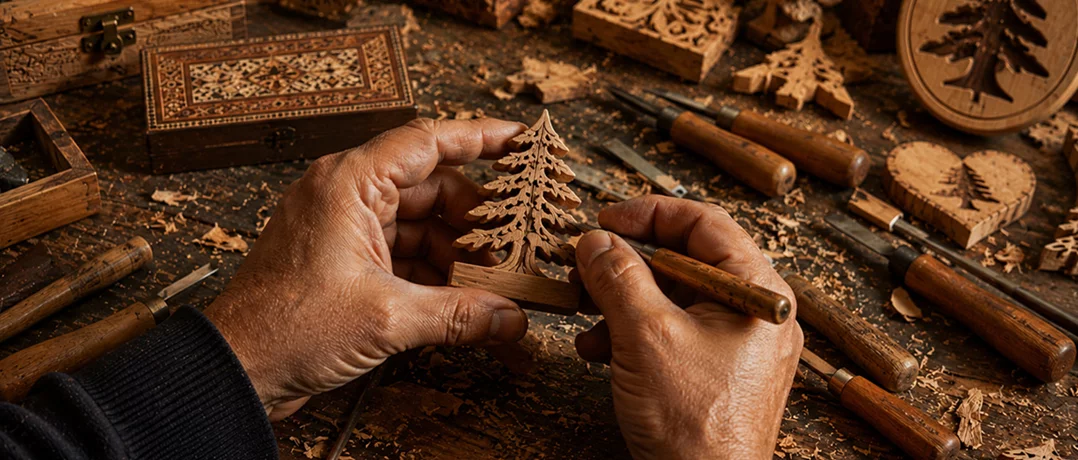
Cedar carving is one of Lebanon's oldest surviving mountain crafts, rooted in the ancient forests that have crowned the heights of northern Lebanon for more than three thousand years. The Cedars of God, Arz el-Rab are among the last remnants of forests that once blanketed the entire Lebanon mountain range. From those same trees, a tradition was born: the art of carving the cedar itself into objects of memory, devotion, and beauty.
Joseph Tawk is 80 years old, and he has been breathing this air since he was sevens. He sits behind a workbench worn smooth by six decades of labor, in a stone-walled workshop in the souk of the Cedars. Joseph Tawk has spent his entire life between those two altitudes, in a workshop that measures perhaps thirty square meters and contains, by his own estimate, "everything."
"I started in the 1960s," he tells The Beiruter. "My father began teaching me when I was seven. How to draw first. Then how to cut. Then how to feel the grain."
His father, Elias Tawk, was himself one of Bsharri's most respected craftsmen, a man who learned the trade when cedar carving in this region was still practiced almost entirely with hand tools, chisels, gouges, and mallets passed down through families the way some fathers pass down land. Joseph inherited both the tools and the knowledge, and when he opened his own workshop in the early 1960s, he was among the first of his generation to do so professionally.
The Phoenicians floated Lebanese cedar logs across the Mediterranean to Egypt, where the Pharaohs used them for funeral boats and temple columns. The Romans stripped entire mountain ranges of cedar to build their fleets. The ancient Greeks prized it for its resistance to rot and insects, a quality that made cedar the preferred wood for manuscripts and sacred objects. And then there is the passage from the First Book of Kings, that King Solomon sent to Hiram of Tyre for cedar beams to build the Temple in Jerusalem, a transaction so famous it appears in Jewish, Christian, and Islamic tradition alike.
"Cedar does not decay," Joseph says simply. "That is why kings wanted it. That is why God's house was built from it."
In his 60-plus years of professional work, Joseph Tawk has produced, by his own modest reckoning, "thousands upon thousands" of pieces. The workshop shelves are lined with finished inventory: carved panels depicting the Cedars grove, name plaques in flowing Arabic and Roman script, decorative crosses, frames, boxes, medallions. Some pieces take an afternoon. “A commissioned Bible case, cedar wood, hand-engraved, fitted with leather hinges, can take several weeks.” These are, Joseph believes, among the most precious objects a craftsman can make from this wood: a vessel for the Word, made from the tree that helped build the house of God.
He speaks of his customers with discretion and tenderness. Over six decades behind this bench, Joseph has heard stories that a novelist would envy. An elderly woman from São Paulo, descendant of Lebanese emigrants, brought him a faded photograph of a village she had never visited and asked him to carve it for her. A man from Australia, third-generation diaspora, wept when he held a piece of cedar for the first time and smelled what his grandfather had described to him as a child. A young couple from Beirut came in the summer before their wedding; they returned a few years later, only one of them, to engrave a name.
"Some come on what may be the last journey of their lives," Joseph says. "Some are just beginning. I have seen everything that a human life contains."
What strikes a visitor most, sitting across from Joseph Tawk in this fragrant room, is the absence of bitterness. Lebanon has given this man every reason for it. He has watched neighbors shutter their businesses and their houses and leave for places far away.
His shop has never closed. "My workshop is a symbol of Lebanon," he says. "A symbol of this country, and a symbol of hope."
In the grove that has stood for three thousand years, the last cedars of Lebanon are doing what they have always done: enduring. Joseph Tawk intends to do the same.