The death of Father Dario Escobar, the Colombian-born Maronite hermit of Qadisha Valley, marks the end of one of Lebanon’s last great monastic lives.




The death of Father Dario Escobar, the Colombian-born Maronite hermit of Qadisha Valley, marks the end of one of Lebanon’s last great monastic lives.

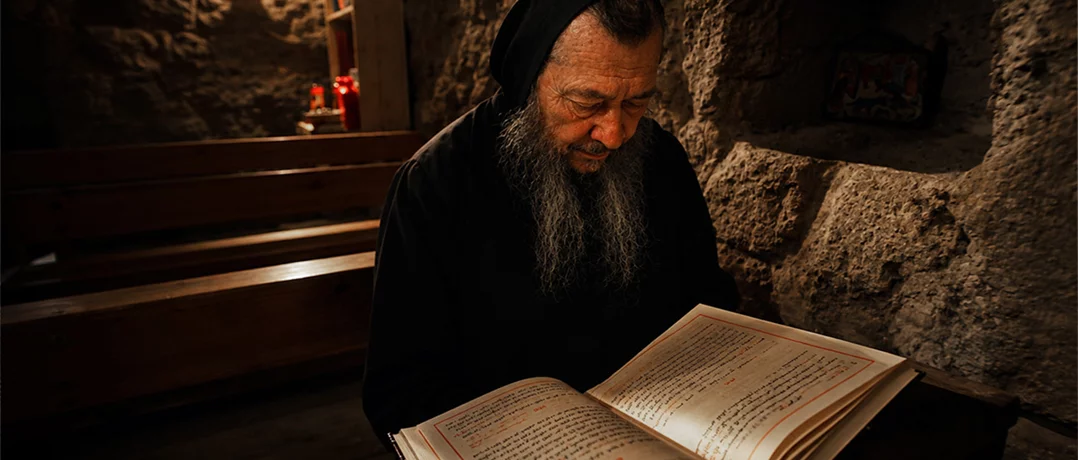
He came from one of the wealthiest families in Colombia. He died in a cave in the mountains of northern Lebanon, sleeping on a stone pillow. And Lebanon mourned him as one of its own.
Father Dario Escobar, the Colombian-born Maronite hermit who for more than two decades made his home in the ancient stone hermitage of Our Lady of Hawqa in Lebanon's Qadisha Valley, passed away on May 18, 2026, at the age of 92. He will be laid to rest in the monastery cemetery, in the same Lebanese mountain soil he had chosen over all the comforts the world had ever offered him.
Dario Escobar was born in 1934 in Medellín, the northwestern Colombian city that would later become infamous for a very different Escobar. The connection was a source of gentle amusement to him. "I have no link with Pablo Escobar," he was fond of saying, though both men came from the same city. The parallels ended there.
The future hermit grew up in a prosperous family, his parents, his six brothers and sisters, in a comfortable house in one of Medellín's fashionable neighborhoods. By any worldly measure, he was a fortunate man. He received a serious education, eventually becoming a lecturer in theology, psychology, and Biblical Greek. He inherited a sizable fortune. And yet, none of it gave him what he was looking for. "Money never made me happy," he would later say from his cave in Lebanon. "On the contrary, it brought me headaches. I decided to leave everything behind and answer the call of God."
His path wound through Latin America and the United States before, in the early 1990s, fate delivered a Lebanese priest into his orbit. The priest spoke of the Qadisha Valley, its ancient monasteries, its cliffs carved with millennia of Christian monasticism, its silence. Something in those words took hold of Father Dario and did not let go. He came to Lebanon. He spent several years moving between its monasteries and hermitages, feeling his way toward a vocation that had been forming his whole life. He eventually joined the Lebanese Maronite Order, adopted the Maronite rite entirely, and in the year 2000 settled at the Hermitage of Our Lady of Hawqa in the Qadisha Valley, and did not leave for more than two decades.
The hermitage of Our Lady of Hawqa sits inside a cave carved into the sandstone cliffs of the Qadisha Valley, accessible only by a narrow, steep footpath that takes the better part of twenty minutes to climb. In winter, when the valley is cold and silent and no visitors come, the isolation is total. In summer, Father Dario could receive hundreds.
His daily routine was strict, almost mathematical. Fourteen hours of prayer. Three hours of work, tending a small kitchen garden of potatoes, beans, and onions, sometimes raided by squirrels and wild boar. Two hours of reading spiritual texts. Five hours of sleep, on a thin mattress covered by a wooden board, his head resting on a lump of stone. A cross, a candle, and an alarm clock were the only ornaments in his cell. He owned no phone, no radio, no television, no computer. He had not returned to Colombia, nor seen his family, in more than twenty years. "I pray for Colombia," he said, "but I don't want to go back."
What made Father Dario's story remarkable was the depth of his adoption of a land that was not his birthplace. He did not come to Lebanon as a tourist or even as a missionary. He came as someone who recognized, in this ancient valley, something his soul had always been seeking.
The Qadisha Valley, whose name means "holy" in Aramaic, is one of the cradles of Eastern Christian monasticism. The earliest Maronite Christians, arriving from Syria in the fifth century, hid in its caves to escape persecution. Father Dario became one of Lebanon's last remaining hermits, at times one of only two or three still practicing the solitary life in the valley.
He embraced the Maronite rite completely. He prayed in the tradition of the Lebanese church. He learned Arabic. He cared about Lebanese politics, following events through the accounts of his visitors. He prayed daily for the country. He never left it.
In his later years, illness made the climb to the hermitage too difficult. He moved to the Monastery of Saint Boula in Hawqa, where he lived quietly until his death. The monastery of Qozhaya, where he will now be buried, will hold him in the same mountainside where he spent the last quarter century of his life.
Dather Dario could have been anything. He was educated, wealthy, worldly, a man who lectured in theology and Biblical Greek and spoke half a dozen languages. He chose, instead, a stone bed, a cave, a garden of potatoes, and fourteen hours of daily prayer in the mountains of northern Lebanon. He chose to become, as the Lebanese knew him, al-habis, the recluse, the enclosed one, of Qannoubine.
The Qadisha Valley is quieter now. But the cave at Hawqa still holds the shape of his decades there. In the stone and the silence, something of Father Dario Escobar will remain.