



As emotional learning is increasingly outsourced to screens, Dr. Layla Itani’s The Journey Box reclaims play as a serious educational tool.
The Journey Box: Screens off, game on

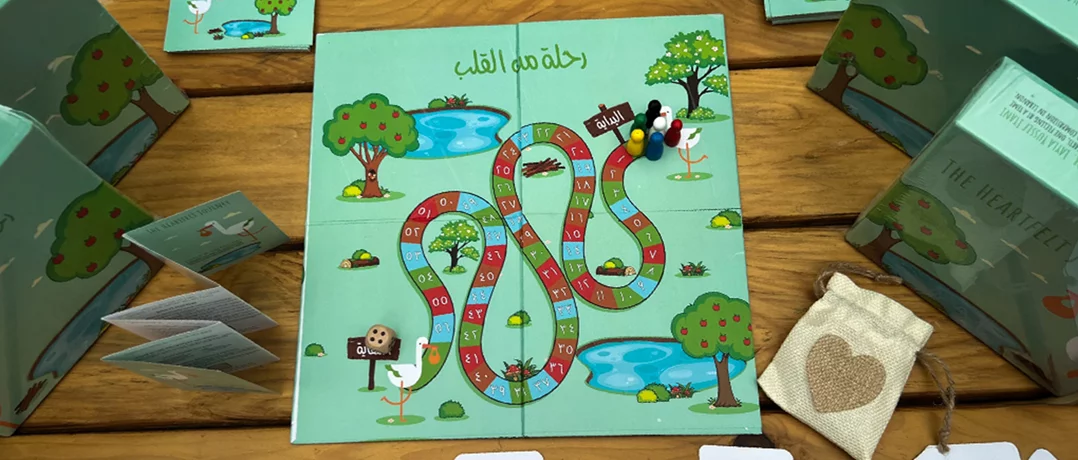
Before the game even begins, the packaging sets the tone.
Soft greens, blues and turquoises calm the surface without dulling it. A stork with a cloth bundle in its beak, a drifting boat and an apple tree rooted and generous. It feels intentionally designed to capture a child’s attention in a time of flashy screens.
Inside, The Journey Box continues that choreography. A small canvas bag stitched with a heart holds the pawn and dice. The set includes an instruction manual, two decks of cards and a colorful board which resembles childhood classic games that contain a starting point, an ending point and a path that connects them.
What stands out most is the language. The game is in Arabic, not simply translated. The phrasing feels intimate, familiar. There is an English version, but the Arabic one makes the experience feel local, grounded.
The Heartfelt Journey stands as one of three educational games that make up The Journey Box educational project, which Dr. Layla Itani established in 2025. The Journey Box provides an educational solution that enables children to learn through direct human interactions that focus on emotional development.
Filling a gap
Itani, who holds a doctorate in educational sciences, teaches at university and consults for schools, did not set out to create a product. She set out to solve a problem.
“In theory, we keep telling parents and teachers to acknowledge emotions,” she says. “But when you actually ask them how, there are no tools.”
In many schools and daycares, emotional learning is reduced to basic flashcards: happy, sad, angry. “Children don’t experience emotions in isolation,” she explains. “They experience them in layers.”
Her initial idea was to import educational resources. Instead, she found options that felt rigid and disconnected from how children learn. “We teach through play,” she says. “Play is a basic right.”
So she built the tools herself.
Learning without noticing
The Heartfelt Journey requires players to roll a die, which determines their movement through the game, while they draw cards after landing on specific colored spaces. The game includes prompts that require children to demonstrate their emotions through physical movement. The content requires users to think about two things through the following questions: What do you want others to know about you when you’re frustrated? How does your body look when you’re excited but impatient?
“A child thinks they’re just throwing dice,” Itani says. “But technically, they’re expressing emotions. And the adult sitting with them can finally see what’s going on.”
Parents often tell her they discovered things they wouldn’t have otherwise known. One mother realized her son was struggling in PE class. Another learned that when her eight-year-old is angry, what he needs is space, not questions, just distance.
“That becomes a cue,” Itani says. “Now the parent knows what regulation looks like for that child.”
There are no built-in “correct” answers. “People ask me where the right response is,” she says. “There isn’t one. Your values decide.”
Beyond the living room
What began as a family board game has entered therapy clinics, special education centers and coaching sessions. Psychologists and therapists vetted all three games, The Heartfelt Journey, Treasures of Gratitude and Thought Capture, grounding them in research.
In clinical settings, the games act as a bridge. “It’s not ‘let’s talk about your feelings,’” Itani explains. “It’s ‘let’s play.’ And from that, everything opens up.”
Thought Capture, aimed at older children and adults, focuses on identifying and reframing thoughts. Treasures of Gratitude encourages expressions of appreciation through playful prompts and collected “gems.” None of them feel clinical, yet all carry therapeutic depth.
Adults, too, have embraced them. “I’ve had people buy the game just for themselves,” Itani says. “It’s not only for kids.”
Though often framed as an antidote to screen dependency, Itani avoids extremes.
“It’s not about zero screen time,” she says. “That just scares parents.” Instead, she advocates balance: if children spend time on a screen, they should also spend time engaged socially and physically, building, creating, playing.
“What’s missing from apps is authenticity,” she explains. “Here, I see your face. I see how your body reacts. I learn by mirroring you.”
And the learning continues after the board is packed away. “So much happens after,” she says. “Children connect real-life moments back to the game.”
Launched in July 2025, The Journey Box is still new. In just a few months, more than 300 copies of The Heartfelt Journey have been sold. “This isn’t about becoming a millionaire,” Itani says. “It’s something I do out of passion.”
-
-

-
Rayanne TawilCultural writer
-
