



Once at the heart of Lebanon's manufacturing economy, the country's leather industry has dwindled to a handful of family-run workshops, where artisans are fighting to preserve a century-old craft through innovation, resilience, and tradition.
The keepers of Lebanon's leather heritage

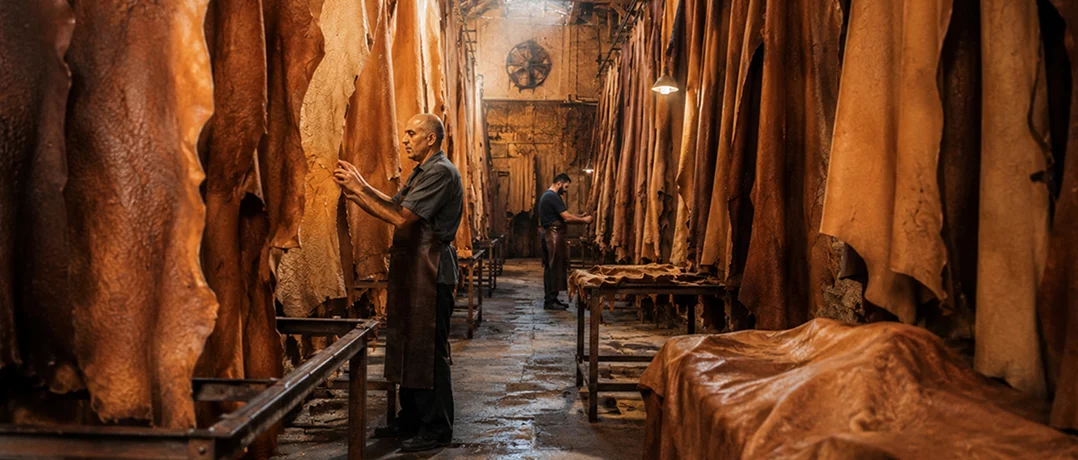
Leather is one of the oldest trades in human history, and in Lebanon it took root across communities. In Bourj Hammoud, the densely packed district just east of the Beirut River, Armenian refugees who had survived the 1915 genocide and fled the collapse of the Ottoman Empire built much of their new life around it. With little capital and few formal industries to join in the 1920s and 1930s, many turned to trades that required only skill and hard work, shoemaking, ironwork, tailoring, and tanning among them. A vertical trade chain quickly took shape: tanners supplied leather to shoemakers, who bought their boxes and thread from neighboring workshops, all clustered together in what became one of the most densely populated manufacturing hubs in the Middle East. But leathercraft in Lebanon was never confined to one community. Elsewhere in Beirut and beyond, Lebanese families built their own workshops around the same material, from bookbinding ateliers to leather-goods houses, each passing skills from father to son over generations.
That world has largely receded. The Lebanese Civil War scattered much of Bourj Hammoud's original workforce, many Armenian shoemakers relocated to Beirut's southern suburb of Dahiyeh in the 1980s, and many more left the country altogether. Where the district once counted dozens of active tanneries feeding a booming domestic shoe industry, only a handful survive today. What remains is a small number of family businesses, some in their third generation, trying to hold on to a craft that once defined entire neighborhoods. Among the names still standing are Tchakerian Leather, an Armenian-founded tannery in Bourj Hammoud, and Abdou, a Lebanese leather manufacturing house run by Chekri Abdou. Their stories, told firsthand, trace both the decline of an industry and the different ways its last practitioners are trying to survive it.
Tchakerian: Three generations, one tannery left standing
Tchakerian Leather traces its roots to the 1920s, when the current owner's grandfather founded the business; the company was formally registered with the government in 1932. Today it is run by the third generation of the family, and by its own account it is the last surviving Armenian-owned tannery in Bourj Hammoud, a neighborhood that once counted dozens of tanneries supporting a booming local shoe industry.
"My grandfather started this business in the '20s. We're the third generation now," the owner said. He described how Bourj Hammoud earned its reputation as a manufacturing hub because tanneries sat alongside the satellite industries, soles, thread, and other components, that shoemaking required. That ecosystem began to erode during the civil war, when many Armenian workers relocated to Dahiyeh, taking the shoemaking trade with them. "The Armenians emigrated, that was the problem," he said. "As a tannery, we're the only one left."
The tannery survived, he argues, because he and his brother studied leather technology in England and returned determined to modernize. "We had to keep renewing our machines," he said. "Other tanneries didn't do that, and after a while, they just weren't cost-effective anymore." He contrasted this with competitors whose younger, foreign-trained successors chose to build careers abroad instead of returning to a country where, in his words, "every odds are against us."
He was candid about the structural problems facing the industry: unchecked smuggling of shoes and leather goods from Turkey, a government he says has never treated industry as a priority, and a raw-material supply chain undermined by slaughterhouses that damage hides because skins fetch only a fraction of an animal's value. "The skin only fetches about ten percent of the value of the animal," he explained, "so they don't bother avoiding holes when they cut it." That damage makes Lebanese hides unsuitable for the automated cutting machines used by manufacturers abroad, forcing tanneries like his to import raw material even when they want to export finished leather.
Despite it all, he sees a narrow opening: a new generation of mostly female entrepreneurs launching small leather-goods and fashion lines. "This is new for our industry, it used to be entirely male-dominated," he said, though he noted their artisanal approach often clashes with the volume-driven mindset of older manufacturers. He does not expect his own children, who live in Denmark and the Netherlands, to take over the business. "It comes down to the country, first of all," he said simply.
Abdou manufacturing: From bookbinding to luxury leather
Chekri Abdou's family business began in a different corner of the leather trade entirely. Founded in 1927, the original workshop produced leather book covers; his father worked on what he describes as one of the most prestigious magazines in the region, bound in leather from the family workshop. But the business ran into difficulties and eventually closed. Abdou reopened it himself roughly twenty years ago, reshaping it around what he had learned growing up around the craft. "I worked with leather books when I was young," he said. "Over time, I realized it wasn't as difficult as I'd thought."
Today, Abdou has repositioned itself as a maker of luxury leather boxes and packaging, serving corporate clients and, increasingly, the hospitality sector. "We still make boxes, but now they're luxury boxes," he said of the company's current identity. The pivot toward hotels came out of necessity after Lebanon's 2019 financial crisis. "We used to work mostly with corporate clients, then we shifted toward hotels," he explained, describing how banks, once reliable clients, abruptly stopped commissioning corporate leather goods once the crisis hit. "All our clients left almost overnight." In hotels, his workshop found a new niche: boxes, trays, and amenity packaging that combine leather with wood, cardboard, and even silk.
Abdou described the recent economic collapse and conflict as harder, in some ways, than the wars of earlier decades. "The last war was difficult," he said, "because in the old wars, the '70s, '80s, '90s, even with the fighting and the bombing, people kept working." This time, he said, commerce itself seemed to grind to a halt in a way that felt different from anything before.
Asked what he learned most from his father, Abdou told The Beiruter: resilience. "He stayed strong, and patient," he said. "And the third thing, which matters most, is that our reputation is our capital." That reputation, a craftsman's word, built and passed down, is what let him rebuild what his father had lost. Unlike Tchakerian, Abdou hopes to keep the business in the family, provided conditions in Lebanon improve. "If things get better, this could become something big, and it will belong to my children, God willing," he said, adding that he believes Lebanese leatherwork can compete directly with the Italian, French, and Chinese factories currently supplying the Gulf market.
Preserving a legacy
Tchakerian Leather and Abdou Tannery are two branches of the same story: an industry built by those with nothing but a craft and a willingness to work, sustained across generations by families who kept reinvesting in it even as the country around them made that harder each decade. Both were sustained across generations by families who kept reinvesting in the work even as the country around them made that harder each decade. the men behind these two businesses, in their own ways, describe a craft that refuses to disappear entirely, one adjusting its machinery and its market, the other reinventing its product line, betting that the intricate skill and craftsmanship built over a century can still find a place.
-
-

-
Jenna GeageaReporter/Writer
-
